
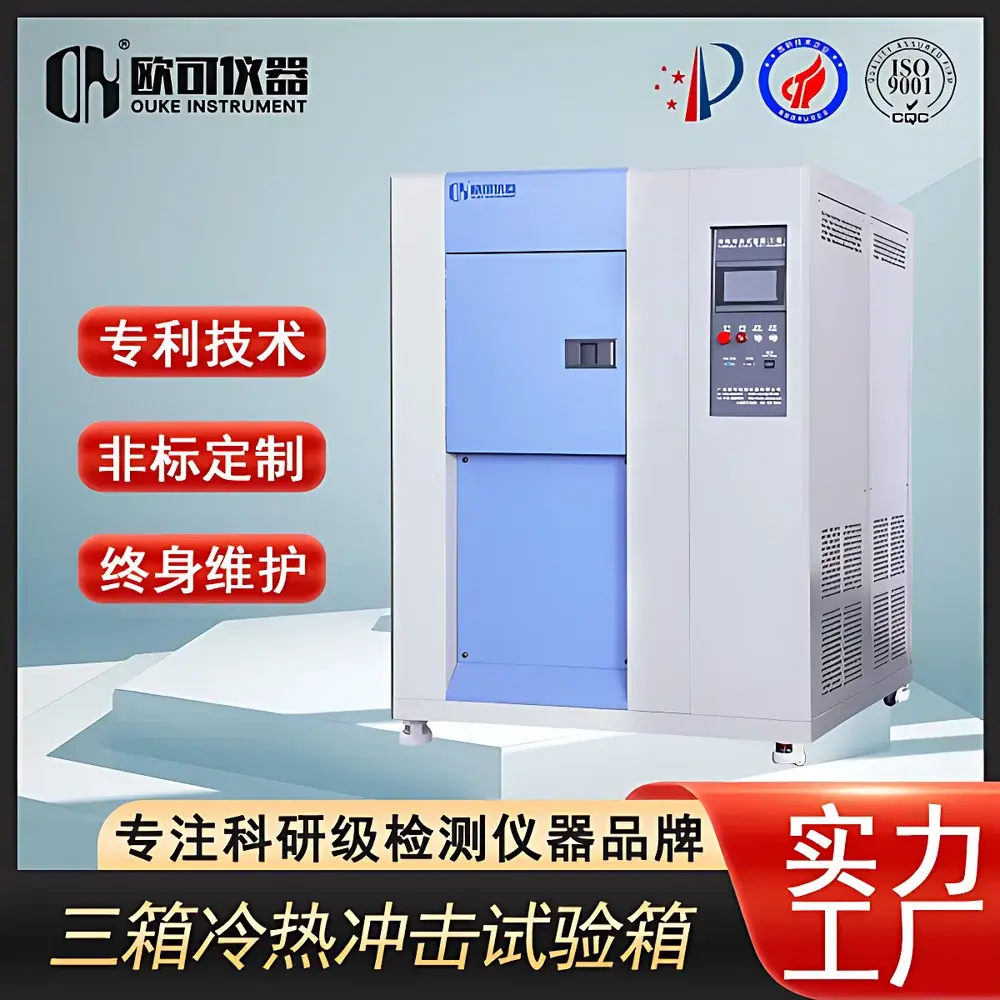
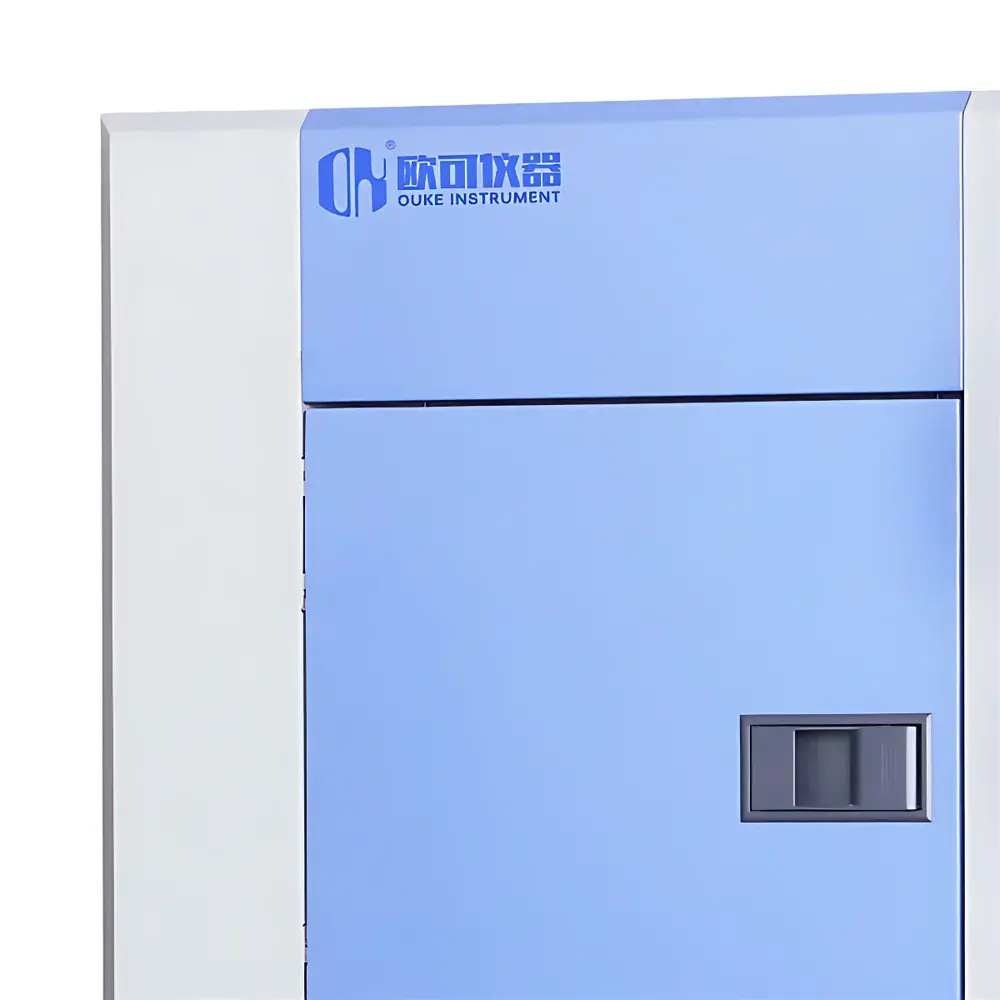
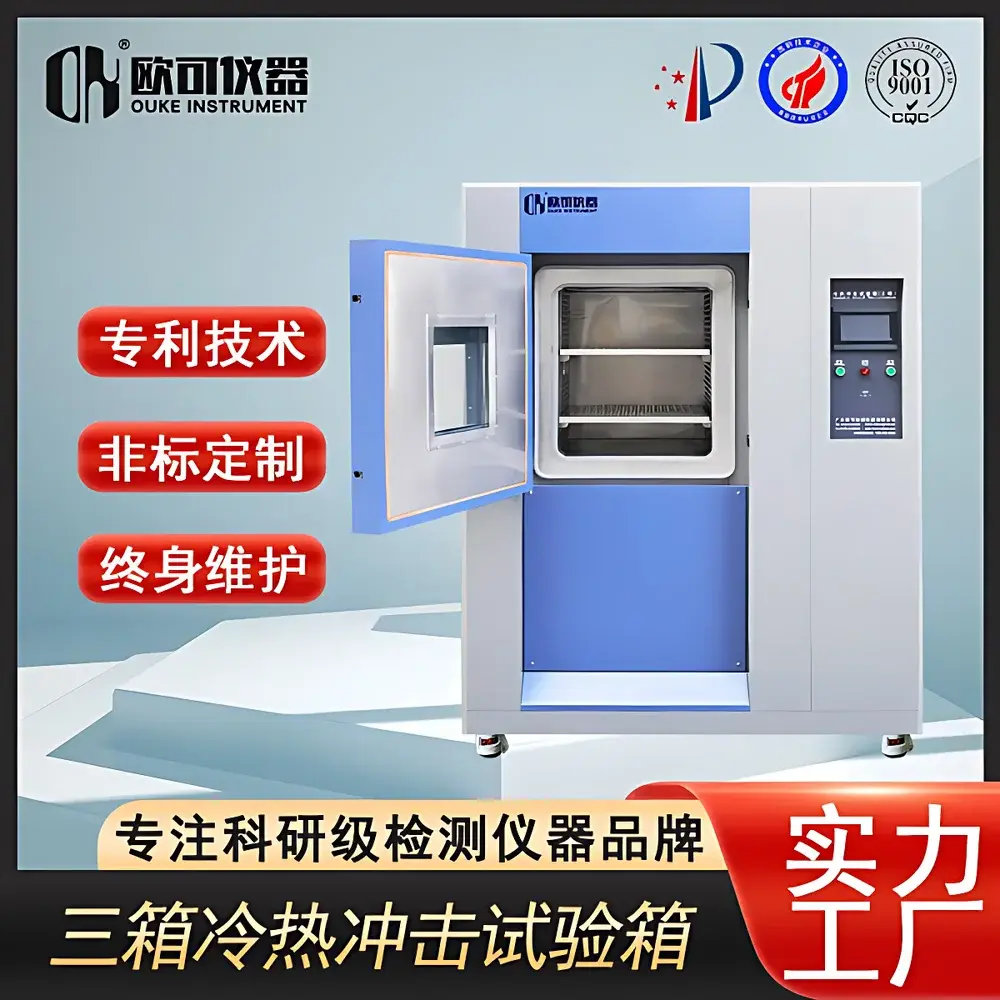
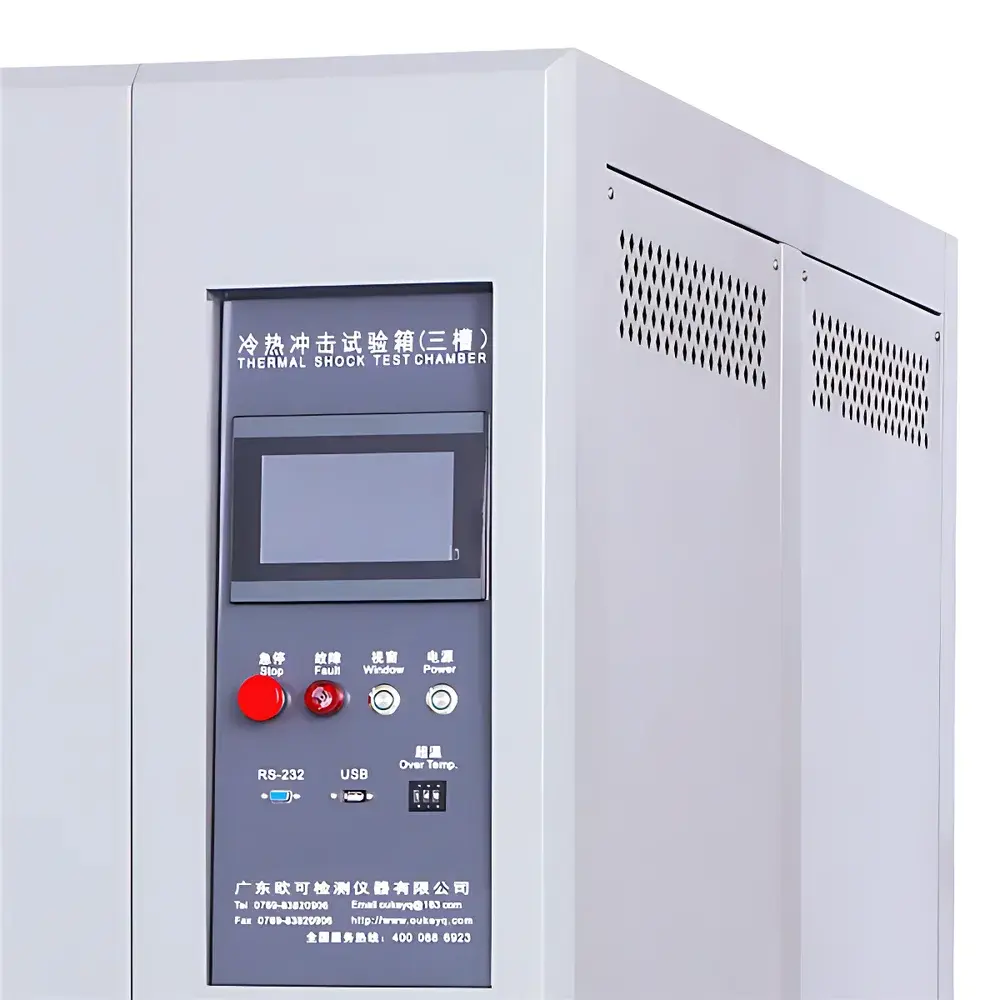
OK Instruments OK-TS-80 Two-Zone Thermal Shock Test Chamber
| Brand | OK Instruments |
|---|---|
| Model | OK-TS-80 |
| Origin | Guangdong, China |
| Manufacturer Type | Direct Manufacturer |
| Temperature Range (Hot Zone) | +150 °C |
| Temperature Range (Cold Zone) | −50 °C |
| Thermal Shock Range | −50 °C to +150 °C |
| Temperature Stability | ±2 °C |
| Heating Rate | 10 °C/min |
| Cooling Rate | 10 °C/min |
| Control Accuracy | ±0.5 °C |
| Uniformity | ±2.0 °C |
| Hot Zone Max Temp | +200 °C |
| Cold Zone Min Temp | −70 °C |
| Recovery Time | <5 min |
| Refrigerant | R404A/R23 |
| Construction | Interior – SUS#304 mirror-finish stainless steel |
| Insulation | High-density fire-retardant PU foam |
| Power Supply | AC 380 V ±5%, 50 Hz ±0.5 Hz, 3-phase 5-wire |
Overview
The OK Instruments OK-TS-80 Two-Zone Thermal Shock Test Chamber is an engineered solution for accelerated reliability evaluation of electronic components, automotive modules, aerospace hardware, and precision optical assemblies subjected to rapid, extreme temperature transitions. Unlike single-chamber thermal cycling systems, this dual-compartment design physically isolates hot and cold reservoirs—enabling true step-change thermal shock testing per IEC 60068-2-14 (Test N), MIL-STD-810H Method 503.6, and GJB 150.5A–2009. The chamber employs independent high-efficiency refrigeration and heating circuits: a dedicated hot zone (RT to +200 °C) and cold zone (RT to −70 °C), with test specimens held stationary in a central transfer chamber. Thermal shock is induced via pneumatically actuated stainless-steel dampers that switch airflow paths within <1 second, delivering repeatable transitions between −50 °C and +150 °C at controlled ramp rates of 10 °C/min. This architecture eliminates thermal inertia artifacts common in single-zone systems, ensuring compliance with stringent qualification protocols requiring defined dwell times, transition durations, and recovery stability.
Key Features
- Intuitive 7-inch color TFT touchscreen controller with multi-language UI (English, Chinese, Spanish), supporting real-time graphing, data logging, and user-defined profile sequencing.
- PID-based digital temperature control with auto-tuning algorithms, achieving ±0.5 °C setpoint accuracy and ±2.0 °C uniformity across the 50 × 40 × 40 cm test volume (W×H×D).
- Programmable cycle parameters: up to 999 cycles, customizable dwell time (1–9999 minutes per zone), automatic defrost scheduling, and pre-conditioning mode (pre-cool/pre-heat activation prior to scheduled start).
- Fail-safe protection system including over-temperature cut-off, compressor high-pressure shutdown, phase failure detection, door interlock, and real-time fault diagnostics with on-screen troubleshooting guidance.
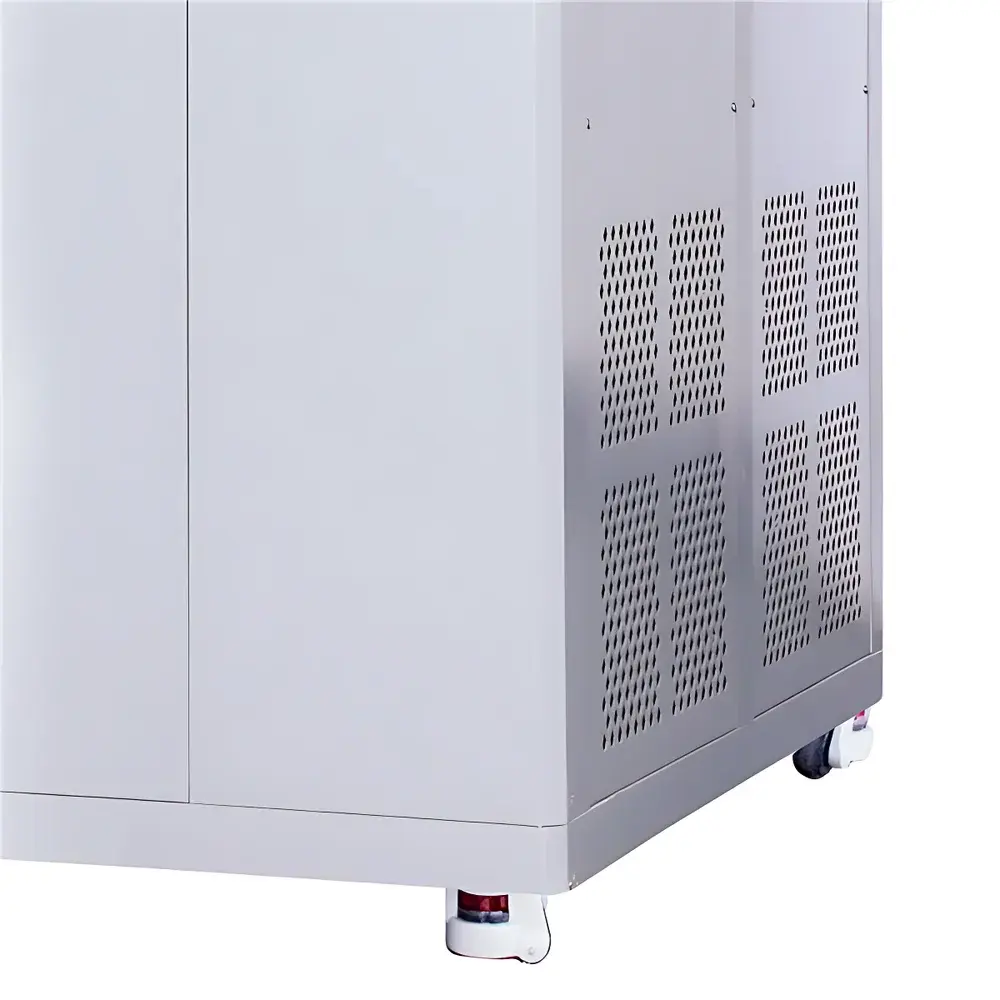
- Modular thermal management: hermetically sealed or semi-hermetic compressors with environmentally compliant R404A/R23 blended refrigerant; optimized heat exchanger geometry for stable low-temperature hold performance at −50 °C.
- Structural integrity: interior chamber fabricated from mirror-finish SUS#304 stainless steel; exterior housing in corrosion-resistant SUS#304 or electrophoretic-coated carbon steel; 120 mm thick polyurethane insulation with flame-retardant certification (UL 94 V-0 equivalent).
Sample Compatibility & Compliance
The OK-TS-80 accommodates test specimens up to 40 L volume (50 × 40 × 40 cm internal dimensions), with two adjustable SUS#304 shelves and a standard 50 mm diameter cable/port access port. Its mechanical design supports static loading up to 30 kg without vibration coupling. The system is validated to meet requirements for environmental stress screening (ESS) and qualification testing per multiple international and defense standards, including: GB/T 2423.22–2002 (Temperature Change), IEC 60068-2-14 (Test N), MIL-STD-810H Method 503.6, GJB 150.5A–2009 (Temperature Shock), GJB 360.7–1987, EIA-364-32 (Thermal Shock for Connectors), and QC/T 17–1992 (Automotive Component Durability). Optional calibration certificates traceable to NIM (National Institute of Metrology, China) are available upon request. All control firmware supports audit-ready operation logs required under GLP and ISO/IEC 17025 laboratory accreditation frameworks.
Software & Data Management
Embedded controller firmware records timestamped temperature readings from three calibrated PT100 sensors (hot zone, cold zone, test chamber) at user-selectable intervals (1–60 seconds). Data exports directly to USB storage in CSV format for post-processing in MATLAB, Excel, or statistical analysis platforms. Optional PC-based OK-DataLink software enables remote monitoring, multi-chamber fleet management, automated report generation (PDF/Excel), and integration with LIMS environments. Full 21 CFR Part 11 compliance is supported via optional audit trail module—including electronic signatures, role-based access control, and immutable record retention—meeting FDA-regulated validation requirements for medical device and pharmaceutical packaging testing labs.
Applications
- Qualification of printed circuit boards (PCBs), BGA solder joints, and MEMS sensors under thermal fatigue stress.
- Validation of automotive ECUs, battery management systems (BMS), and ADAS camera housings per ISO 16750-4 and SAE J2223.
- Reliability screening of avionics enclosures, radar waveguides, and satellite subsystems per DO-160 Section 4 and MIL-STD-704.
- Material compatibility assessment of conformal coatings, potting compounds, and elastomeric seals used in harsh-environment electronics.
- Process development support for reflow soldering, die attach, and wafer-level packaging where interfacial delamination risk must be quantified.
FAQ
What is the difference between two-zone and single-zone thermal shock chambers?
Two-zone systems maintain separate hot and cold reservoirs, enabling faster, more precise transitions with minimal thermal overshoot. Single-zone units rely on reversing refrigerant flow or heater/cooler alternation, resulting in longer recovery times and reduced repeatability.
Can the OK-TS-80 perform temperature cycling as well as thermal shock?
Yes—the controller supports both discrete shock profiles (e.g., −50 °C → +150 °C in ≤5 min) and gradual ramp-and-soak cycling (e.g., linear 5 °C/min ramps between −40 °C and +85 °C over 120-minute periods).
Is external water cooling required for continuous operation at −50 °C?
No—this model uses air-cooled condensers with enhanced fin density and variable-speed fans, eliminating dependency on chilled water infrastructure while maintaining stable sub-zero performance.
How is temperature uniformity verified during IQ/OQ validation?
A 9-point sensor mapping protocol (per ASTM E741 and ISO 17025 Annex A.3) is recommended using NIST-traceable PT100 probes; OK Instruments provides a validation support package including template protocols and uncertainty budgets.
Are custom internal dimensions or auxiliary interfaces (e.g., Ethernet, 4–20 mA output) available?
Yes—OK Instruments offers OEM engineering services for non-standard chamber volumes, additional feedthroughs, integrated humidity control (as hybrid TH/TS variants), and industrial communication protocols (Modbus TCP, Profibus DP).



