
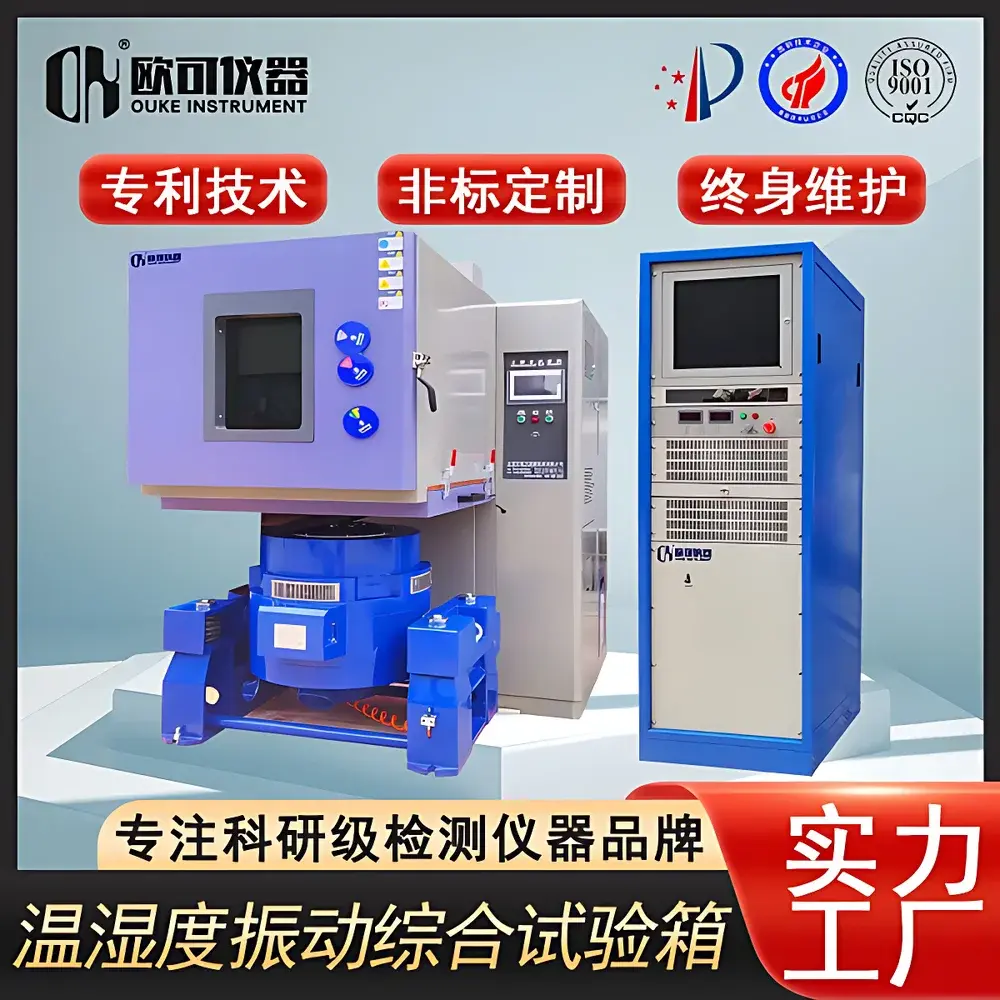
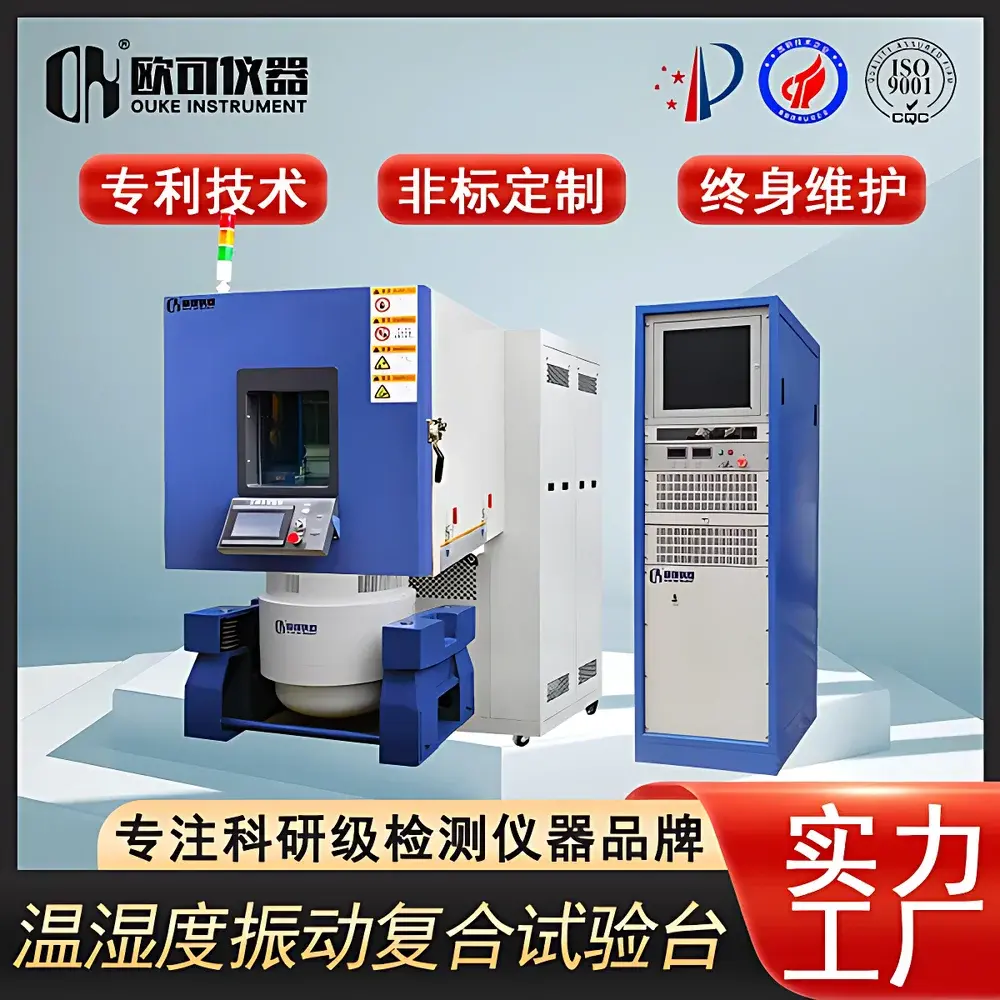
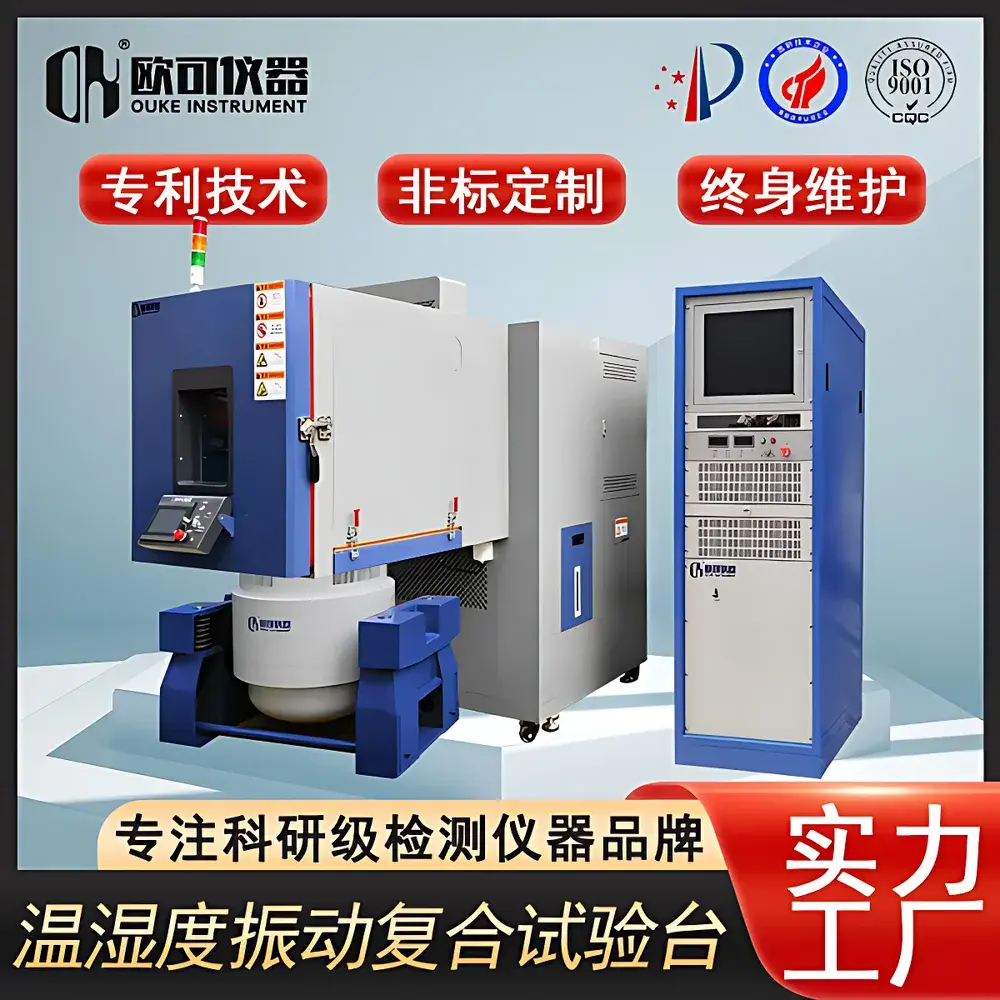
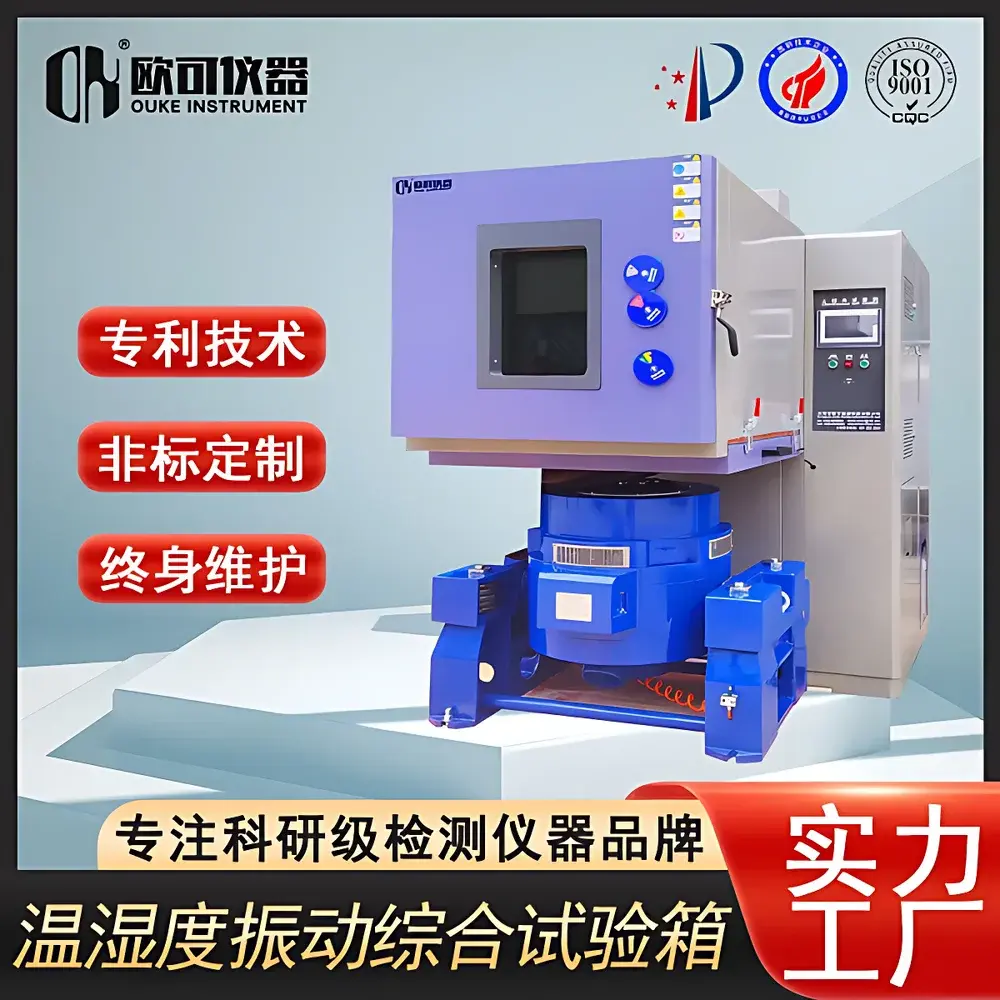
OK Instruments OK-ZTH-1440.1688 Combined Temperature-Humidity-Vibration Test Chamber
| Brand | OK Instruments |
|---|---|
| Origin | Guangdong, China |
| Manufacturer Type | Direct Manufacturer |
| Country of Origin | China |
| Model | OK-ZTH-1440.1688 |
| Temperature Range | −70 °C to +150 °C |
| Humidity Range | 20–98 %RH at 20–85 °C |
| Temperature Ramp Rate | 5 / 10 / 15 °C/min |
| Temperature Uniformity | ≤ ±0.5 °C |
| Standard Load Capacity | 15 kg aluminum mass with 350 W internal heat dissipation |
Overview
The OK Instruments OK-ZTH-1440.1688 Combined Temperature-Humidity-Vibration Test Chamber is an integrated environmental reliability testing system engineered for simultaneous or sequential application of thermal, hygric, and mechanical stresses. It operates on the principle of multi-stress acceleration—leveraging controlled temperature cycling, precise humidity regulation, and high-fidelity electrodynamic vibration excitation to replicate real-world operational, transportation, and storage conditions. Unlike standalone environmental chambers or vibration shakers, this tri-combined system enables true concurrent stress application: for example, executing random vibration spectra while ramping temperature from −40 °C to +85 °C at 10 °C/min under 85 %RH—mimicking under-hood automotive electronics exposure or avionics deployment in tropical maritime environments. Its architecture supports both HALT (Highly Accelerated Life Testing) and HASS (Highly Accelerated Stress Screening) protocols, fulfilling critical requirements in product qualification, design validation, and failure mode analysis across regulated industries.
Key Features
- Triple-stress integration: Independent yet synchronized control of temperature, relative humidity, and vibration via a unified industrial PC-based controller with deterministic real-time OS.
- Robust mechanical interface: Precision-machined stainless-steel transition flange with dual-stage dynamic sealing (silicone elastomer + magnetic compression seal), ensuring <0.5 Pa·m³/s helium leak rate while transmitting vibration energy up to 2000 Hz without resonance coupling or thermal bridging.
- Thermal subsystem: Dual-stage cascade refrigeration (R404A/R23) with French Tecumseh or German Copeland compressors; NiCr heating elements with PID+feedforward control; steam boiler humidification (not ultrasonic) for stable RH control down to 20 %RH at +20 °C.
- Vibration subsystem: Electromagnetic shaker with 16 kN peak force, 76 mm stroke, and DC–2000 Hz bandwidth; integrated power amplifier with closed-loop current feedback and harmonic distortion <1.2 % THD at full load.
- Environmental uniformity: Multi-wing centrifugal air circulation driven by long-shaft AC motor; temperature deviation ≤ ±0.5 °C (at 150 °C steady state); humidity variation ≤ ±2 %RH across 1440 L working volume.
- Safety & compliance architecture: Triple-redundant over-temperature cutoffs, condensate level monitoring, vibration over-acceleration shutdown, ground-fault interrupters, and dry-run protection for humidifier.
Sample Compatibility & Compliance
The chamber accommodates test specimens up to 15 kg mass (standard aluminum reference load) with maximum power dissipation of 350 W—suitable for ECUs, battery modules, RF transceivers, and optical sensor assemblies. Internal dimensions support standard MIL-STD-810G and IEC 60068-2 compliant fixture mounting. The system conforms to key regulatory and industry standards including GB/T 2423.1–2423.50 (China National Standards), GJB 150A–2009 (Chinese Military Standards), IEC 60068-2-64 (random vibration), IEC 60068-2-30 (damp heat cyclic), and SAE J2412 (automotive component testing). All control software logs meet GLP/GMP audit trail requirements per FDA 21 CFR Part 11 when configured with electronic signatures and user access tiers.
Software & Data Management
Control and data acquisition are managed through OK-TestSuite™ v4.2—a deterministic Windows-based platform supporting ISO/IEC 17025 traceable calibration workflows. The software provides programmable test profiles with nested loops, conditional branching (e.g., “hold at 85 °C/85 %RH until vibration response RMS exceeds threshold”), and synchronized multi-channel logging at 10 kHz sampling (vibration acceleration, chamber temperature/humidity, DUT surface thermocouple, and chamber pressure). Raw data exports to CSV, MATLAB .mat, and ASAM MDF4 formats. Optional add-ons include automated report generation (PDF/HTML), cloud backup to secure AWS S3 buckets, and REST API integration for MES/PLM systems.
Applications
- Automotive: Validation of ADAS cameras, radar housings, and 48V battery management systems under combined thermal shock and road-spectrum vibration.
- Aerospace: Qualification of satellite payload electronics subjected to launch vibration while exposed to tropical humidity and thermal vacuum pre-conditioning cycles.
- Energy Storage: Cycle-life evaluation of Li-ion pouch cells under simultaneous 45 °C/95 %RH and 20–2000 Hz random vibration to assess electrolyte leakage and tab weld integrity.
- Medical Devices: IEC 60601-1 compliance testing of portable ultrasound units undergoing transport simulation with temperature ramping and broadband shaking.
- Industrial IoT: Reliability screening of edge computing gateways deployed in offshore oil platforms with salt-laden humid air and structural vibration.
FAQ
Does the system support true simultaneous temperature-humidity-vibration operation?
Yes. The OK-ZTH-1440.1688 implements hardware-synchronized control via shared timebase and FPGA-based signal routing—enabling concurrent execution of temperature ramps, humidity holds, and vibration spectra without timing jitter or phase drift.
What is the maximum specimen size that fits inside the 1440 L chamber?
The internal working volume measures 1000 × 1000 × 1440 mm (W × D × H). Maximum recommended DUT footprint is 800 × 800 mm to maintain ≥100 mm clearance from walls and ensure airflow uniformity.
Is third-party calibration and certification available?
Yes. OK Instruments provides optional NIST-traceable calibration certificates (per ISO/IEC 17025) for temperature, humidity, and acceleration sensors, including on-site verification and uncertainty budgets.
Can the system be upgraded to support extended low-temperature performance?
The base model supports −70 °C. An optional liquid nitrogen assist module extends capability to −85 °C with ramp rates maintained at ≥5 °C/min between −40 °C and −85 °C.
How is data integrity ensured during long-duration tests (e.g., 1000-hour HASS)?
The controller employs dual SSD RAID 1 mirroring, automatic journaling file system, and periodic checksum validation. Power-loss recovery resumes tests from last valid checkpoint without data corruption.



