
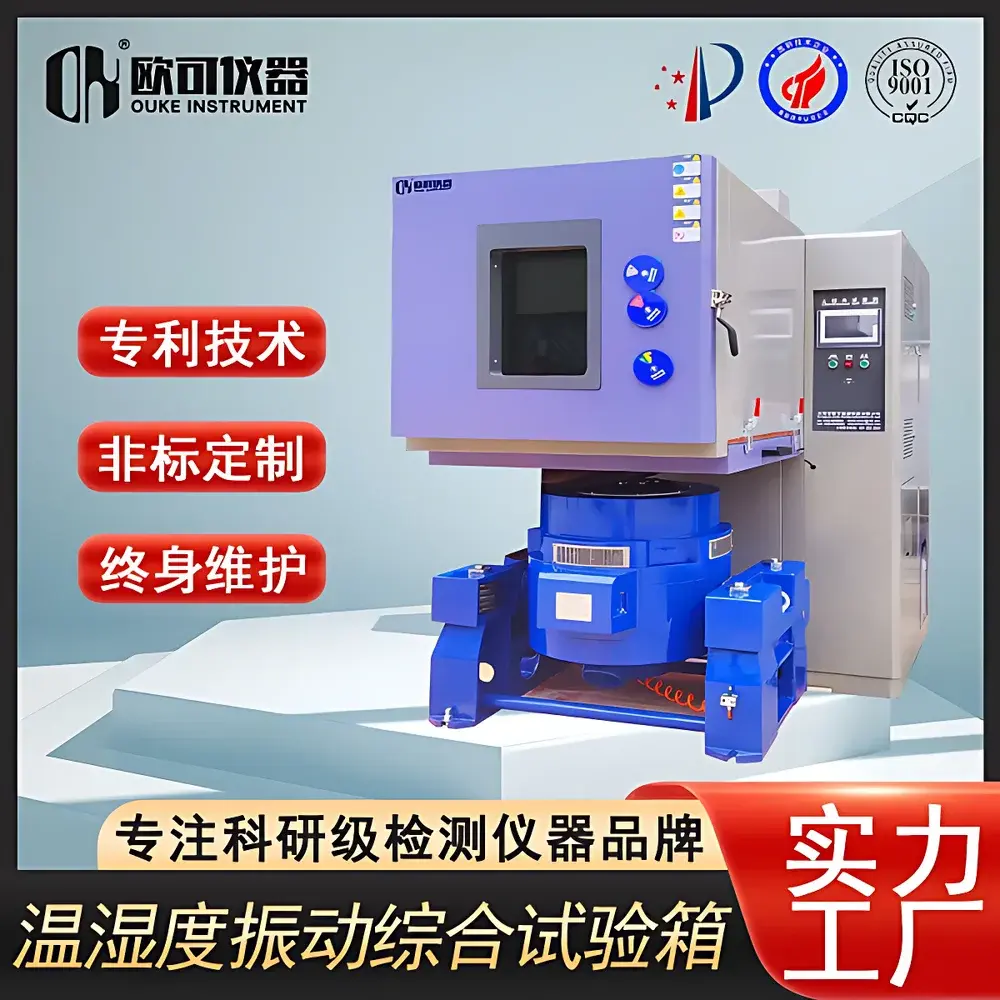
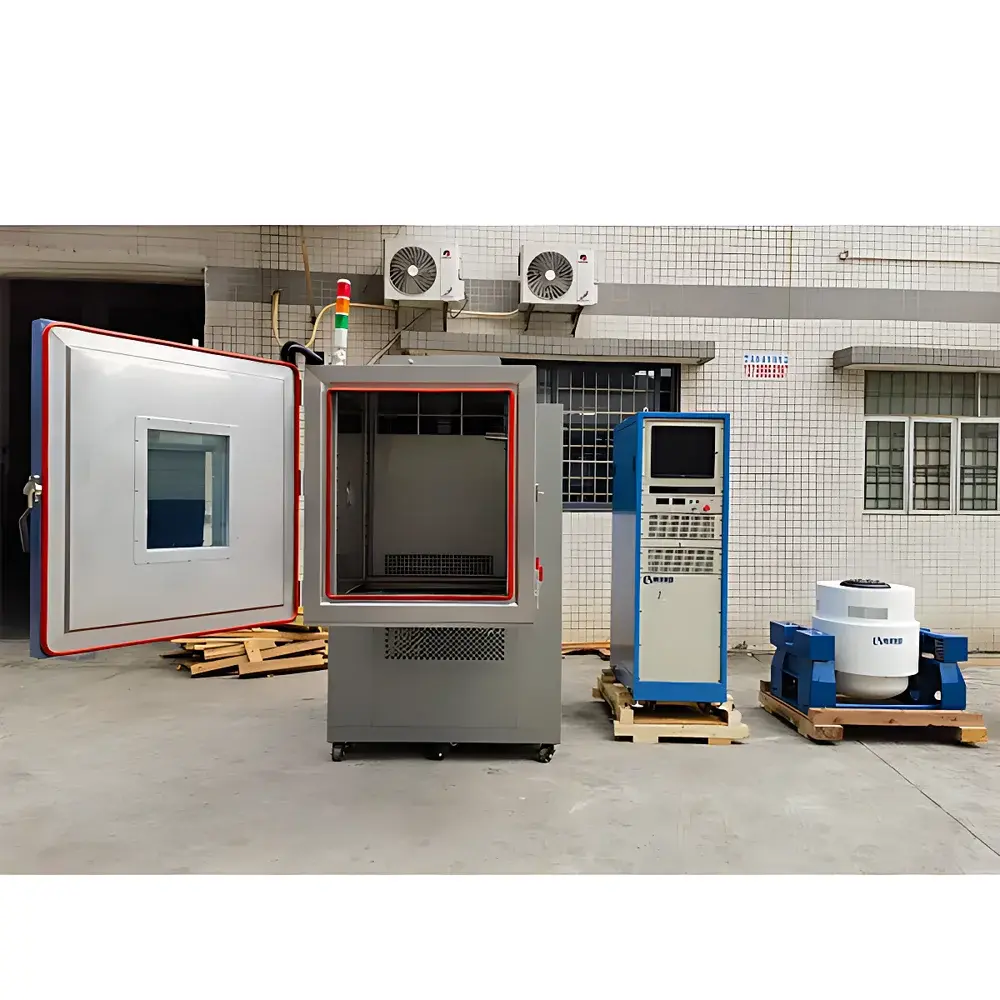
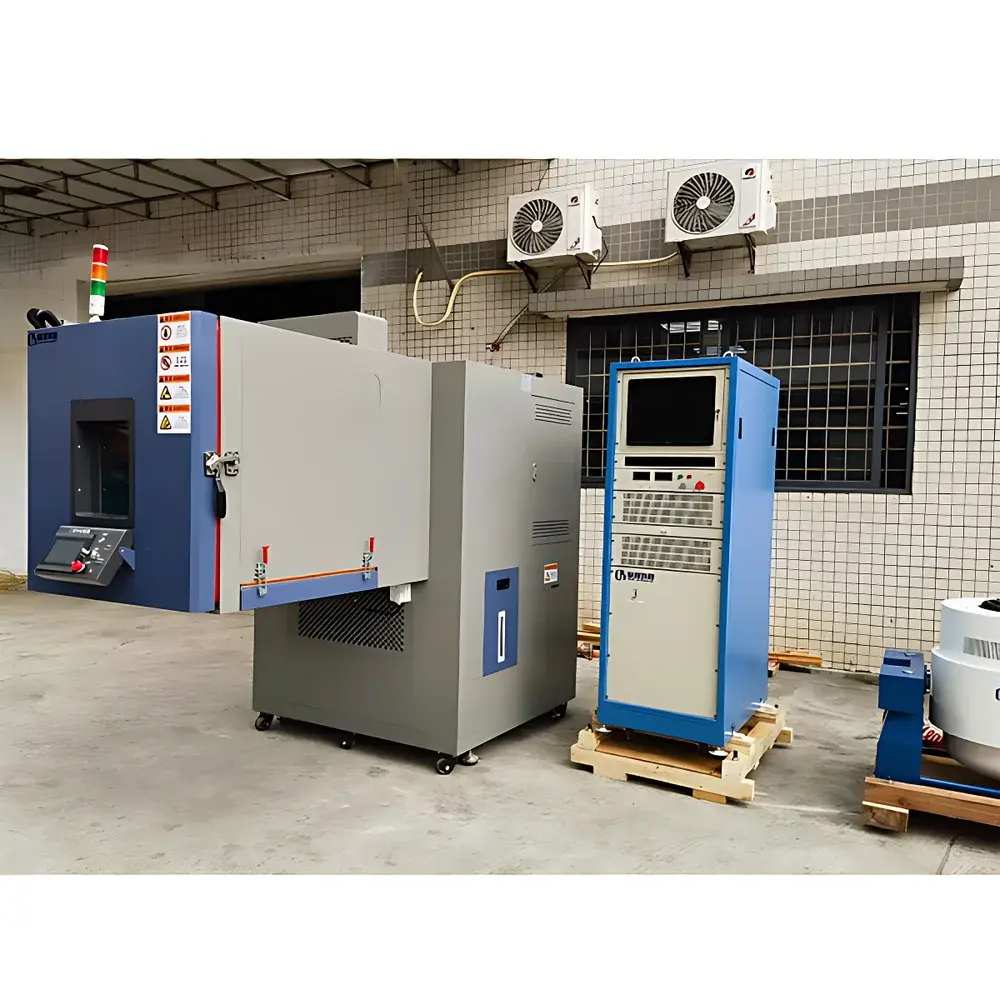
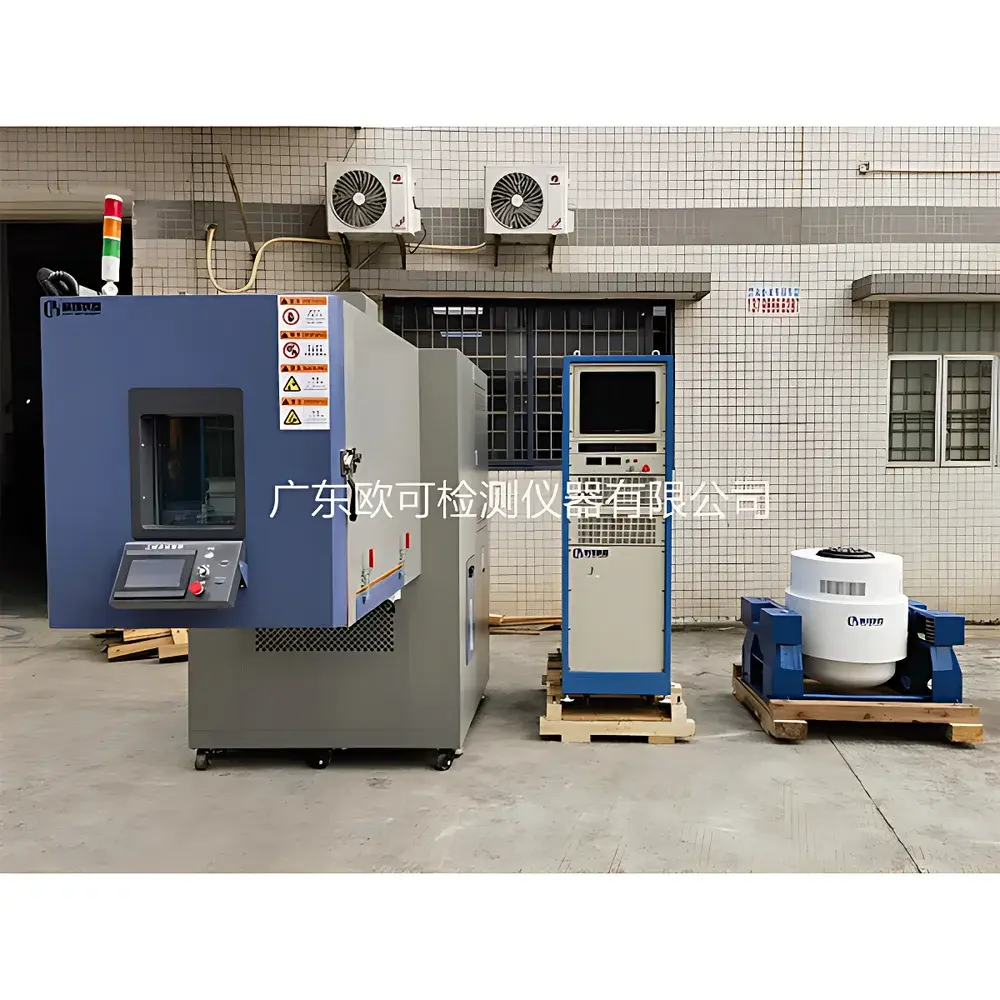
OK Instruments OK-ZTH-390.147 Combined Temperature-Humidity-Vibration Environmental Test Chamber
| Brand | OK Instruments |
|---|---|
| Origin | Guangdong, China |
| Manufacturer Type | Direct Manufacturer |
| Country of Origin | China |
| Model | OK-ZTH-390.147 |
| Temperature Range | −70 °C to +150 °C |
| Humidity Range | 20–98 %RH (at 20–85 °C) |
| Temperature Ramp Rate | 5 / 10 / 15 °C/min |
| Temperature Uniformity | ≤ ±0.5 °C |
| Standard Load Capacity | 15 kg aluminum mass, 350 W internal heat dissipation |
Overview
The OK Instruments OK-ZTH-390.147 Combined Temperature-Humidity-Vibration Environmental Test Chamber is an integrated reliability validation platform engineered for simultaneous application of thermal, hygric, and mechanical stress stimuli. It operates on the principle of multi-stress acceleration—leveraging synergistic interactions among temperature cycling, controlled humidity exposure, and broadband electrodynamic vibration—to replicate real-world operational, transportation, and storage conditions encountered by high-reliability products. Unlike sequential or single-stress testing, this chamber enables concurrent execution of ASTM D471, IEC 60068-2-6 (vibration), IEC 60068-2-30 (damp heat cyclic), and MIL-STD-810H Method 514.8-compliant test profiles within a single, tightly coordinated environmental envelope. Its architecture supports deterministic and random vibration spectra while maintaining traceable thermal-hygrometric control—critical for qualifying electronics, avionics, automotive ECUs, battery modules, and aerospace subsystems under GLP/GMP-aligned test protocols.
Key Features
- Triple-stress synchronization: Independent yet fully coordinated control of temperature, relative humidity, and vibration parameters via a unified industrial PLC-based controller with real-time feedback loops.
- High-fidelity thermal management: Dual-stage mechanical refrigeration system (cascade configuration) enabling stable operation down to −70 °C; resistive heating elements with PID tuning for precise ramping up to +150 °C at selectable rates of 5, 10, or 15 °C/min.
- Humidity generation and regulation: Steam-based humidification (electric boiler) coupled with deep-coil dehumidification ensures accurate RH control between 20–98 %RH across the 20–85 °C operational band.
- Vibration integration: Integrated electrodynamic shaker with vertical actuation axis penetrating the chamber base through a dynamically sealed feedthrough; maintains hermetic integrity during 5–2000 Hz random or swept-sine excitation.
- Thermal-hygrometric uniformity: Optimized air circulation design with laminar flow plenum and calibrated sensor grid (≥9 measurement points) validates ≤ ±0.5 °C temperature deviation and ±3 %RH spatial variation at standard load (15 kg Al block, 350 W).
- EMI-resilient architecture: Shielded signal pathways, isolated power supplies, and differential sensor interfaces mitigate electromagnetic interference from shaker coil currents—ensuring stable PID convergence and sensor accuracy under full-vibration load.
Sample Compatibility & Compliance
The OK-ZTH-390.147 accommodates test specimens up to 15 kg mounted on its rigid shaker table, with provisions for custom fixture integration. Internal chamber dimensions support typical automotive ECU housings, PCB assemblies, battery pouch cells, and small avionics enclosures. The system complies with structural requirements of ISO 16750-4 (road vehicles), RTCA DO-160G Section 25 (environmental conditions), and GB/T 2423.102–2008 (combined temperature/humidity/vibration testing). All control firmware implements audit-trail logging per FDA 21 CFR Part 11 requirements when operated in validated mode, supporting IQ/OQ/PQ documentation packages for regulated industries.
Software & Data Management
The embedded HMI runs OK-TestSuite v3.2—a deterministic real-time test sequencing engine supporting multi-segment profile definition (e.g., “Soak at 85 °C/85 %RH for 2 h → initiate 10–2000 Hz random vibration at 1.05 g²/Hz PSD”). Data acquisition records synchronized time-series streams from ≥12 channels—including chamber air temperature, chamber wall temperature, RH, shaker armature displacement, acceleration, and drive current—at up to 10 kHz sampling rate. Export formats include CSV, TDMS, and ASAM MDF 4.2. Remote monitoring and alarm escalation are enabled via Ethernet/IP with TLS 1.2 encryption; historical data retention adheres to ISO/IEC 17025 clause 7.5.2 for result traceability.
Applications
- Automotive: Accelerated life testing of ADAS sensors, powertrain control units, and high-voltage battery management systems under combined thermal cycling and road-spectrum vibration.
- Aerospace: Qualification of satellite payload electronics subjected to launch vibration while exposed to low-pressure, high-humidity soak conditions simulating ground handling environments.
- Electronics Manufacturing: Failure mode identification in multilayer PCBs experiencing coefficient-of-thermal-expansion (CTE) mismatch-induced solder joint fatigue under humid thermal cycling + mechanical resonance.
- Energy Storage: Performance degradation analysis of lithium-ion pouch cells under 45 °C/95 %RH storage combined with 10–500 Hz sinusoidal vibration replicating EV chassis dynamics.
- Railway Signaling: Compliance verification of trackside interlocking controllers per EN 50125-3, including damp heat cycling followed by functional vibration testing without interruption.
FAQ
What standards does the OK-ZTH-390.147 support for combined environment testing?
It natively supports test method definitions from IEC 60068-2-6, IEC 60068-2-30, MIL-STD-810H Method 514.8 and 507.6, and GB/T 2423.102–2008.
Can the vibration system operate independently of temperature/humidity control?
Yes—the shaker subsystem can be commissioned in standalone mode for mechanical qualification, while environmental conditioning remains disabled or held at ambient conditions.
Is the chamber suitable for testing lithium batteries per UN 38.3 requirements?
When configured with optional explosion-proof ventilation, inert gas purge interface, and thermal runaway detection inputs, it meets Clause 38.3.4.1a for altitude simulation and Clause 38.3.4.2c for temperature cycling—but full UN 38.3 certification requires third-party validation of the complete test setup.
How is calibration traceability maintained across all three stress domains?
Temperature and humidity sensors are NIST-traceable Class A platinum RTDs and capacitive hygrometers; shaker calibration uses certified reference accelerometers and laser vibrometry per ISO 16063-21, with annual recalibration certificates provided.
What safety interlocks are implemented to protect samples and operators?
Hardware-enforced dual-channel safety relays monitor overtemperature (±5 °C beyond setpoint), overhumidity (>100 %RH), shaker overtravel (>±25 mm), excessive coil current (>110 % rated), and door-open conditions—triggering immediate shutdown and latching fault state.
Related Products



