
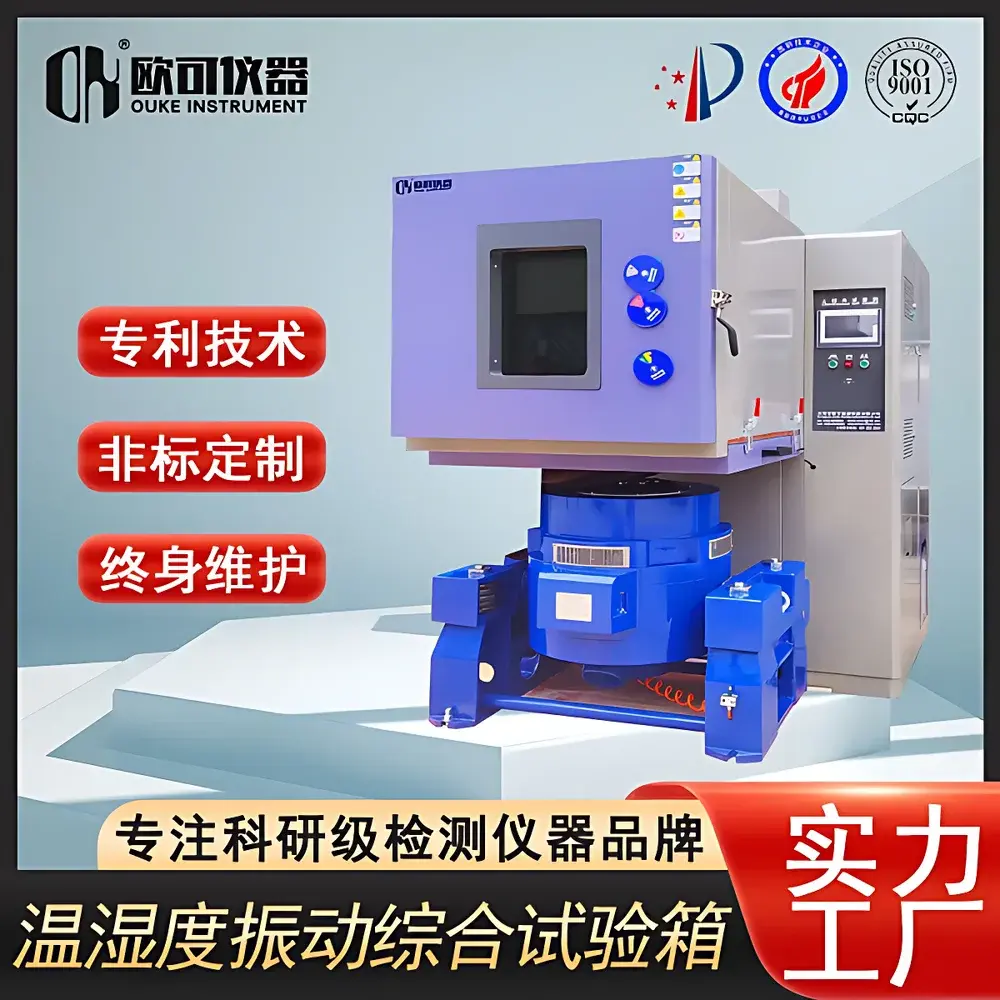
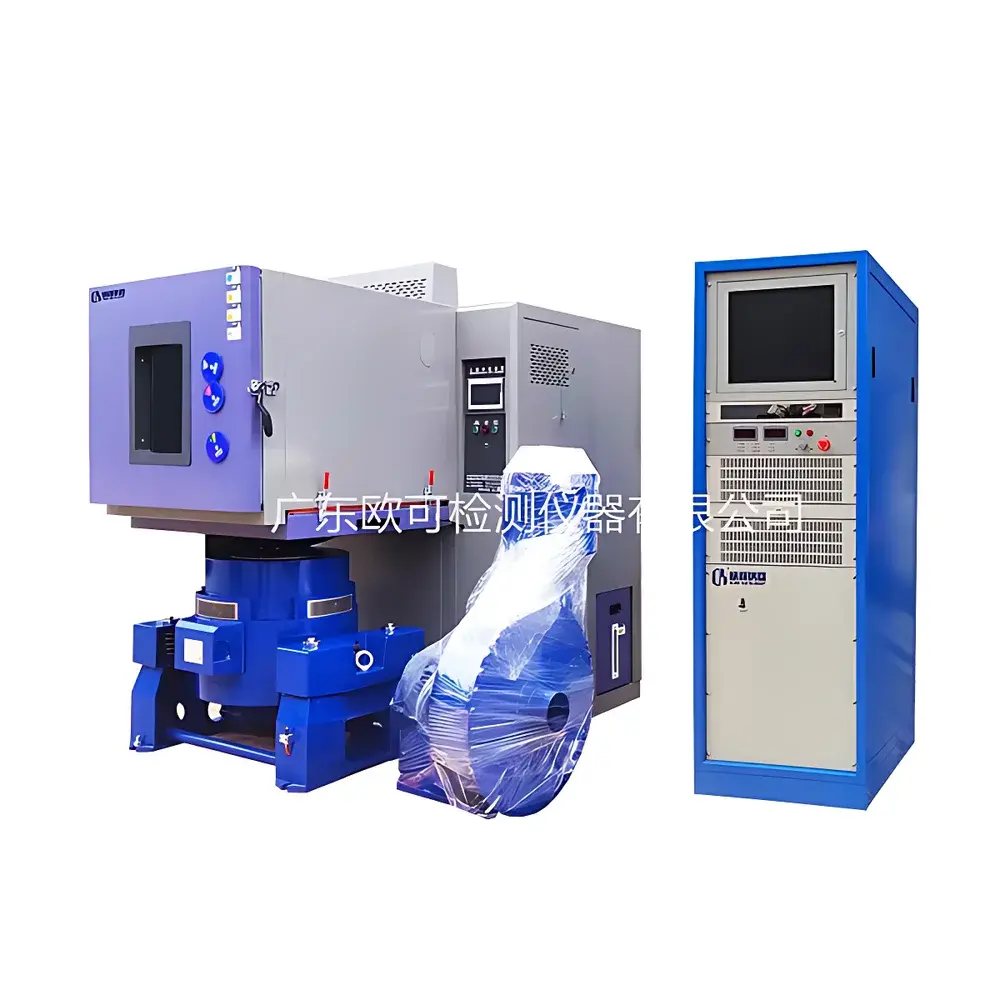
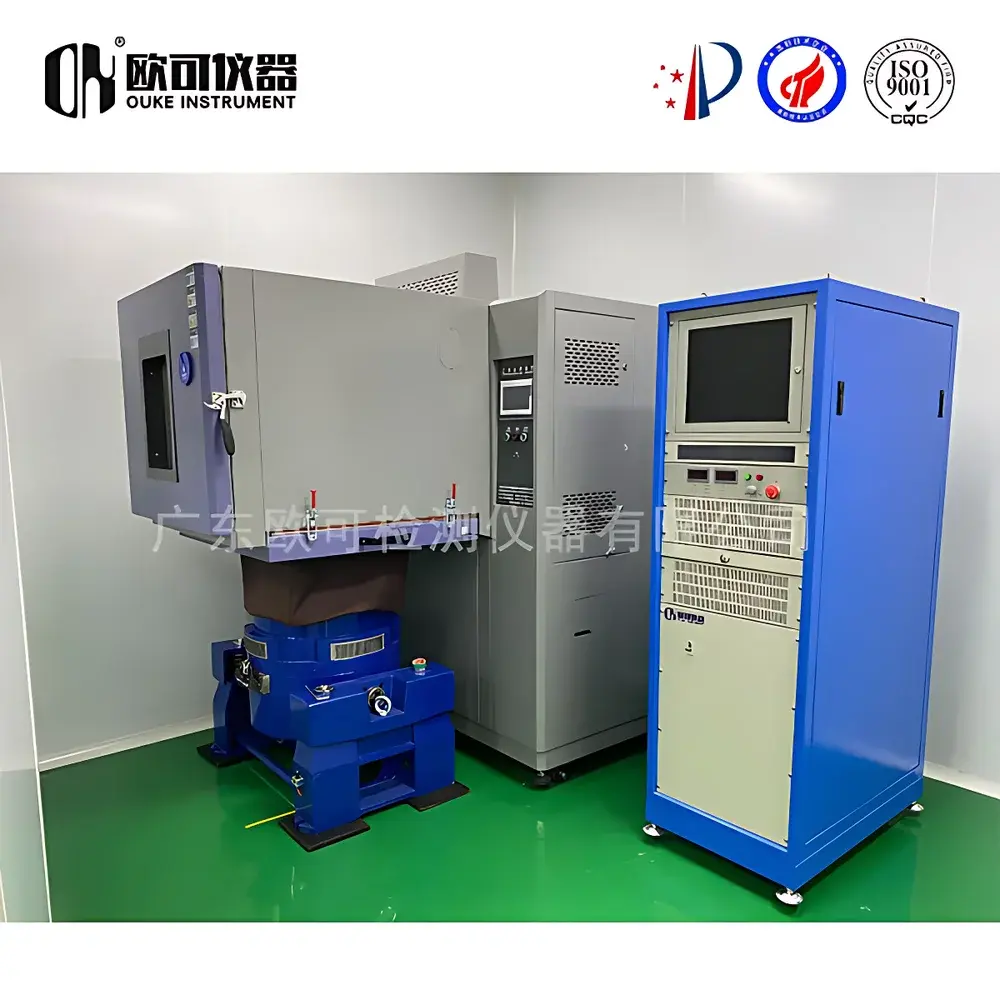
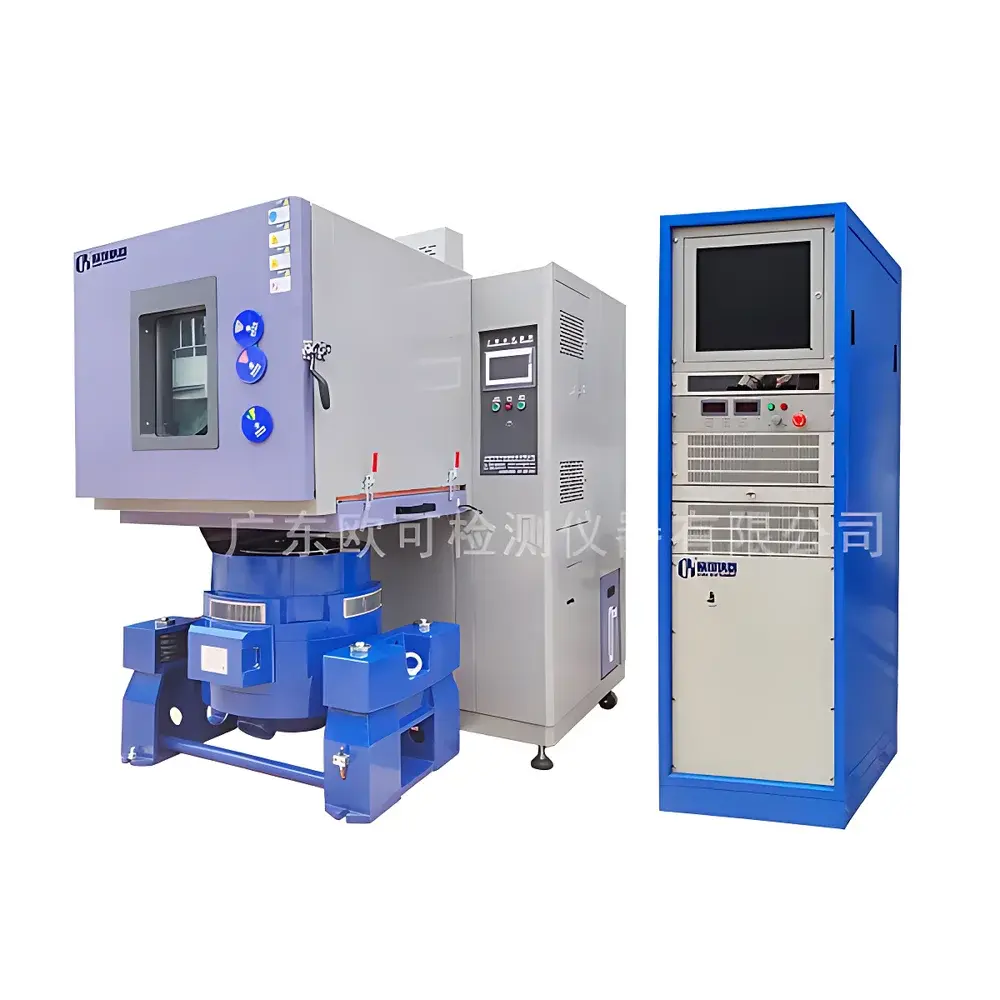
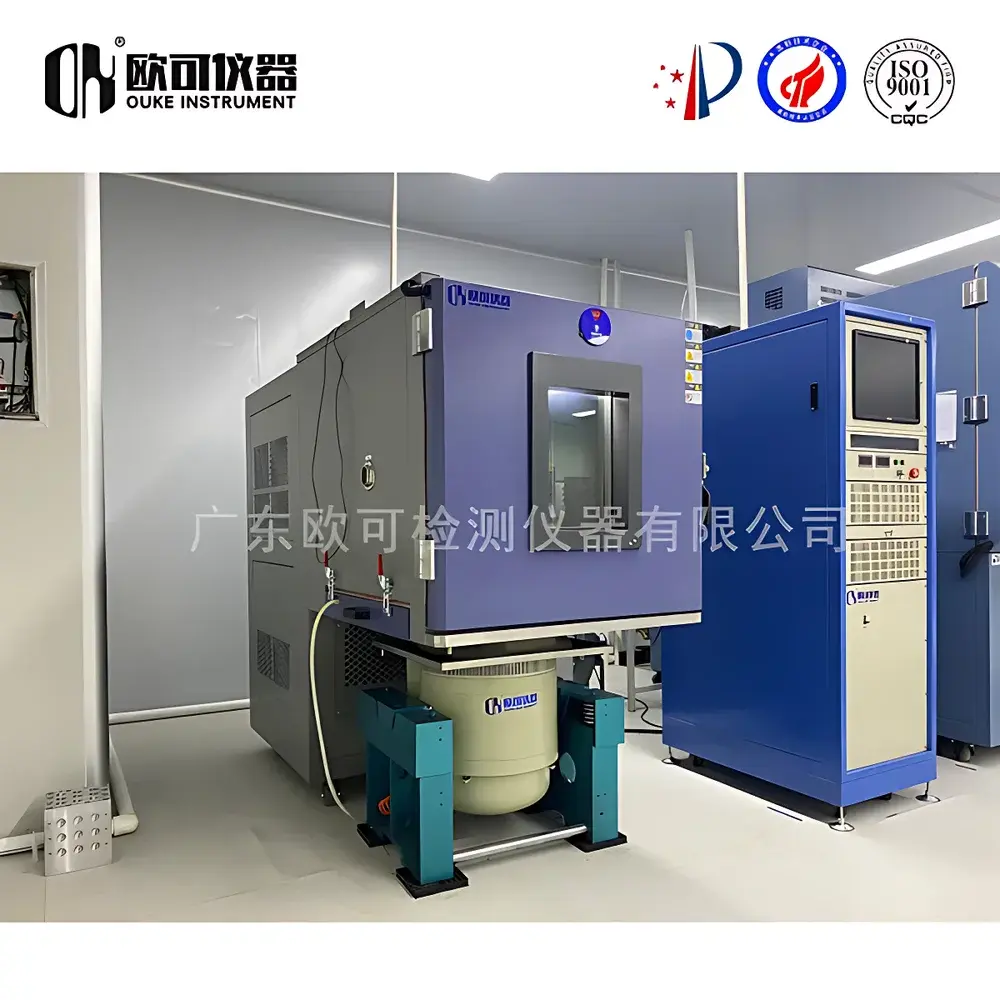
OK Instruments OK-ZTH-390.168 Combined Temperature-Humidity-Vibration Test Chamber
| Brand | OK Instruments |
|---|---|
| Origin | Guangdong, China |
| Manufacturer Type | Direct Manufacturer |
| Product Origin | Domestic (China) |
| Model | OK-ZTH-390.168 |
| Temperature Range | −70 °C to +150 °C |
| Humidity Range | 20–98 %RH at 20–85 °C |
| Temperature Ramp Rate | 5 / 10 / 15 °C/min |
| Temperature Uniformity | ≤ ±0.5 °C |
| Standard Load Capacity | 15 kg aluminum mass, 350 W internal heat dissipation |
Overview
The OK Instruments OK-ZTH-390.168 Combined Temperature-Humidity-Vibration Test Chamber is an integrated environmental reliability testing system engineered for simultaneous or sequenced application of thermal, hygric, and mechanical stress stimuli. Unlike sequential or standalone environmental chambers, this tri-stress chamber implements true multi-axis coupling—enabling concurrent control of temperature, relative humidity, and electrodynamic vibration in a single test volume. Its operational principle relies on synchronized real-time coordination between three independent subsystems: a forced-air thermal-humidity chamber with dual-stage refrigeration and steam-based humidification, a high-fidelity electromagnetic shaker with hermetically sealed actuator and liquid-cooled coil assembly, and a deterministic real-time controller compliant with IEC 61508 SIL2 functional safety architecture. Designed for accelerated life testing and failure mode analysis under realistic field conditions, the chamber supports standardized stress profiles defined in MIL-STD-810H Method 520.4 (Combined Environments), ISO 16750-4 (Road Vehicles), GJB 150.25A (Military Equipment), and IEC 60068-2-68 (Combined Temperature/Humidity/Vibration). The chamber’s structural integrity is reinforced with stainless steel 304 inner walls, double-glazed observation window with anti-condensation heating, and vibration-isolated base frame anchored to reinforced concrete foundation.
Key Features
- Triple-stress synchronization: Simultaneous execution of temperature ramping, humidity conditioning, and vibration excitation (sine, random, shock, or user-defined PSD profiles) within a unified test sequence.
- Thermal performance: Wide operating range from −70 °C to +150 °C with programmable ramp rates of 5, 10, or 15 °C/min; temperature stability maintained at ≤ ±0.5 °C under dynamic load.
- Humidity control: Steam-generation humidification system delivering 20–98 %RH across 20–85 °C ambient; integrated dehumidification via refrigerated coil condensation with automatic drain management.
- Vibration subsystem: Electromagnetic shaker with 15 kg payload capacity, 5–2000 Hz frequency bandwidth, and peak acceleration up to 100 g (configurable per model variant); actuator designed with IP55-rated enclosure, high-temp insulation (Class H), and closed-loop water cooling.
- Integrated control architecture: OK-TCMS v4.2 software platform with deterministic real-time kernel, dual-channel Ethernet redundancy, and support for test script import/export in XML/ATML format.
- Safety & compliance: Dual-channel over-temperature cutoff, humidity sensor fault detection, vibration overload shutdown, emergency stop with mechanical latch, and full audit trail logging aligned with GLP/GMP documentation requirements.
Sample Compatibility & Compliance
The OK-ZTH-390.168 accommodates samples up to 15 kg mounted on standard 390 mm × 390 mm shaker table surface, with maximum dimensional envelope of 600 mm (W) × 600 mm (D) × 600 mm (H) internal chamber volume. It supports rigid and semi-rigid DUTs including automotive ECUs, avionics modules, PCB assemblies, power converters, and sealed enclosures rated IP54 or higher. All thermal-humidity-vibration profiles are traceable to NIST-calibrated reference sensors (PT100 for temperature, capacitive polymer for RH, laser interferometer for displacement). The system complies with CE marking requirements (2014/30/EU EMC Directive, 2014/35/EU LVD Directive), RoHS 2011/65/EU, and meets mechanical safety provisions of ISO 12100. Optional validation packages include IQ/OQ documentation per ASTM E2500-13 and 21 CFR Part 11-compliant electronic signatures for regulated industries.
Software & Data Management
OK-TCMS v4.2 provides hierarchical user access (Operator, Engineer, Administrator), real-time waveform monitoring with 10 kHz sampling resolution, and synchronized multi-parameter data acquisition (temperature, RH, acceleration, velocity, displacement, drive voltage). Test sequences are defined using graphical drag-and-drop logic blocks or imported from MATLAB/Simulink-generated .m files. Raw data is stored in HDF5 format with embedded metadata (timestamp, operator ID, calibration certificate IDs, environmental setpoints). Export options include CSV, Excel (.xlsx), and universal ASAM MDF4 for post-processing in tools such as nCode DesignLife or Siemens Testlab. Audit trails record all parameter changes, user logins, alarm events, and calibration interventions with SHA-256 hashing and time-stamped digital signatures—fully satisfying FDA 21 CFR Part 11 Subpart C requirements for electronic records and signatures.
Applications
- Automotive electronics validation per ISO 16750-4: Replicating combined thermal cycling (−40 °C ↔ 85 °C), 85 %RH soak, and road-simulation vibration spectra during engine start-stop cycles.
- Aerospace component qualification per MIL-STD-810H Method 520.4: Simulating ascent-phase thermal transients, cabin humidity ingress, and launch-stage random vibration (PSD up to 0.04 g²/Hz).
- Consumer electronics drop-and-environment testing: Executing pre-conditioning at 60 °C/95 %RH for 48 h followed by mechanical shock (half-sine, 1500 g, 0.5 ms) while maintaining elevated temperature.
- Power semiconductor reliability assessment: Subjecting SiC MOSFET modules to temperature cycling (−55 °C ↔ 175 °C) under 30 g random vibration to accelerate bond wire fatigue mechanisms.
- Medical device sterilization compatibility testing: Evaluating housing integrity and display functionality after exposure to 121 °C saturated steam (simulated via rapid humidity ramp) coupled with transport vibration profiles.
FAQ
Does the OK-ZTH-390.168 support true simultaneous triple-stress operation?
Yes. All three stress domains operate concurrently under a single deterministic scheduler with sub-millisecond synchronization accuracy.
What is the maximum allowable sample height when mounted on the shaker table?
The vertical clearance from shaker table surface to chamber ceiling is 600 mm; however, dynamic headroom must be verified per test profile to avoid contact during peak displacement.
Is third-party calibration and certification available?
OK Instruments offers optional UKAS-accredited calibration services (ISO/IEC 17025) for temperature, humidity, and vibration channels, including uncertainty budgets and traceable certificates.
Can the system interface with external data acquisition hardware?
Yes—via IEEE 1588 PTPv2 time synchronization and TCP/IP API (RESTful JSON endpoints) for integration with LabVIEW, Python, or enterprise MES systems.
What maintenance intervals are recommended for long-term reliability?
Compressor oil and refrigerant checks every 12 months; shaker coil insulation resistance testing every 6 months; humidity sensor recalibration annually or after 2000 hr of cumulative operation.



