
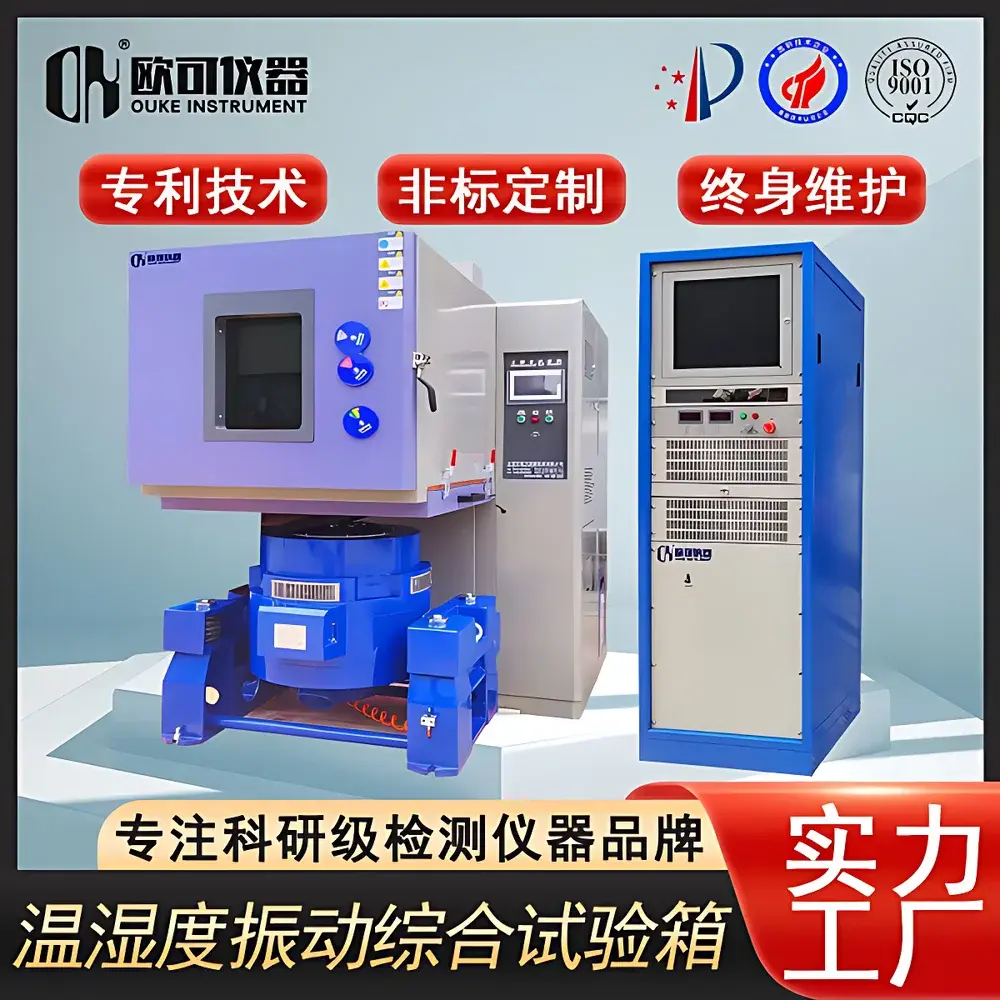
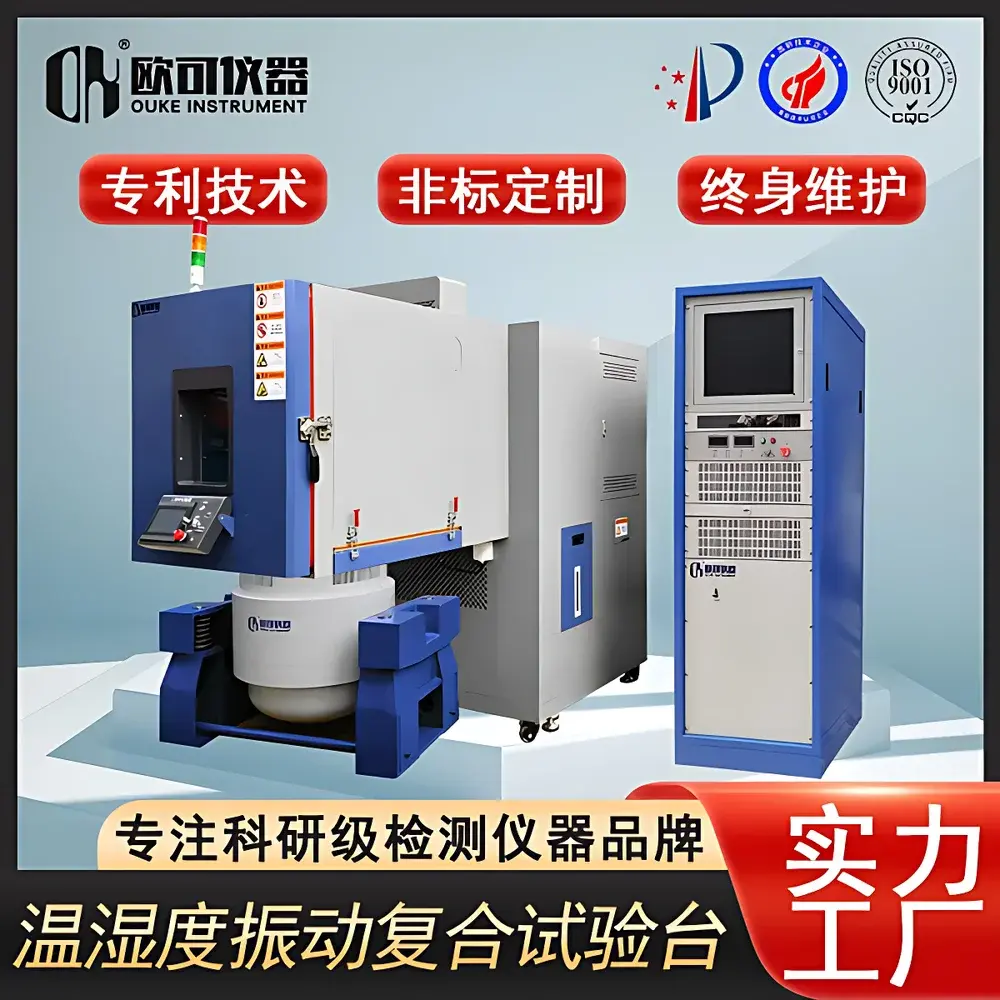

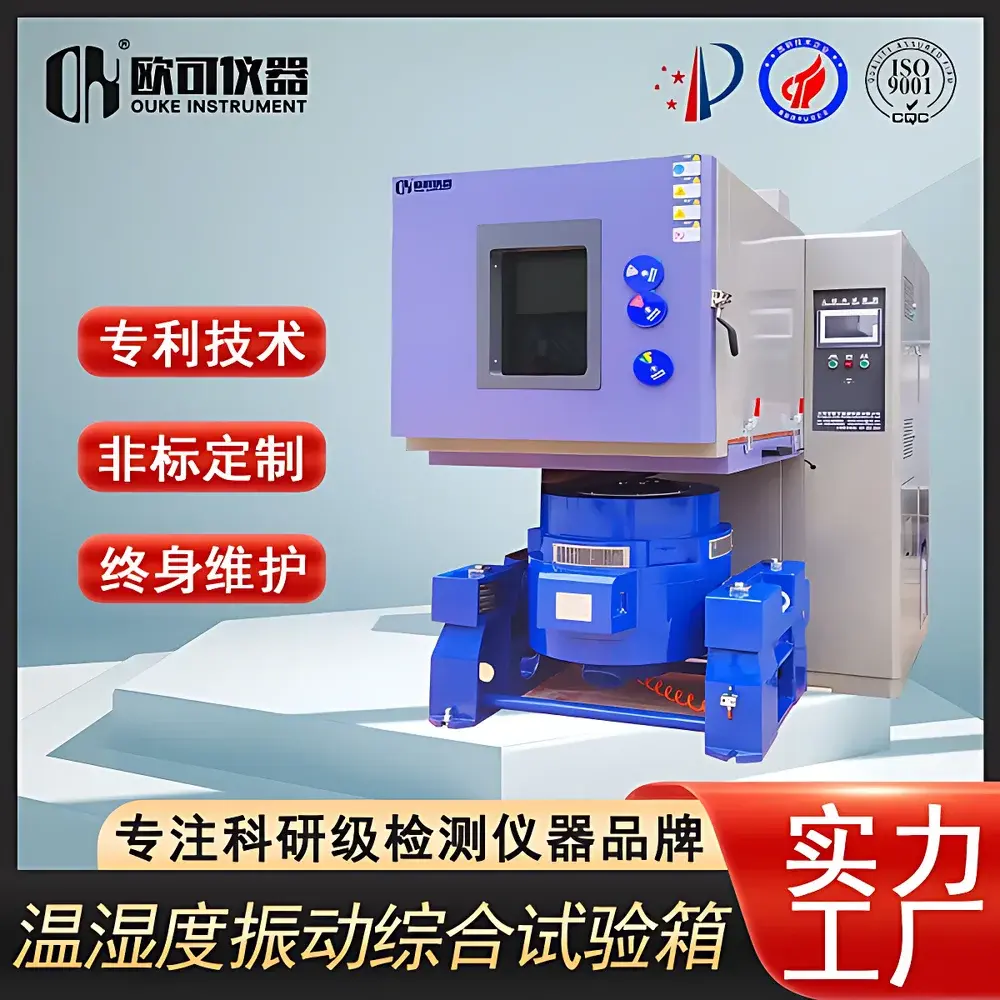
OK Instruments OK-ZTH-390.231 Combined Temperature-Humidity-Vibration Test System
| Brand | OK Instruments |
|---|---|
| Origin | Guangdong, China |
| Manufacturer Type | Direct Manufacturer |
| Country of Origin | China |
| Model | OK-ZTH-390.231 |
| Temperature Range | −70 °C to +150 °C |
| Humidity Range | 20–98 %RH (at 20–85 °C) |
| Temperature Ramp Rate | 5 / 10 / 15 °C/min |
| Temperature Uniformity | ≤ ±0.5 °C |
| Standard Load Capacity | 15 kg aluminum mass block, 350 W internal heat dissipation |
Overview
The OK Instruments OK-ZTH-390.231 Combined Temperature-Humidity-Vibration Test System is an integrated environmental reliability platform engineered for simultaneous application of mechanical vibration, thermal cycling, and controlled humidity stress within a single test chamber. It operates on the principle of multi-stress coupling—leveraging synergistic failure mechanisms that cannot be replicated by sequential or isolated environmental testing. Unlike standalone vibration shakers or climatic chambers, this system implements precise spatiotemporal coordination between dynamic excitation (via electromagnetic shaker) and static/dynamic climate control (via refrigeration, heating, humidification, and dehumidification subsystems), enabling accelerated life testing, design validation, and root-cause analysis of latent defects in high-reliability products.
Key Features
- Triple-stress integration: Simultaneous real-time control of temperature (−70 °C to +150 °C), relative humidity (20–98 %RH, conditioned within 20–85 °C operational envelope), and broadband mechanical vibration (sine, random, shock, and road-spectrum profiles).
- Electromagnetic shaker core: High-fidelity moving-coil actuator with active cooling (air or liquid) to maintain coil integrity under sustained thermal load and prevent magnetic demagnetization during prolonged low-temperature operation.
- Dynamic thermal isolation: Custom-engineered flexible bellows seal between shaker armature and climatic chamber wall—designed for ≥100 mm peak-to-peak displacement while minimizing thermal conduction and vapor leakage across extreme temperature gradients.
- Precision climate control: Dual-stage mechanical refrigeration (cascade compressor system) for rapid cooldown; PID-controlled resistive heating elements; ultrasonic humidification with deionized water supply; condensation-based dehumidification via chilled coil; and optimized forced-air circulation ensuring ≤±0.5 °C temperature uniformity per IEC 60068-3-5.
- Integrated control architecture: Master test sequencer synchronizing vibration controller (with real-time FFT, PSD, and resonance tracking) and climate controller (with dew-point and RH feedback loops) via IEEE 1588 PTP or deterministic EtherCAT timing.
Sample Compatibility & Compliance
The system accommodates test specimens up to 15 kg mounted on standard aluminum fixture plates, with provision for high-temperature/low-outgassing cabling, hermetic feedthroughs, and calibrated high-temperature accelerometers (up to 200 °C). It supports specimen-level monitoring via optional thermocouple arrays, humidity sensors, and strain gauges routed through shielded, low-thermal-expansion conduits. The OK-ZTH-390.231 is designed to execute test profiles compliant with MIL-STD-810G Method 527.1 (Combined Environmental Conditions), IEC 60068-2-68 (Vibration and Temperature), IEC 60068-2-30 (Damp Heat, Cyclic), and GB/T 2423.34 (Combined Temperature, Humidity, and Vibration Testing). Its architecture meets GLP/GMP audit requirements for traceable calibration records, event logging, and user-access control per ISO/IEC 17025 guidelines.
Software & Data Management
Control and data acquisition are managed via OK Instruments’ proprietary TriStress Suite, a Windows-based application supporting full test sequencing, live waveform overlay (vibration PSD vs. temperature/humidity time-series), automated pass/fail evaluation against user-defined thresholds, and export to CSV, MATLAB (.mat), or UFF58 formats. All system events—including setpoint deviations, alarm triggers, power interruptions, and controller synchronization status—are timestamped with microsecond resolution and stored with SHA-256 checksum integrity. Audit trails comply with FDA 21 CFR Part 11 requirements for electronic records and signatures, including role-based access control, electronic signatures for test initiation/modification, and immutable log archiving.
Applications
- Aerospace: Qualification of avionics enclosures, inertial measurement units (IMUs), and satellite payload components subjected to launch vibration superimposed on cryogenic thermal soak and re-entry humidity exposure.
- Automotive: Validation of ADAS ECUs, battery management systems (BMS), and powertrain control modules under combined road-induced random vibration at elevated ambient humidity and cyclic temperature extremes.
- Medical Devices: Accelerated aging of implantable electronics and diagnostic imaging subsystems per ISO 14971 risk management protocols involving humidity-induced corrosion under mechanical flexure.
- Defense Electronics: HALT/HASS screening of ruggedized communication radios and radar front-ends deployed in tropical maritime or arctic field environments.
- Consumer Electronics: Stress screening of foldable display assemblies, where thermal expansion mismatch between OLED layers and hinge mechanisms is exacerbated by humidity-driven interfacial swelling during vibration.
FAQ
What standards does the OK-ZTH-390.231 support for combined environmental testing?
It natively supports test execution per MIL-STD-810G Method 527.1, IEC 60068-2-68, IEC 60068-2-30, and GB/T 2423.34. Custom profile scripting allows implementation of internal corporate specifications or customer-defined stress sequences.
Can the system perform temperature ramping while simultaneously applying random vibration?
Yes. The master sequencer coordinates real-time modulation of vibration PSD amplitude and temperature setpoints, enabling synchronized thermal transients (e.g., 10 °C/min ramp) with broadband random excitation (e.g., 5–2000 Hz, 6 g2/Hz).
Is the chamber capable of maintaining humidity at sub-zero temperatures?
Humidity control is specified for 20–85 °C; below 0 °C, the chamber operates in dry-freeze mode with dew point maintained below −40 °C to prevent ice formation on fixtures and sensors.
How is vibration isolation from the facility floor ensured during combined operation?
The system includes passive air-spring isolators rated for ≥90 dB attenuation at 5–50 Hz, plus optional active vibration cancellation for facilities with high ambient seismic noise.
What maintenance intervals are recommended for long-term reliability?
Compressor oil and refrigerant levels require verification every 12 months; shaker coil insulation resistance must be tested quarterly; and humidity sensor calibration is recommended every 6 months using NIST-traceable saturated salt solutions.



