
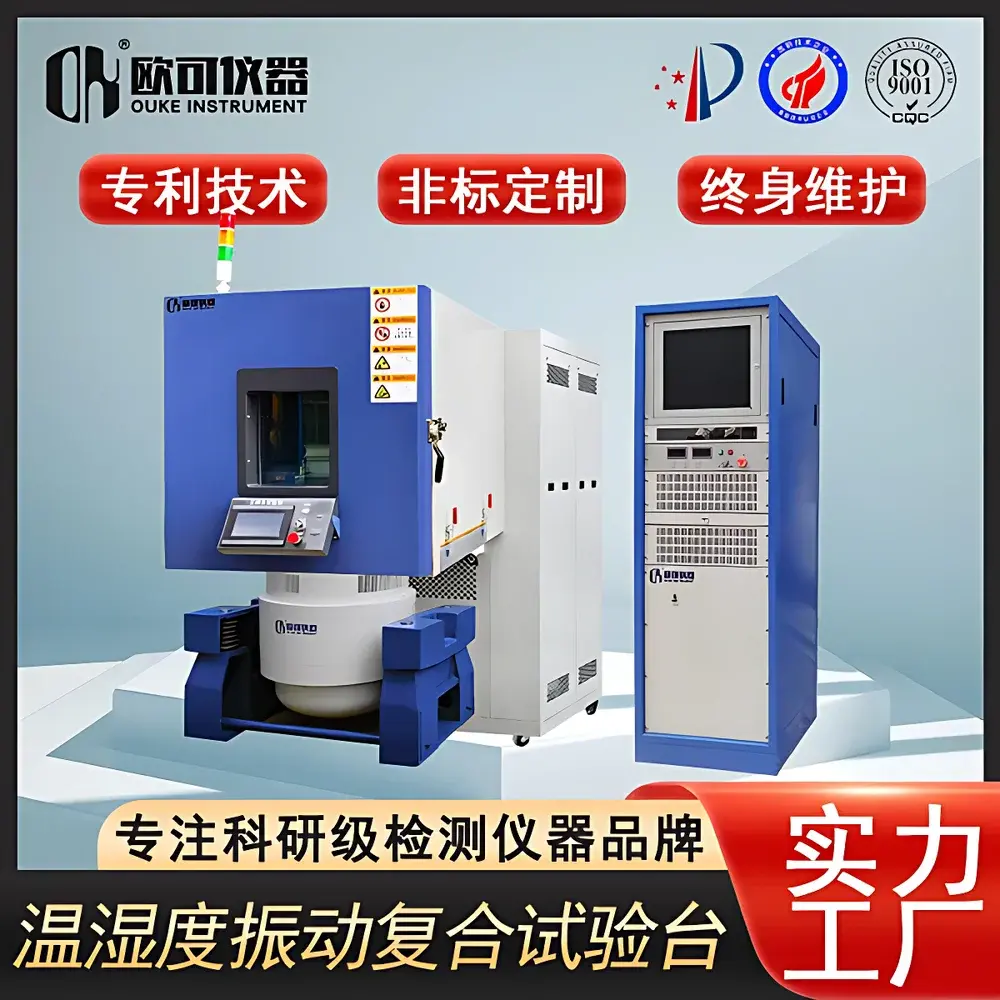
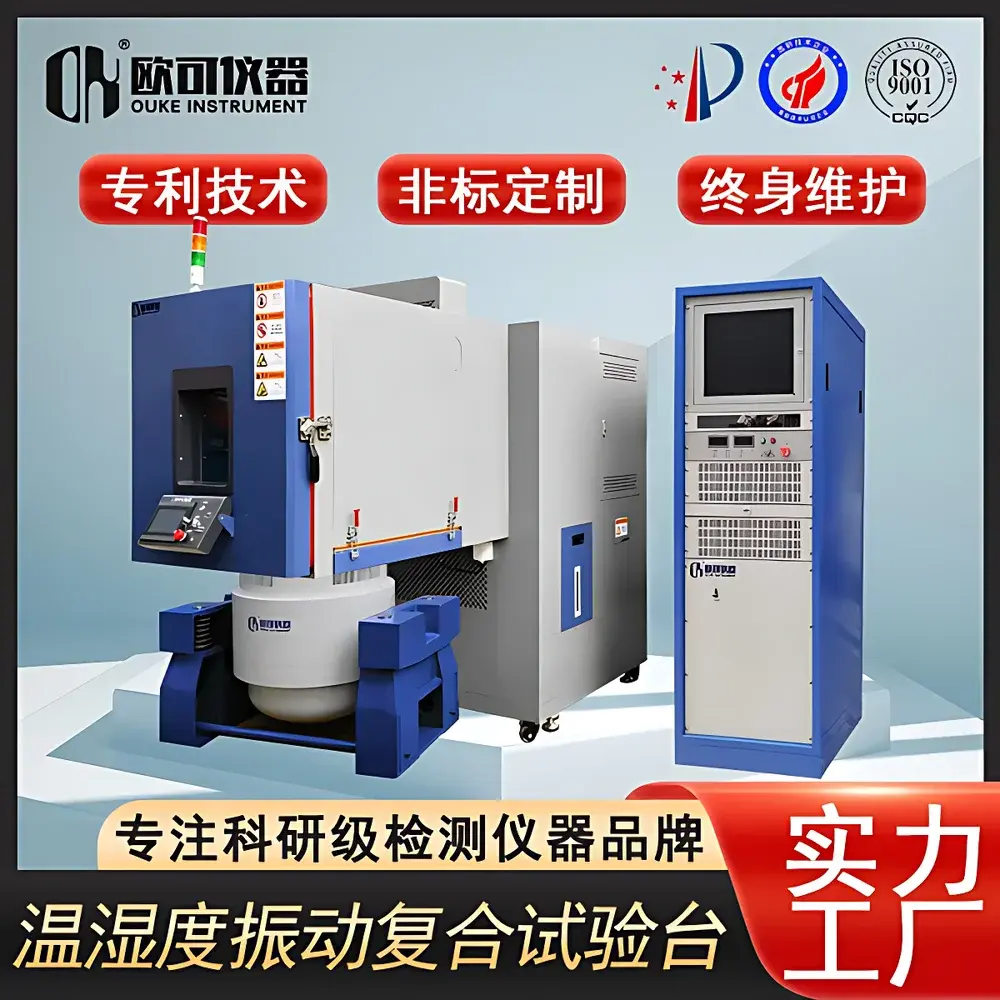
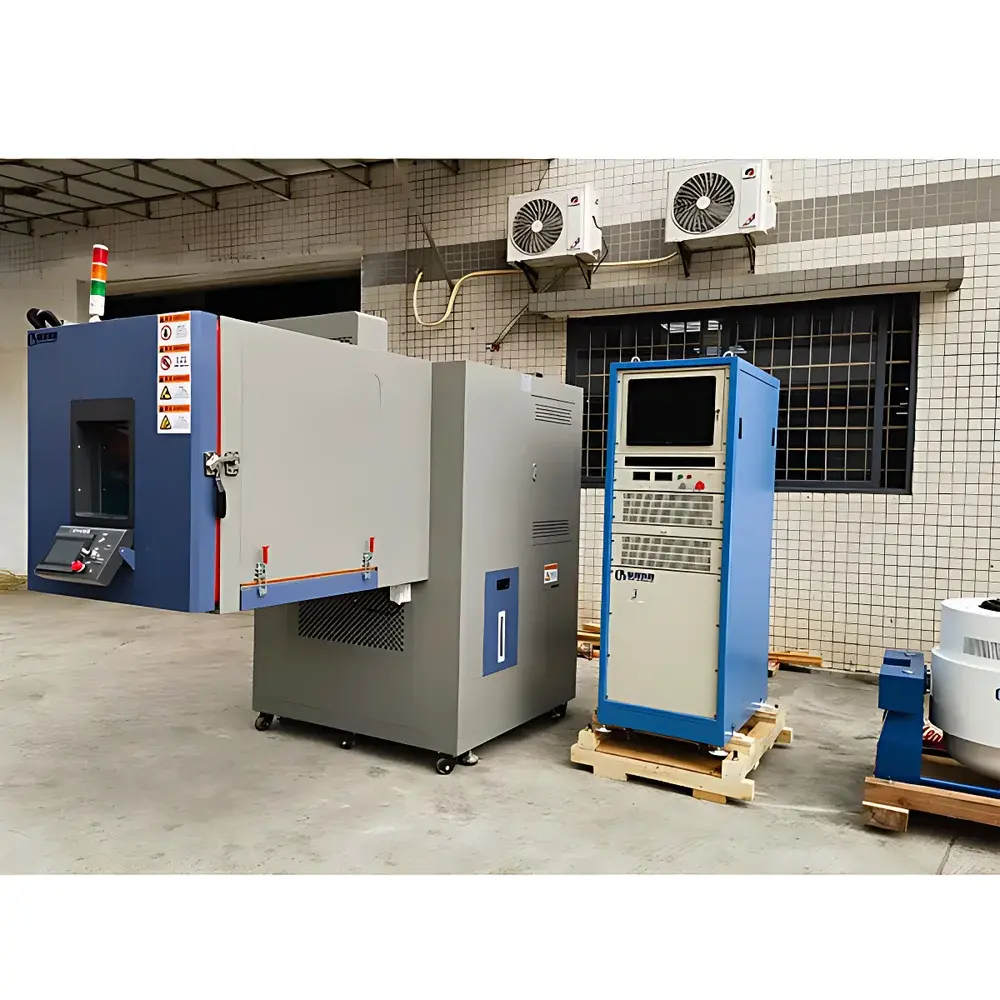
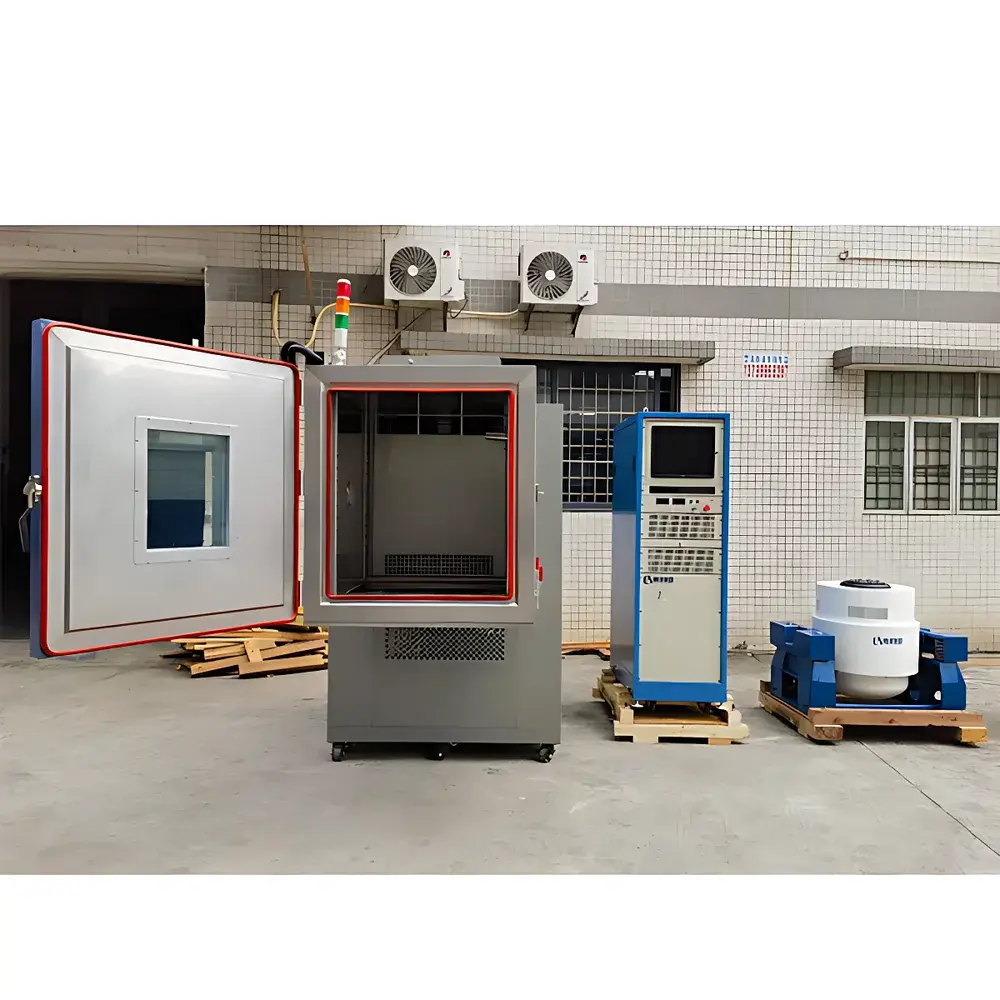
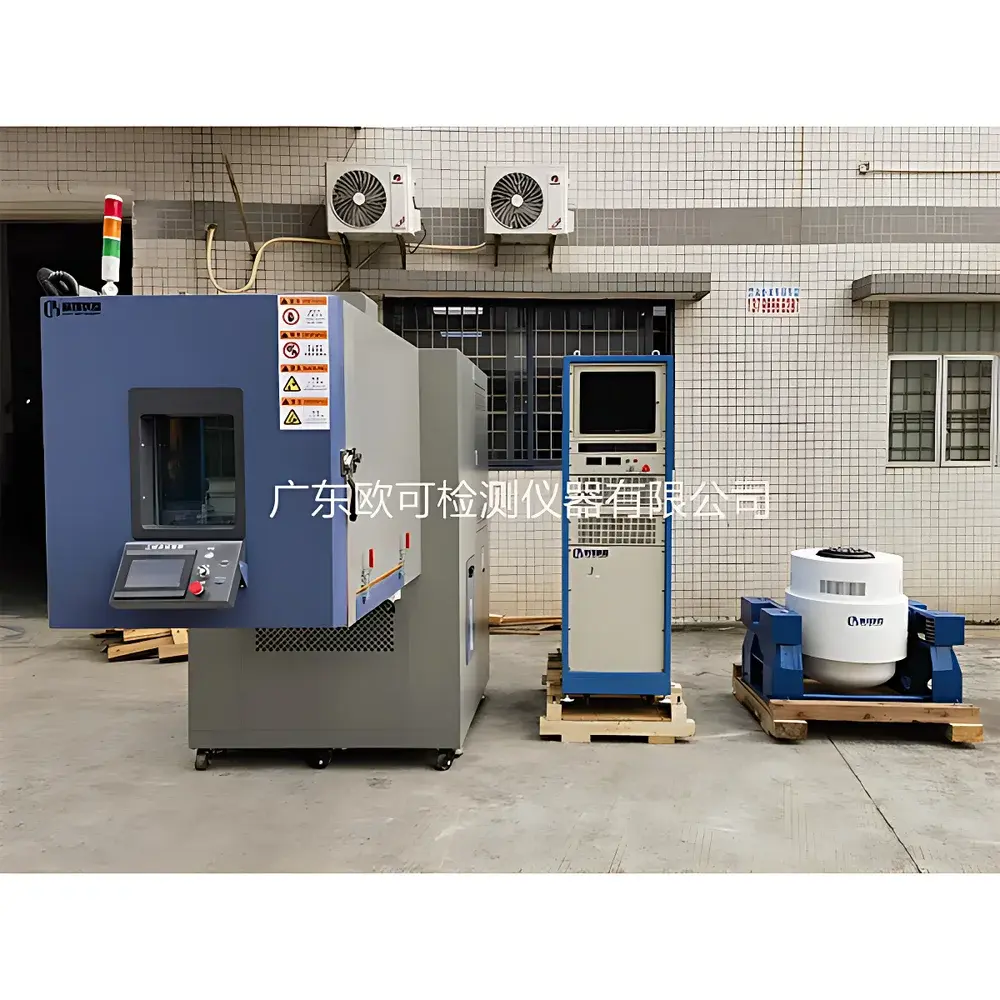
OK Instruments OK-ZTH-390 Combined Temperature-Humidity-Vibration Test System
| Brand | OK Instruments |
|---|---|
| Origin | Guangdong, China |
| Manufacturer Type | Direct Manufacturer |
| Country of Origin | China |
| Model | OK-ZTH-390 |
| Temperature Range | −70 °C to +150 °C |
| Humidity Range | 20–98 %RH at 20–85 °C |
| Temperature Ramp Rate | 5 / 10 / 15 °C/min |
| Temperature Uniformity | ≤ ±0.5 °C |
| Standard Load Capacity | 15 kg aluminum mass with 350 W internal heat dissipation |
Overview
The OK Instruments OK-ZTH-390 Combined Temperature-Humidity-Vibration Test System is an integrated environmental reliability platform engineered for concurrent application of thermal, hygric, and mechanical stresses. It operates on the principle of multi-stress acceleration—simultaneously subjecting test specimens to controlled temperature cycling, humidity modulation, and broadband vibration (typically vertical-axis, with optional triaxial configurations). This capability enables replication of real-world operational environments where synergistic stress interactions dominate failure mechanisms—such as solder joint fatigue under thermal cycling combined with resonant excitation, or condensation-induced corrosion exacerbated by dynamic loading. Unlike sequential or single-stress testing, the OK-ZTH-390 supports true coupled stress profiles, making it essential for qualification per MIL-STD-810 Method 527, RTCA DO-160G Section 25, IEC 60068-2-68, and ISO 16750-4. Its architecture integrates a high-fidelity climatic chamber with a high-force electrodynamic shaker via a hermetically sealed moving-coil feedthrough, preserving chamber integrity while enabling precise dynamic transmission.
Key Features
- Triple-stress synchronization engine: Real-time coordination of temperature/humidity setpoints and vibration control signals (sine, random, shock, or custom time-history waveforms) with sub-second timestamp alignment and programmable trigger logic (e.g., initiate random vibration upon reaching −40 °C).
- Climatic chamber: Constructed from SUS304 stainless steel interior; refrigeration system employs cascade mechanical compression with optional liquid nitrogen assist for rapid cooldown to −70 °C; humidity generation via steam injection with PID-controlled saturation chamber.
- Vibration subsystem: 390 kN peak force electrodynamic shaker with 25 mm peak-to-peak displacement capability and 1 Hz–2000 Hz frequency bandwidth; equipped with closed-loop accelerometer feedback and force-limited operation modes.
- Thermal performance: Achieves linear ramp rates of 5, 10, or 15 °C/min across full temperature range; temperature uniformity maintained within ±0.5 °C at any steady-state condition per IEC 60068-3-5.
- Mechanical integration: Reinforced base frame with active air-spring isolation; integrated shaker mounting interface compliant with ISO 10816-3 vibration severity thresholds for foundation stability.
- Safety architecture: Dual-redundant overtemperature/overhumidity cutoffs; emergency stop circuitry meeting EN 60204-1; interlocked access door with break-glass release and position sensing.
Sample Compatibility & Compliance
The OK-ZTH-390 accommodates standard test loads up to 15 kg (aluminum reference mass), with maximum internal power dissipation of 350 W. Its chamber volume and shaker stroke are optimized for electronics enclosures, automotive ECUs, avionics line-replaceable units (LRUs), and battery modules. The system complies with electromagnetic compatibility (EMC) requirements per CISPR 11 Group 2 Class A and meets structural safety standards under ISO 12100. Calibration traceability follows ISO/IEC 17025 via accredited third-party providers. For regulated industries, the system supports audit-ready documentation—including calibration certificates, validation protocols (IQ/OQ/PQ), and electronic log files compatible with FDA 21 CFR Part 11-compliant data management systems.
Software & Data Management
Control and monitoring are executed via OK-TestSuite™ v4.2—a Windows-based application featuring dual-domain scripting (Python API support) and synchronized waveform editing. Users define multi-segment test profiles combining thermal ramps, dwell periods, humidity transitions, and vibration spectra in a unified timeline. All sensor data—including chamber thermocouples, RH sensors, shaker armature acceleration, and load cell outputs—are acquired at ≥10 kHz sampling rate and logged with nanosecond timestamp resolution. Raw datasets export in IEEE CDF or HDF5 format for post-processing in MATLAB, Python (SciPy), or commercial FEA tools. Audit trails record operator actions, parameter changes, and alarm events with immutable digital signatures—fully supporting GLP/GMP and ISO 9001 quality system requirements.
Applications
- Aerospace: Qualification of flight-critical components (e.g., inertial measurement units, power converters) per DO-160G Sections 20, 21, and 25.
- Automotive: Validation of ADAS radar housings, traction inverters, and 48V battery management systems against ISO 16750-4 thermal-shock-vibration coupling.
- Defense electronics: Environmental screening of missile seeker assemblies and secure comms terminals per MIL-STD-810H Method 527.
- Renewable energy: Accelerated life testing of photovoltaic string inverters and grid-tied ESS controllers under cyclic humidity freeze-thaw and seismic vibration profiles.
- Medical devices: Verification of implantable pulse generator housings and diagnostic imaging subsystems per IEC 60601-1 Clause 11.2.3.
FAQ
What standards does the OK-ZTH-390 support out-of-the-box?
Preconfigured test templates are available for MIL-STD-810H Method 527, IEC 60068-2-68, RTCA DO-160G Section 25, and ISO 16750-4. Custom profile development is supported via OK-TestSuite™ scripting.
Can the system perform triaxial vibration while maintaining temperature and humidity control?
Yes—the optional OK-ZTH-390-TriAx configuration integrates three orthogonal electrodynamic shakers with independent motion controllers, fully synchronized with climatic parameters.
Is remote monitoring and control supported?
The system includes OPC UA server functionality and TLS-secured web interface for real-time status viewing, alarm notification, and limited parameter adjustment from external networks.
What maintenance intervals are recommended for long-term reliability?
Compressor oil and filter replacement every 2,000 operating hours; shaker armature inspection and coil resistance verification every 500 hours; annual full calibration and leak integrity check per ISO/IEC 17025 procedures.
Does OK Instruments provide installation and validation services?
Yes—factory acceptance testing (FAT), site acceptance testing (SAT), and IQ/OQ/PQ documentation packages are available as optional service add-ons, delivered by ISO 13485-certified field engineers.



