
Instytut Fotonowy Electrochemical Kelvin Probe System
| Brand | Instytut Fotonowy |
|---|---|
| Origin | Poland |
| Model | Electrochemical Kelvin Probe |
| Weight | 15 kg |
| Dimensions | 40 × 40 × 45 cm |
| Power Supply | 230 V, 50 Hz or 115 V, 60 Hz |
| PC Interface | USB 2.0 |
| Measurement Principle | Dual-channel lock-in amplifier-based vibrating capacitor method |
| Contact Potential Difference (CPD) Range | −5 to +5 V |
| CPD Resolution | 0.15 mV |
| Current Ranges | 300 nA / 30 nA / 3 nA / 300 pA |
| Probe Tip | Au mesh, 2.5 mm diameter |
| Vertical Positioning Resolution | 20 µm |
| Typical CPD Measurement Gap | 0.2–1 mm |
| XY Motorized Stage | 50 × 50 mm travel range |
| Faraday Cage | Standard airtight version with inert gas flow system |
| Electrochemical Cell | PTFE body, Kapton-insulated sample substrate, Ag/AgCl reference electrode option |
| Optical Access | Fused silica window, UV-enhanced mirror, liquid light guide for bottom illumination |
| Environmental Sensors | Integrated temperature and humidity monitoring |
| Laser Guidance System | Visible alignment laser with automatic gap-sensing barrier |
Overview
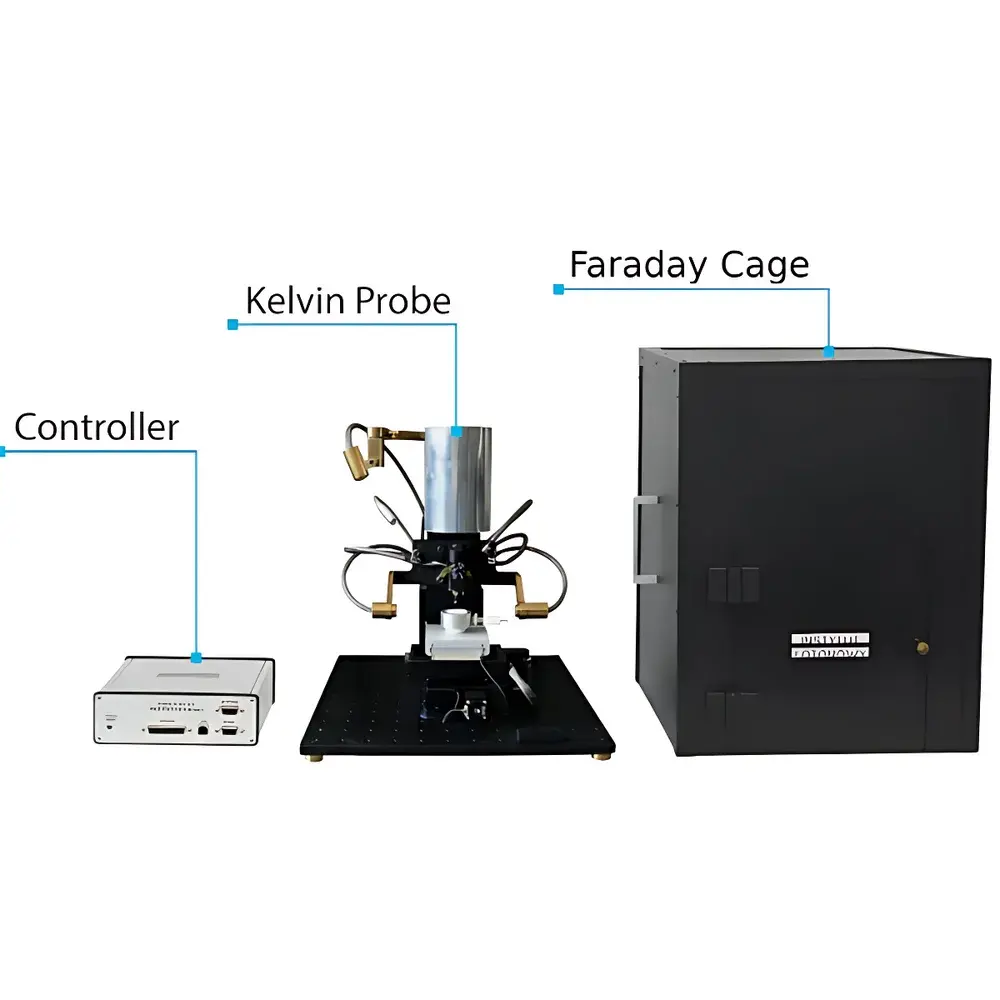
The Instytut Fotonowy Electrochemical Kelvin Probe System is a precision surface science instrument engineered for non-contact, high-resolution measurement of contact potential difference (CPD) at solid–liquid and solid–electrolyte interfaces under controlled electrochemical conditions. It operates on the vibrating capacitor principle—where a conductive probe tip oscillates at a fixed frequency above a sample surface, generating an AC signal proportional to the local work function difference between tip and sample. This signal is demodulated using a dual-channel lock-in amplifier to extract CPD with sub-millivolt resolution. Unlike conventional Kelvin probes limited to air or vacuum environments, this system integrates a fully compatible electrochemical cuvette module within a grounded, airtight Faraday cage, enabling real-time CPD mapping during potentiodynamic or chronoamperometric experiments. Designed for fundamental studies of interfacial energetics, corrosion onset, semiconductor/electrolyte band alignment, and photoelectrochemical charge transfer, it supports quantitative correlation between surface potential dynamics and electrochemical driving forces.
Key Features
- Integrated dual-channel lock-in amplifier architecture optimized for low-noise CPD detection in electrically noisy electrochemical environments
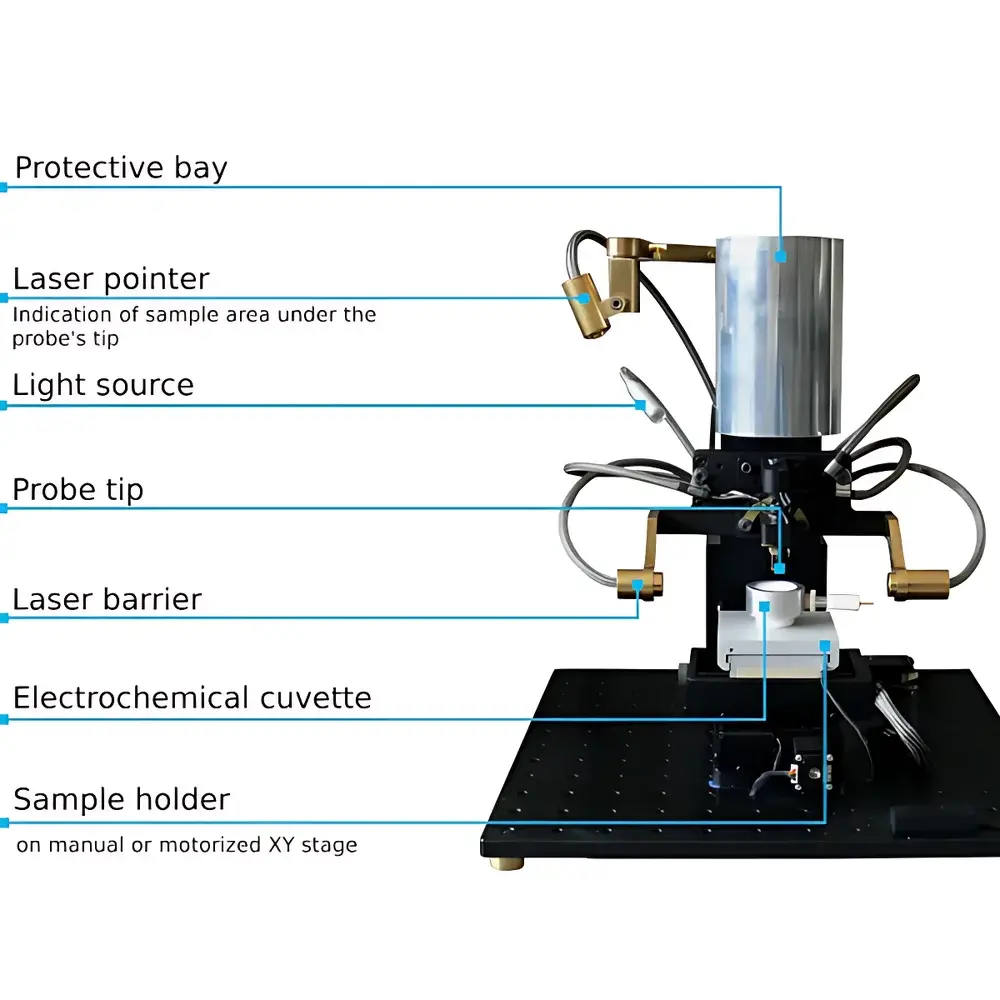
- Gold-mesh vibrating probe tip (2.5 mm diameter) with 20 µm vertical positioning resolution and automated resonance frequency scanning
- Motorized XY stage (50 × 50 mm travel) enabling programmable raster scanning and spatially resolved CPD mapping
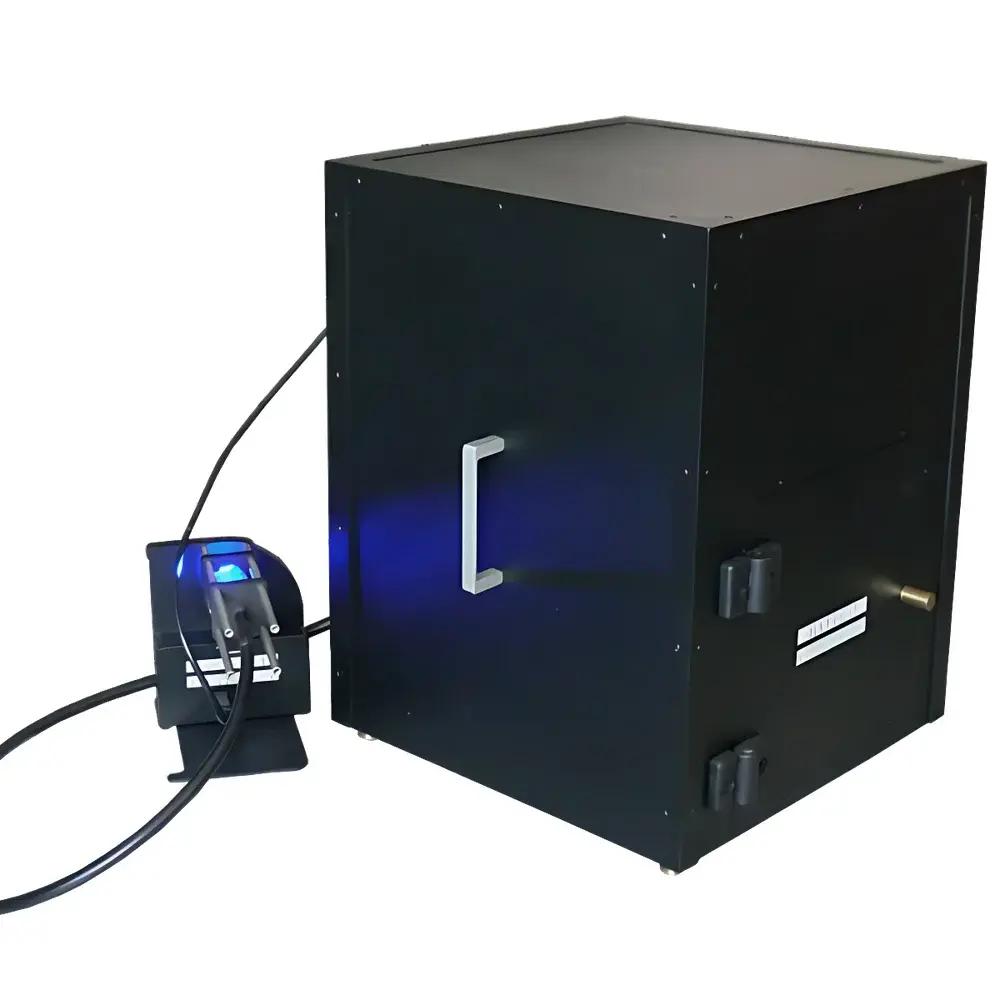
- Airtight Faraday cage with inert gas inlet/outlet ports and integrated humidity/temperature sensors for ambient-controlled measurements
- Laser-guided gap control system: visible alignment laser with proximity-sensing barrier that halts tip descent upon reaching user-defined minimum distance (0.2–1 mm typical)
- Modular electrochemical cuvette assembly featuring PTFE construction, Kapton-insulated sample substrates with top/bottom electrical contacts, and optional Ag/AgCl reference electrode integration
- Optical compatibility: fused silica viewport, UV-enhanced mirror, and liquid light guide support in situ optical characterization (e.g., concurrent CPD and photocurrent monitoring)
- Automatic parasitic current compensation and amplitude-adjustable tip oscillation for stable operation across varying electrolyte conductivities
Sample Compatibility & Compliance
The system accommodates solid-state samples of arbitrary geometry—including thin films, single crystals, patterned electrodes, and photoactive semiconductors—mounted on customizable holders with top- or bottom-contact configurations. The electrochemical cuvette supports aqueous and non-aqueous electrolytes, with PTFE containment ensuring chemical inertness and minimal background interference. All electrical connections comply with IEC 61000-4-3 (EMC immunity) and IEC 61010-1 (safety requirements for laboratory equipment). The Faraday cage meets ISO/IEC 17025-recommended shielding standards for trace-level potential measurements. While not pre-certified for GMP or FDA 21 CFR Part 11, the system’s audit-ready data logging architecture—including timestamped raw lock-in outputs, environmental metadata, and operator ID tagging—supports GLP-compliant workflows when deployed with validated software protocols.
Software & Data Management
Control and acquisition are managed via Windows-based application supporting scripting (Python API), real-time visualization, and multi-parameter synchronization. Each measurement session records CPD, tip–sample distance, applied bias, current response, temperature, humidity, and stage coordinates in HDF5 format—ensuring FAIR (Findable, Accessible, Interoperable, Reusable) data principles. Export options include CSV, MATLAB .mat, and Origin-compatible files. The software includes built-in routines for CPD drift correction, local work function calibration against reference metals (Au, Pt, Ni), and overlay of electrochemical transients (e.g., cyclic voltammetry) with spatial CPD profiles. Data integrity is preserved through checksum validation and optional encrypted storage.
Applications
- Quantitative mapping of surface photovoltage (SPV) and band bending at semiconductor–electrolyte junctions in photoelectrochemical cells
- In situ monitoring of passive film formation and localized corrosion initiation on stainless steel or aluminum alloys
- Work function evolution during electrochemical doping of organic semiconductors and 2D materials (e.g., MoS₂, graphene)
- Interfacial dipole analysis at self-assembled monolayer (SAM)-modified electrodes
- Correlation of CPD hysteresis with redox state changes in battery electrode materials (e.g., LiCoO₂, Si anodes)
- Fundamental studies of electron transfer kinetics at bioelectrode interfaces (e.g., enzyme-modified electrodes)
FAQ
What electrochemical techniques can be synchronized with CPD measurement?
Potentiostatic control (open-circuit potential, OCP), cyclic voltammetry (CV), chronoamperometry (CA), and linear sweep voltammetry (LSV) are fully supported via analog/digital I/O integration with standard potentiostats.
Is the system compatible with ultra-high vacuum (UHV) environments?
No—the Faraday cage and electrochemical cuvette are designed for ambient-pressure, inert-atmosphere operation; UHV adaptation would require custom vacuum flange integration and is not part of the standard configuration.
Can the gold probe tip be replaced with other materials?
Yes—custom probe tips (e.g., Pt, Ni, carbon fiber) can be mounted using the standardized mechanical interface, though calibration against reference work functions must be re-established.
What is the minimum measurable CPD change under typical electrochemical conditions?
With averaging over 1 s integration time and optimal signal-to-noise ratio, the system resolves CPD fluctuations down to ±0.2 mV in buffered aqueous electrolytes.
Does the software support automated batch scanning across multiple samples?
Yes—scriptable stage control allows unattended sequential measurement of up to 99 predefined positions, with auto-focus and gap calibration executed prior to each scan.



