
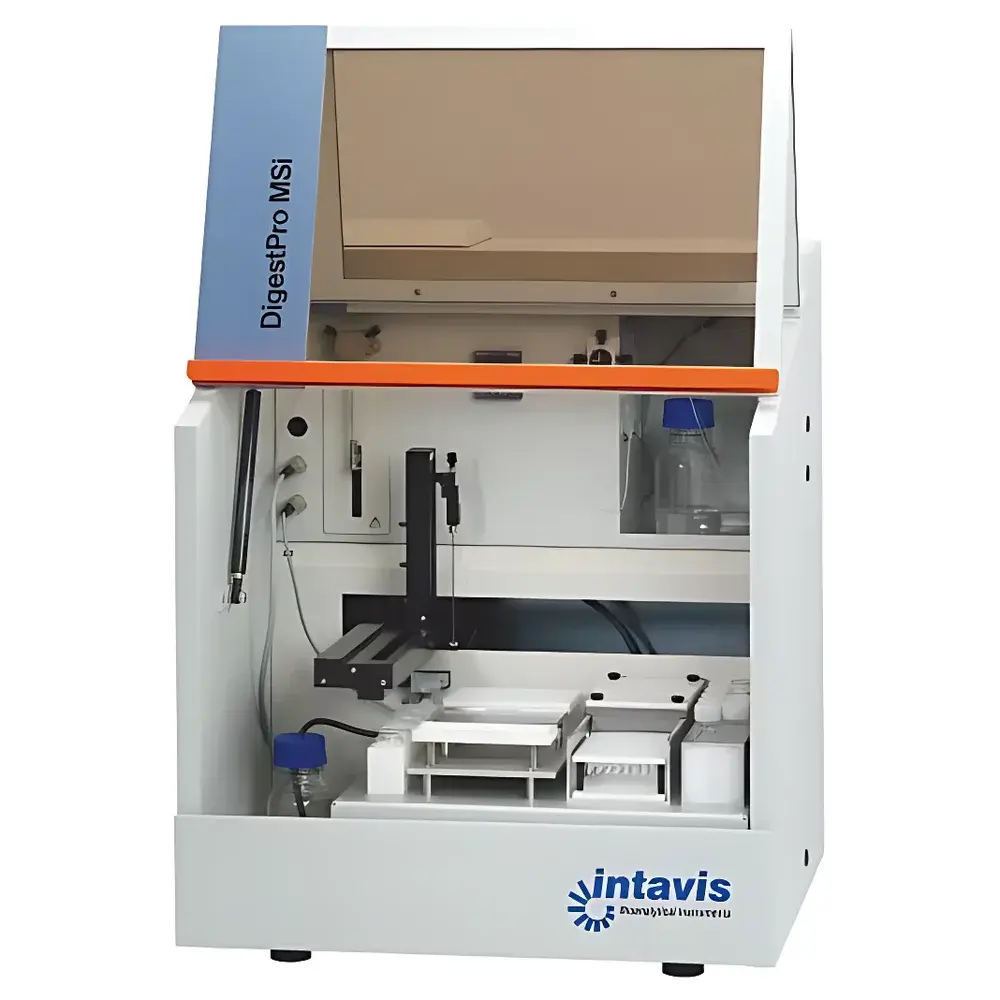
INTAVIS DigestPro MSi Automated Protein Digestion and MALDI Sample Preparation System
| Brand | Intavis |
|---|---|
| Origin | Germany |
| Manufacturer Type | Authorized Distributor |
| Product Category | Imported Instrument |
| Model | INTAVIS DigestPro MSi |
| Pricing | Available Upon Request |
Overview
The INTAVIS DigestPro MSi is an integrated, benchtop automated platform engineered for reproducible, high-throughput protein digestion and MALDI-TOF mass spectrometry sample preparation. It operates on a positive-pressure liquid handling principle—eliminating physical contact between dispensing needles and gel bands or solution-phase samples—to ensure zero cross-contamination and maximal sample integrity. Designed specifically for proteomics workflows, the system executes enzymatic cleavage (e.g., trypsin, Lys-C, Asp-N) under precisely controlled thermal conditions (up to 80 °C), followed by downstream processing including desalting, concentration, affinity enrichment, and direct spotting onto commercial MALDI targets. Its architecture supports both in-gel and in-solution digestion protocols, making it compatible with Coomassie- or silver-stained SDS-PAGE gels (1–30 mm³ volume), low-abundance protein solutions (down to low-fmol levels, dependent on downstream MS sensitivity), and chemically modified peptides (e.g., isotopically labeled, phosphorylated, or affinity-tagged species).
Key Features
- 96-well parallel processing capacity with independent thermal control per reaction zone
- Non-contact, positive-pressure fluid delivery system—no needle-to-gel contact, eliminating mechanical loss or carryover
- Valve-free microfluidic design ensuring intrinsic contamination resistance and long-term reliability
- Integrated temperature-controlled incubation (ambient to 80 °C) with real-time monitoring and programmable ramping profiles
- Flexible reagent management: 23 onboard reagent positions, including 4 refrigerated slots (4–10 °C) for enzyme and volatile reagent stability
- Precision liquid handling: 5–100 µL for digestion steps; 0.5–150 µL for MALDI spotting, desalting, and enrichment workflows
- Native compatibility with ZipTip® pipette tips for solid-phase assisted digestion (SPAD), C18-based desalting, and TiO₂-mediated phosphopeptide enrichment
- Automated sandwich spotting, direct transfer, and affinity capture protocols optimized for α-cyano-4-hydroxycinnamic acid (CHCA) and sinapinic acid (SA) matrices
Sample Compatibility & Compliance
The DigestPro MSi accommodates diverse biological sample formats—including excised polyacrylamide gel bands, denatured/reduced protein solutions, immunoprecipitated complexes, and affinity-purified fractions—without requiring manual intervention between digestion and MALDI target loading. Its closed-system architecture meets core requirements for GLP-compliant proteomics labs, supporting full audit trails, user-access controls (administrator/operator/guest roles), and method versioning. While not certified as FDA 21 CFR Part 11–compliant out-of-the-box, the system’s software logs all parameter changes, run timestamps, operator IDs, and instrument status events—enabling laboratories to implement supplementary validation documentation per ISO/IEC 17025 or CAP accreditation frameworks. All consumables—including standard 96-well PCR plates, MALDI target plates (e.g., Bruker AnchorChip®, Opti-TOF™), and commercially available ZipTips®—are fully supported without proprietary lock-in.
Software & Data Management
Controlled via a Windows®-based graphical interface, the DigestPro MSi software provides intuitive drag-and-drop protocol building, real-time visualization of liquid handling progress, and live temperature/pressure feedback. Pre-validated method templates are included for common workflows: in-gel tryptic digestion, SPAD with ZipTip® C18, TiO₂ phosphopeptide enrichment, and MALDI matrix co-spotting. Every run generates a timestamped log file containing environmental parameters, reagent lot tracking (user-entered), step-by-step execution records, and error flags. All data files are stored in open-format CSV and XML structures, facilitating integration with LIMS environments and third-party data analysis pipelines (e.g., MaxQuant, Proteome Discoverer). Software updates are delivered via secure HTTPS download and require digital signature verification.
Applications
- High-reproducibility bottom-up proteomics sample prep for discovery and targeted MS workflows
- Phosphoproteome analysis via automated TiO₂ enrichment coupled with on-tip digestion
- Post-translational modification (PTM) mapping using isotopic labeling (SILAC, TMT) and affinity capture prior to MALDI spotting
- Low-input clinical proteomics—processing limited biopsy material or CSF-derived proteins with minimal handling loss
- Quality control of recombinant biopharmaceuticals through peptide mapping consistency assessment
- Method development for novel proteases, chemical cleavage agents, or immobilized enzyme reactors
FAQ
What sample types can be processed on the DigestPro MSi?
Gel-excised protein bands (1–30 mm³), solution-phase proteins (including low-concentration or high-salt lysates), immunoprecipitates, and affinity-enriched fractions.
Is the system compatible with non-Intavis consumables?
Yes—it accepts standard 96-well plates, commercial MALDI targets, and third-party pipette tips (e.g., ZipTip® C18, TiO₂, IMAC), with no hardware or firmware restrictions.
Can digestion and MALDI preparation be run sequentially in one workflow?
Yes—the platform executes end-to-end protocols from initial digestion through desalting, enrichment, and matrix-assisted spotting without manual transfer.
How is data integrity ensured during unattended operation?
All runs generate immutable logs with operator ID, timestamp, parameter set, and hardware status; optional external NAS or network drive backup is supported.
What maintenance is required for long-term reliability?
Routine cleaning of the fluidics path and sealing surfaces every 200 runs; annual calibration of temperature modules and liquid volume verification using gravimetric assay per ISO 8655.



