
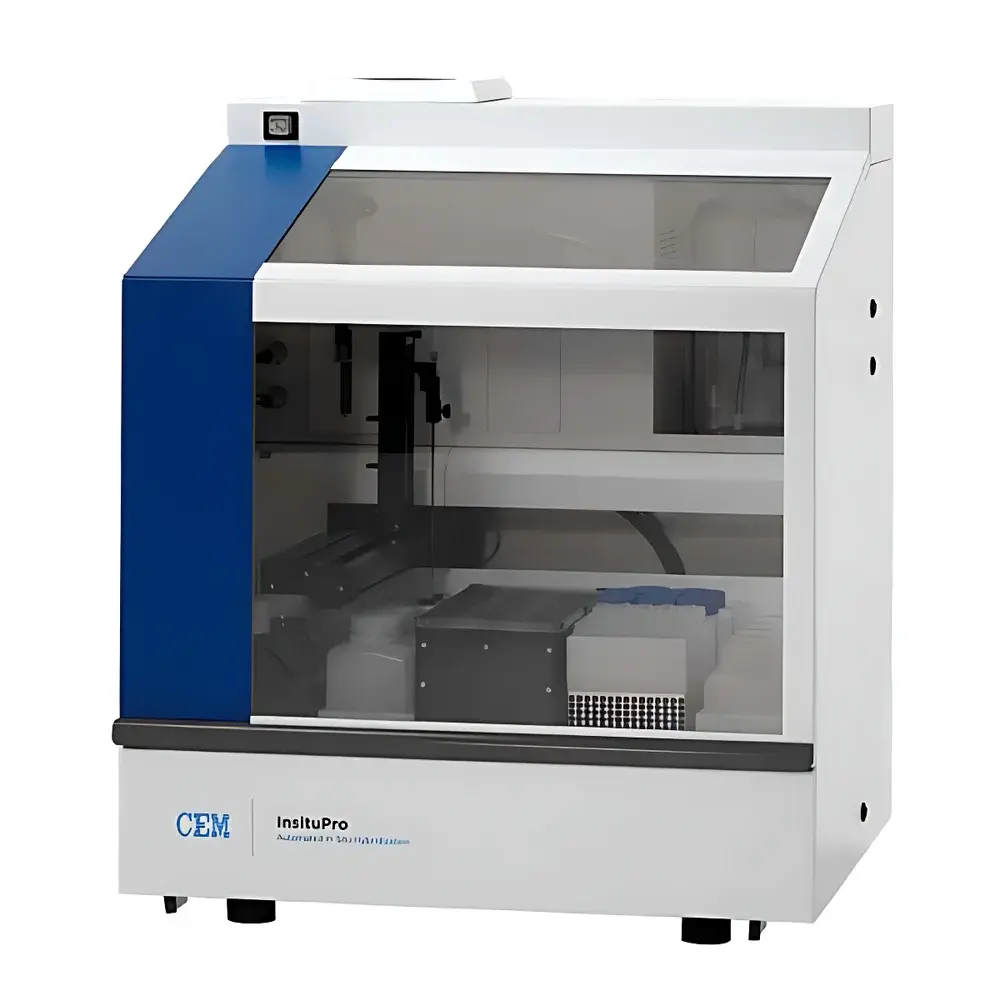
Intavis InsituPro Vsi Automated In Situ Hybridization and Immunohistochemistry System
| Brand | CEM |
|---|---|
| Origin | USA |
| Manufacturer Status | Authorized Distributor |
| Origin Category | Imported |
| Model | InsituPro Vsi |
| Instrument Type | In Situ Hybridization System |
| Temperature Range | 6–75 °C (Basket Mode), 10–70 °C (Slide Mode) |
| Buffer Volumes | 2×1000 mL, 3×50 mL, 6×125 mL, 7×50 mL |
Overview
The Intavis InsituPro Vsi is an automated platform engineered for high-precision, reproducible in situ hybridization (ISH) and immunohistochemistry (IHC) workflows on whole-mount specimens, cryosections, paraffin sections, and tissue arrays. Developed by Intavis — a subsidiary of CEM Corporation — and refined since its global launch in 2007, the system implements a closed-loop fluidic architecture grounded in programmable peristaltic and valve-driven liquid handling. It executes sequential steps including rehydration, protease K digestion, post-fixation, pre-hybridization, probe/antibody hybridization or incubation, stringency washes, blocking, signal amplification, and final detection—all under tightly controlled thermal and temporal parameters. Designed for developmental biology, neuroanatomy, and comparative genomics labs, the InsituPro Vsi supports rigorous spatial transcriptomics and protein localization studies across model organisms including Danio rerio, Mus musculus, Drosophila melanogaster, Xenopus laevis, Gallus gallus, and arachnid species.
Key Features
- Modular sample handling with interchangeable carriers: basket mode (for whole-mounts and vibratome sections), slide mode (standard 75 × 25 × 1 mm or 76 × 26 × 1 mm glass slides), and large-specimen mode (up to 32 samples per run)
- Independent thermal control of up to 18 buffer positions and 60 probe/antibody wells, with real-time software-regulated heating/cooling zones (2 × 250 mL heated, 2 × 50 mL cooled)
- Integrated heated lid technology minimizing condensation on cover slips and enhancing probe/antibody recovery efficiency
- Step motor-driven precision mechanics ensuring long-term operational stability and reduced mechanical drift over thousands of cycles
- Configurable incubation temperature range: 6–75 °C (basket), 10–70 °C (slide), with ramp rates optimized for gentle tissue preservation
- Automated buffer volume management—supports dual 1000 mL reservoirs for PBST/TBST-intensive protocols and flexible small-volume dispensing (50 mL tubes or 125 mL bottles, with 50 mL centrifuge tube compatibility)
Sample Compatibility & Compliance
The InsituPro Vsi accommodates specimens ranging from 0.05 mm (early embryonic zebrafish) to 12 mm (adult mouse brain hemispheres), with dedicated carrier kits for small (5 mm basket), medium (9 mm basket), and large (13 mm basket) specimens. Slide-based workflows comply with ANSI/ISO 8601 labeling conventions and standard histopathology slide dimensions. The system meets laboratory requirements for GLP-compliant documentation when paired with audit-trail-enabled software configurations; optional integration with LIMS supports 21 CFR Part 11–aligned electronic signatures and version-controlled protocol archiving. All fluidic pathways are chemically resistant to common ISH/IHC reagents—including formamide, SSC, DAB, and HRP-conjugated antibodies—ensuring cross-contamination avoidance and protocol fidelity across multi-user environments.
Software & Data Management
The InsituPro Control Suite provides a graphical, drag-and-drop interface for constructing stepwise protocols with granular control over incubation duration, agitation frequency, temperature setpoints, wash volumes, and reagent delivery sequences. Each step logs timestamped metadata—including actual temperature profiles, fluid dispense accuracy verification, and error flags—exportable as CSV or XML for traceability. Protocol libraries can be shared across instruments via encrypted USB or network drive, enabling inter-lab method harmonization. Software supports dynamic calculation of reagent consumption per run, automatic low-volume alerts, and calibration history tracking aligned with ISO/IEC 17025 quality assurance frameworks.
Applications
- Spatial gene expression mapping in vertebrate and invertebrate embryos using DIG- or fluorescein-labeled RNA probes
- Double-label ISH/IHC co-detection of mRNA and protein targets in neural circuits and organogenesis models
- High-throughput screening of antisense oligonucleotide efficacy in zebrafish phenotypic assays
- Standardized IHC validation of antibody specificity across tissue microarrays (TMAs)
- Optimized hybridization kinetics studies requiring precise temperature ramping and dwell time modulation
- Reproducible protocol transfer between core facilities and satellite labs via validated, version-controlled method files
FAQ
Can the InsituPro Vsi process both whole-mount and sectioned tissues in the same run?
No—sample carriers must be homogenous per run (e.g., all baskets or all slides) to ensure uniform thermal and fluidic exposure. However, protocols can be saved and rapidly reloaded for different carrier types.
Is the system compatible with fluorescent in situ hybridization (FISH) protocols requiring stringent light protection?
Yes—the instrument enclosure includes optional opaque shielding modules, and all fluidic lines and incubation chambers are designed to minimize ambient light exposure during probe hybridization steps.
What maintenance is required for long-term fluidic integrity?
Daily priming and weekly cleaning cycles are recommended using manufacturer-specified detergent solutions; tubing sets are field-replaceable with documented lifetime specifications exceeding 5,000 runs.
Does the software support integration with third-party image analysis platforms?
Yes—raw metadata exports (CSV/XML) include coordinate-mapped step logs and thermal profiles, enabling direct ingestion into MATLAB, Python-based analysis pipelines, or commercial digital pathology suites.
Are consumables such as baskets and slide racks supplied sterile?
Sterile, RNase/DNase-free disposable baskets and reusable anodized aluminum slide racks are available; autoclavable metal components meet ISO 13485 biocompatibility standards.





