
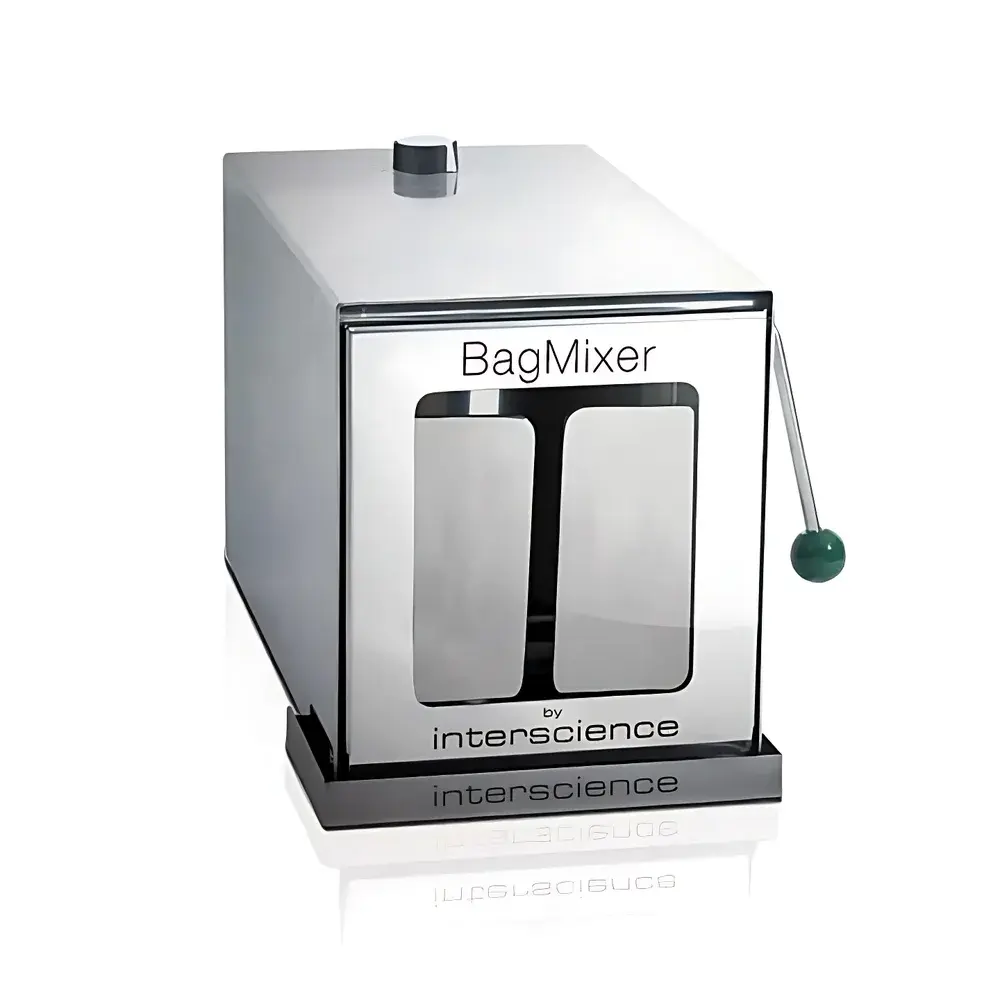
Interscience BagMixer® 400W Laboratory Stomacher Homogenizer
| Brand | Interscience |
|---|---|
| Origin | France |
| Model | BagMixer® 400W |
| Power Supply | 110–220 V, 50–60 Hz |
| Dimensions (W × D × H) | 26 × 39 × 29 cm |
| Weight | 16.5 kg |
| Sample Capacity | 50–400 mL |
| Homogenization Time Settings | 30, 60, 90, 120, 150, 180, 210 s, ∞ |
| Fixed Speed | 8 strokes/sec |
| Noise Level | ≤48 dB(A) |
| Enclosure Material | 304L stainless steel body with polycarbonate viewing window |
| Door Opening Angle | 270° |
| Door Weight | 950 g |
Overview
The Interscience BagMixer® 400W is a precision-engineered laboratory stomacher homogenizer designed for rapid, reproducible, and contamination-free sample preparation in microbiological and food safety testing workflows. Operating on the principle of controlled paddle-beating motion within sterile, single-use filter bags, it delivers consistent mechanical lysis of biological matrices—including solid foods, environmental swabs, clinical specimens, and agricultural samples—without blade contact or internal chamber residue. Unlike rotor-stator or probe-based homogenizers, the BagMixer® 400W eliminates cross-contamination risk by isolating each sample within its own sealed bag, making it compliant with ISO 6887-1, ISO 11290-1, and FDA Bacteriological Analytical Manual (BAM) Chapter 3 requirements for enumeration and enrichment protocols. Its fixed-speed (8 strokes/sec), high-inertia paddle system ensures uniform energy transfer across variable viscosities and particulate loads, enabling reliable recovery of viable microorganisms—including stressed, injured, or biofilm-associated cells—critical for accurate CFU quantification.
Key Features
- Q-tight® sealing system ensures leak-proof containment during homogenization, validated for use with Interscience’s certified sterile filter bags (e.g., FilterBag® series) meeting ASTM D638 and ISO 527 tensile strength specifications.
- 270° wide-opening front door with ergonomic 950 g counterbalance enables unobstructed access to the homogenization chamber—facilitating rapid bag insertion, visual inspection, and residue-free cleaning.
- Full 304L stainless steel chassis provides corrosion resistance, structural rigidity, and compatibility with alcohol-based disinfectants and routine lab decontamination protocols.
- Integrated Lightcode™ LED indicator illuminates the work surface upon cycle completion—providing clear visual feedback without requiring proximity or auditory confirmation, essential in high-throughput or noise-sensitive environments.
- Acoustically optimized damping architecture reduces operational noise to ≤48 dB(A), significantly below industry benchmarks (typically ≥54 dB), supporting GLP-compliant laboratories where ambient noise control is mandated per ISO/IEC 17025 Clause 5.3.2.
- Removable stainless steel paddle and polycarbonate drip tray feature radius-rounded edges and smooth surfaces—minimizing microbial adhesion and enabling efficient wipe-down with ethanol or quaternary ammonium solutions between runs.
Sample Compatibility & Compliance
The BagMixer® 400W accommodates standard 400 mL filter bags (including Interscience’s ISO-certified FilterBag® and FilterBag® Plus variants), as well as 50–200 mL mini-bags for low-volume applications such as environmental swab eluates or small tissue biopsies. It supports homogenization of heterogeneous solids (e.g., ground meat, leafy greens, cheese), semi-solids (e.g., yogurt, sauces), and liquid suspensions (e.g., water concentrates, rinse fluids). All components comply with EU Regulation (EC) No 1935/2004 for food contact materials and are RoHS 3 and REACH-conformant. The device meets IEC 61010-1:2010 safety standards for laboratory equipment and carries CE marking under the Low Voltage Directive (2014/35/EU) and EMC Directive (2014/30/EU).
Software & Data Management
As a standalone electromechanical instrument, the BagMixer® 400W operates without embedded firmware or digital connectivity—ensuring deterministic timing, zero software validation burden, and full auditability under FDA 21 CFR Part 11 Annex 11 and EU GMP Annex 11 requirements. Time settings (30–210 s + continuous mode) are selected via tactile rotary dial with mechanical detents, eliminating drift or calibration dependency. Cycle logs are maintained manually in lab notebooks or integrated into LIMS via external barcode-scanned run records linked to batch IDs, sample IDs, and operator initials—supporting traceability in ISO/IEC 17025-accredited microbiology labs.
Applications
- Routine enumeration of aerobic plate count (APC), Enterobacteriaceae, Listeria monocytogenes, Salmonella spp., and E. coli in food, feed, and environmental monitoring programs.
- Preparation of homogenates for ISO 11133-compliant culture media performance testing and reference strain viability assessment.
- Processing of clinical specimens (e.g., stool, wound swabs) prior to PCR, MALDI-TOF MS, or automated plating systems.
- Standardized extraction of microplastics from wastewater sludge or sediment matrices per ASTM D8337-22 guidance.
- Homogenization of plant tissues for DNA/RNA isolation workflows where mechanical shearing must be minimized to preserve nucleic acid integrity.
FAQ
Is the BagMixer® 400W suitable for use in biosafety level 2 (BSL-2) laboratories?
Yes—the Q-tight® seal and closed-bag operation prevent aerosol generation, and the stainless steel housing allows surface decontamination with approved disinfectants per CDC/NIH BMBL 6th edition guidelines.
Can I use non-Interscience bags with this unit?
While mechanically compatible with many 400 mL stomacher bags, only Interscience-certified FilterBag® products guarantee validated seal integrity, consistent wall thickness, and compliance with ISO 6887-1 Annex A leakage testing.
What maintenance is required beyond routine cleaning?
No scheduled calibration or lubrication is needed; dampers are warrantied for 3 years post-registration, and the main unit carries lifetime coverage against manufacturing defects.
Does the device support programmable multi-step protocols?
No—it features fixed speed and discrete time presets only, prioritizing simplicity, reliability, and regulatory transparency over software complexity.
How does the 48 dB(A) noise rating compare to typical lab acoustic environments?
It falls within the “quiet office” range (per ISO 3744), allowing uninterrupted voice communication at 1 m distance and reducing cumulative noise exposure in shared analytical suites per OSHA 29 CFR 1910.95.



