
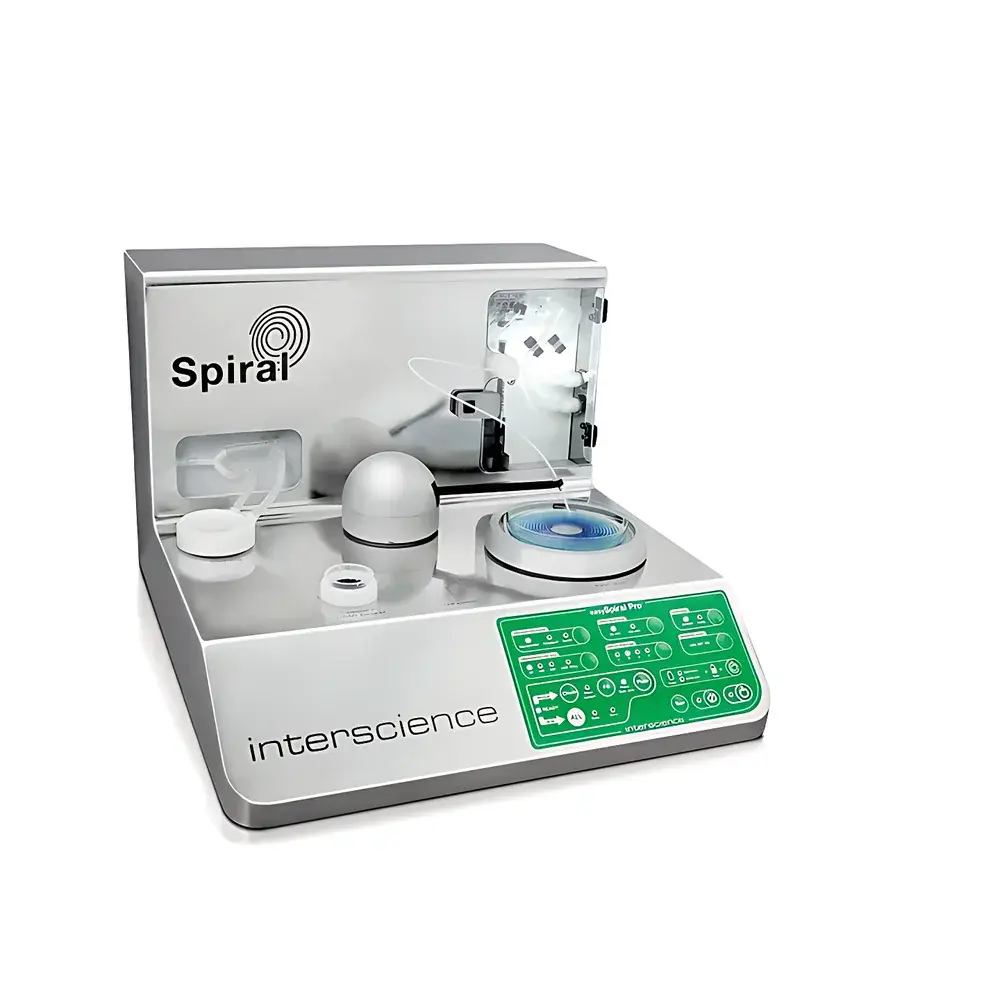
Interscience easySpiral® Automated Spiral Plater
| Brand | Interscience |
|---|---|
| Origin | France |
| Model | easySpiral® |
| Dispensing Volume | 1000 µL |
| Preset Volumes | 50 µL or 100 µL |
| Counting Range | 300–1.3 × 10⁵ CFU/mL |
| Cycle Time | 25 s |
| Overflow Pressure | 8 bar |
| Disinfectant Capacity (Standard Mode) | 600 cycles per 2 L bottle |
| Same-Sample Continuous Plating | up to 20 Petri Dishes (50 µL each) |
| Auto-Disinfection Protocol | Yes |
| Compatible Dish Diameter | 90 mm |
| Inoculation Pattern | Exponential Spiral & Circular Spiral |
| Dimensions | 38 × 42 × 29 cm |
| Weight | 15.6 kg |
| Power Supply | 100–240 V, 50/60 Hz |
| Compliance | AFNOR V08-100, ISO 7218 |
Overview
The Interscience easySpiral® Automated Spiral Plater is an engineered solution for standardized, high-throughput microbial enumeration in compliance with internationally recognized microbiological testing protocols. Based on the principle of controlled spiral plating—where a calibrated loop deposits decreasing volumes of sample across a rotating agar surface—the instrument enables precise, reproducible colony formation without manual intervention. Unlike manual or semi-automated systems, the easySpiral® integrates sample aspiration, tip rinsing, disinfection, and spiral deposition into a single 25-second cycle, minimizing operator variability and eliminating subjective interpretation of dilution factors. Its design adheres strictly to the performance criteria defined in AFNOR V08-100 and ISO 7218 for quantitative microbiological analysis, ensuring data integrity across food safety, pharmaceutical, clinical, and environmental laboratories.
Key Features
- Patented electro-mechanical rotating arm system enabling rapid, repeatable motion control with sub-millimeter positioning accuracy
- Integrated overflow-based disinfection technology operating at 8 bar pressure—ensuring complete decontamination of the dispensing tip between samples without mechanical scrubbing or disposable nozzles
- Two preset dispensing volumes (50 µL and 100 µL) optimized for standard plate count methodologies, with total dispense capacity up to 1000 µL per cycle
- Full automation of cleaning, sampling, and plating—no manual pipetting, loop flaming, or calibration adjustments required
- Support for exponential and circular spiral patterns on standard 90 mm Petri dishes, compatible with both traditional and chromogenic agars
- Low consumables footprint: one 2 L disinfectant bottle supports up to 600 full cycles, reducing plastic waste and operational cost by approximately 67% versus conventional systems requiring disposable tips or cartridges
- Compact benchtop footprint (38 × 42 × 29 cm) and lightweight construction (15.6 kg) designed for integration into ISO Class 5 or ISO Class 7 laminar flow hoods or biosafety cabinets
Sample Compatibility & Compliance
The easySpiral® accepts liquid samples—including broth cultures, food homogenates, water concentrates, and pharmaceutical suspensions—within a validated concentration range of 300 to 1.3 × 10⁵ CFU/mL. It is routinely deployed in laboratories subject to regulatory oversight under FDA Bacteriological Analytical Manual (BAM), ISO 6579, ISO 4833-2, and USP / . The device’s automated disinfection sequence meets the sterility assurance level (SAL) requirements specified in AFNOR V08-100 for spiral platers used in accredited testing facilities. All operational parameters—including cycle timing, volume delivery, and rotation speed—are factory-calibrated and traceable to NIST-certified standards. No user-performed calibration is required, and the system maintains consistent performance across ambient temperatures from 15 °C to 30 °C.
Software & Data Management
The easySpiral® operates via embedded firmware with no external PC dependency. All configuration settings—including selected volume, pattern type, dish diameter, and disinfectant refill counter—are stored locally with non-volatile memory retention. Cycle logs record timestamp, sample ID (manually entered), pattern type, and total cycles completed—supporting internal audit trails and GLP-compliant documentation. While the instrument does not feature network connectivity or electronic signature capability, its deterministic operation and fixed parameter set align with FDA 21 CFR Part 11 Annex 11 expectations for low-risk, closed-system instrumentation where output is directly observable on plated media. Export of raw cycle data is not supported; however, printed lab notebooks or digital photography of plates serve as primary records per ISO/IEC 17025 clause 7.8.
Applications
- Quantitative aerobic plate counts (APC) in dairy, meat, and ready-to-eat food production
- Environmental monitoring of cleanrooms and manufacturing suites per ISO 14644-1
- Bioburden testing of medical devices and sterile packaging components
- Microbial limit testing (MLT) in pharmaceutical quality control laboratories
- Validation of disinfectant efficacy studies requiring standardized inoculum application
- Educational use in university microbiology teaching labs emphasizing Good Microbiological Practice (GMP)
FAQ
Does the easySpiral® require proprietary consumables?
No. It uses standard 90 mm Petri dishes and commercially available disinfectants (e.g., 70% ethanol or quaternary ammonium solutions). No disposable tips, cartridges, or branded reagents are necessary.
Can it process viscous or particulate-laden samples?
Yes—provided the sample is pre-filtered or centrifuged to avoid clogging the 0.8 mm internal fluid path. Homogenized food extracts and filtered water samples are routinely processed without modification.
Is validation support provided for laboratory accreditation?
Interscience supplies a comprehensive IQ/OQ protocol package, including test scripts, acceptance criteria, and blank forms aligned with ISO/IEC 17025 and ISO 13485 requirements. Installation qualification includes verification of electrical safety, dimensional fit, and basic functional testing.
How is cross-contamination prevented between samples?
Through a dual-stage overflow rinse: first, pressurized disinfectant flushes the entire fluidic pathway; second, a vacuum-assisted air purge removes residual liquid before next sample aspiration—verified per AFNOR V08-100 Annex C.
What maintenance is required?
Daily wipe-down of external surfaces and weekly inspection of the rotating arm track and disinfectant reservoir seals. No scheduled lubrication or recalibration is needed within the first 24 months of operation.



