
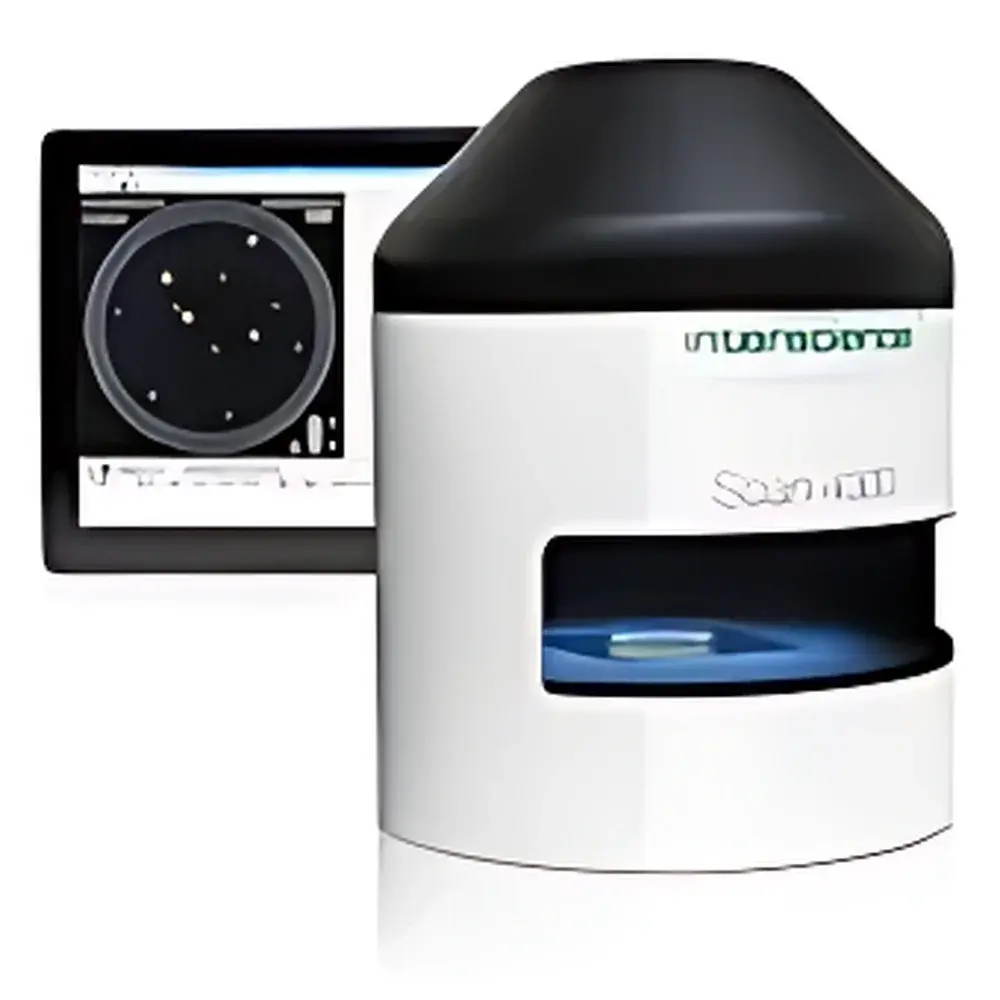
Interscience Scan® 4000 Automated Colony Counter
| Brand | Interscience |
|---|---|
| Origin | France |
| Model | Scan® 4000 |
| Instrument Type | Fully Automated Colony Counter |
| Counting Speed | 1000 colonies/sec |
| Camera | 5 MP Color CCD with 69× Zoom |
| Minimum Detectable Colony Size | 0.05 mm |
| Petri Dish Compatibility | Ø 55–150 mm (round), up to 120 mm (square) |
| Illumination System | Programmable White Dome LED with 7 Configurable Modes (top/bottom white/black background) |
| Inhibition Zone Measurement Accuracy | 0.1 mm |
| Color Detection Capacity | Up to 7 Colors per Plate |
| Supported Media | Chromogenic Agar, Mueller-Hinton Agar, Blood Agar, Chocolate Agar, PetriFilm™, RIDA™ Count, Compact Dry™, Filter Membranes, Antibiotic Discs & Wells |
| Data Export Formats | PDF, JPEG, PNG, BMP, Excel™ |
| Compliance | GLP, 21 CFR Part 11, ISO 15189, ISO 7218, ISO 4833-2, NF V08-034, NF V08-100, AOAC 977.27, FDA-BAM |
| Dimensions (W×D×H) | 47 × 47 × 64 cm |
| Weight | 25 kg |
| Power Supply | 100–240 V ∼ 50/60 Hz, 140 W |
| Required PC Spec | Windows 7 SP1 or later, Quad-core Intel i5/i7 or AMD FX-6000+, ≥2.4 GHz, ≥4 GB RAM, Dedicated GPU (AMD/NVIDIA), ≥1280×1024 Display, USB 2.0, CD-ROM Drive |
Overview
The Interscience Scan® 4000 is a high-resolution, fully automated colony counter and inhibition zone analyzer engineered for precision microbiological enumeration and antimicrobial susceptibility testing in regulated laboratory environments. Based on advanced digital image acquisition and adaptive threshold segmentation algorithms, the system captures high-fidelity images of microbial growth using a 5-megapixel color CCD camera with 69× optical zoom and programmable white dome LED illumination. Its core measurement principle relies on contrast-based morphological segmentation under standardized lighting conditions—enabling reproducible detection of colonies as small as 0.05 mm in diameter across diverse agar formulations and inoculation methods. Unlike manual or semi-automated systems, the Scan® 4000 implements dynamic background normalization and multi-spectral color separation to resolve overlapping colonies and distinguish morphologically similar isolates on chromogenic media—critical for clinical diagnostics, food safety validation, and pharmaceutical QC workflows.
Key Features
- True full automation: One-touch operation from image capture to validated report generation, compliant with 21 CFR Part 11 audit trail requirements.
- Seven programmable illumination modes—including top/bottom white and black background configurations—optimized for transparency, opacity, and reflectivity variations across media types (e.g., blood agar hemolysis patterns vs. chromogenic E. coli differentiation).
- Multi-modal counting support: Validated protocols for pour plate, spread plate, spiral plating (Spiral®), and loop dilution (circular mode), with automatic recognition of plate geometry and inoculation pattern.
- Integrated inhibition zone analysis: Measures zones of growth inhibition around antibiotic discs, wells, or cylinders with ±0.1 mm accuracy; supports CLSI and EUCAST interpretive criteria via configurable breakpoint libraries.
- Multi-color colony classification: Simultaneous detection and quantification of up to seven distinct color classes per plate—essential for simultaneous enumeration of multiple pathogens on selective chromogenic agars (e.g., CHROMagar™ Candida + MRSA).
- Expanded media compatibility: Native support for commercial rapid methods including PetriFilm™, RIDA™ Count, Compact Dry™, Easy Plate™, and membrane filtration assays—eliminating manual interpretation bias.
- Stainless steel enclosure and IP54-rated internal optics ensure durability in high-humidity BSL-2 and cleanroom environments.
Sample Compatibility & Compliance
The Scan® 4000 accommodates standard round Petri dishes (Ø 55–150 mm) and square plates (up to 120 mm), including deep-agar and double-layer formats used in phage assays or anaerobic culture. It validates colony morphology against ISO 4833-2:2016 (microbiology of food and animal feeding stuffs), ISO 7218:2017 (general requirements and guidance for microbiological examinations), and NF V08-034/V08-100 (French standards for food microbiology). For antimicrobial testing, it aligns with CLSI M02-A12 and M07-A10 methodologies on Mueller-Hinton, blood, and chocolate agars. All data handling—including user authentication, electronic signatures, version-controlled software updates, and immutable audit logs—meets GLP and ISO 15189 accreditation requirements. The system is preconfigured for FDA-BAM Chapter 3 (Aerobic Plate Count) and AOAC 977.27 (Standard Plate Count) validation protocols.
Software & Data Management
Scan® software (v6.x or later) provides a validated, installable Windows application with role-based access control, electronic signature capability, and full 21 CFR Part 11 compliance—including operator traceability, event logging, and data integrity safeguards. Each session generates a self-contained .scan file containing raw image, processing parameters, and metadata—enabling full re-analysis without loss of fidelity. Reports export to PDF (with embedded digital signatures), raster formats (JPEG/PNG/BMP), and structured Excel™ workbooks compatible with LIMS/SIL integration via secure USB 2.0 or network-enabled export. Software updates are delivered automatically post-registration, with version history and change logs archived for regulatory review. The system supports multilingual UI (English, French, German, Spanish, Japanese, Russian, Chinese) without requiring OS-level language configuration.
Applications
- Clinical microbiology labs performing routine culture enumeration and AST in accordance with ISO 15189 quality management systems.
- FDA-regulated pharmaceutical facilities conducting environmental monitoring (EM), media fill testing, and sterility assay validation.
- Food and beverage QA/QC departments executing ISO 22000-aligned pathogen screening on chromogenic and rapid-method platforms.
- Contract research organizations (CROs) delivering GLP-compliant antimicrobial efficacy studies for biocide registration.
- Academic and public health laboratories requiring traceable, auditable colony data for outbreak investigation and antimicrobial resistance surveillance.
FAQ
Does the Scan® 4000 require annual calibration by Interscience-certified personnel?
Yes. While the system includes three NIST-traceable calibration discs for daily verification, annual performance qualification (PQ) by an Interscience-certified engineer is required to maintain ISO 15189 and 21 CFR Part 11 compliance.
Can the instrument process plates with condensation or uneven agar surfaces?
Yes. The adaptive illumination system dynamically compensates for surface irregularities and minor moisture artifacts through real-time background subtraction and multi-angle light diffusion—validated per ISO 7218 Annex B.
Is remote software update supported over LAN/WAN?
No. Updates must be installed locally via authenticated USB drive or CD-ROM to preserve data integrity and prevent unauthorized modification—consistent with IEC 62304 Class B medical device software requirements.
What is the minimum PC specification for real-time image processing?
A dedicated GPU (NVIDIA GeForce GTX 1050 or AMD Radeon RX 560) is mandatory for sub-second rendering of 5 MP images during live preview and batch analysis.
How does the system handle overlapping colonies in dense samples?
It applies watershed segmentation with user-adjustable separation intensity and shape filters (circularity, aspect ratio, solidity), validated against ISO 4833-2 Annex D for high-density plate correction.



