
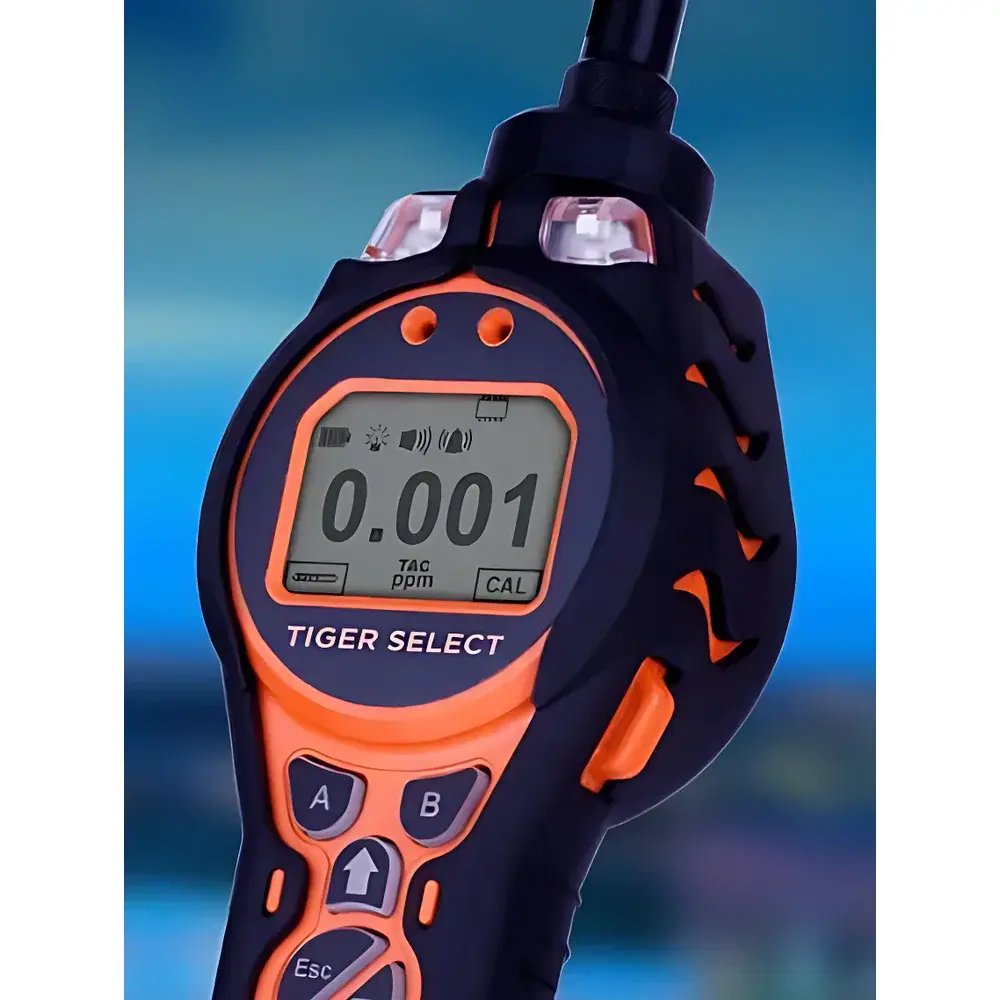
Ion Science TIGER Select Handheld Benzene & Total Aromatic Compounds (TAC) Detector
| Brand | Ion Science |
|---|---|
| Origin | UK |
| Model | TIGER Select |
| Detection Principle | Photoionization Detection (PID) with 10.0 eV UV Lamp |
| Resolution | 10 ppb (benzene) |
| Range | 0–200 ppm (with benzene pre-filter), 0–20,000 ppm (TAC mode, gas-dependent) |
| Response Time (T90) | <2 s |
| Accuracy | ±10% of reading ±1 digit (benzene) |
| Linearity | ±5% of reading ±1 digit |
| Intrinsically Safe Certification | II 1G Ex ia II C T4 Ga (Ta = –15 °C to +45 °C) |
| Battery Life | Up to 24 h (rechargeable Li-ion), 8.5 h (3×AA alkaline) |
| Data Logging | >120,000 timestamped records |
| Calibration | 2-point and 3-point via certified calibration kit |
| Alarm | Visual (amber/red LED), audible (95 dBA @ 300 mm), vibratory (pre-programmed TWA/STEL) |
| Flow Rate | 220 mL/min (low-flow alarm at 150 cc/min) |
| Operating Temp | –20 °C to +60 °C |
| Humidity | 0–99% RH (non-condensing) |
| IP Rating | IP65 |
| EMC Compliance | EN 61326-1:2006, EN 50270:2006, CFR 47 Part 15 Class A |
| Dimensions (w/o filter) | 465 × 89 × 61 mm |
| Weight (instrument only) | ~0.55 kg |
| packaged weight | 5 kg |
Overview
The Ion Science TIGER Select is a field-deployable, intrinsically safe handheld photoionization detector (PID) engineered for the selective and quantitative measurement of benzene and total aromatic compounds (TAC) in industrial, environmental, and occupational hygiene applications. Unlike generic VOC monitors, the TIGER Select integrates a high-output 10.0 eV krypton UV lamp with proprietary humidity-resistant electrode architecture and contamination-resistant sensor design—enabling stable, low-drift performance across challenging real-world conditions including high relative humidity, particulate-laden air, and variable temperature gradients. Its dual-mode operation—TAC mode (direct measurement without pre-filtration) and benzene-selective mode (using an integrated benzene-specific pre-filter)—provides analytical flexibility while maintaining trace-level sensitivity down to 10 ppb benzene equivalent. The instrument complies with international safety and electromagnetic compatibility standards required for use in Zone 0/1 hazardous areas, including ATEX, IECEx, UL, and CSA certifications.
Key Features
- Dual-Mode Detection Architecture: Switch seamlessly between Total Aromatic Compounds (TAC) quantification and benzene-selective analysis using a removable, field-installable benzene pre-filter—eliminating cross-sensitivity from non-aromatic VOCs such as aldehydes or ketones.
- High-Stability 10.0 eV PID Sensor: Features Ion Science’s patented anti-humidity electrode technology and robust krypton lamp assembly, delivering consistent ionization efficiency and minimizing zero drift—even at >90% RH and ambient temperatures up to +60 °C.
- Real-Time Quantitative Readout: Displays live concentration values with T90 response time under 2 seconds; supports both instantaneous peak detection and time-weighted average (TWA) / short-term exposure limit (STEL) calculations per OSHA and ACGIH guidelines.
- Intrinsically Safe Design: Certified to II 1G Ex ia II C T4 Ga for use in explosive gas atmospheres (including benzene vapor), with independent verification by ITS and compliance with UL 913, UL 61010-1, and CAN/CSA C22.2 No. 61010-1.
- Comprehensive Data Integrity: Logs over 120,000 measurements with embedded date/time stamps; supports USB 1.1 direct download for audit-ready reporting aligned with ISO 17025 and GLP documentation requirements.
- Field-Serviceable Configuration: Includes modular accessories—benzene pre-filter, PTFE particulate disc, activated carbon scrubber, MiniPID component removal tool, and calibrated cleaning reagent—to maintain sensor fidelity during extended deployments.
Sample Compatibility & Compliance
The TIGER Select is validated for detection of benzene (C6H6) and structurally related aromatic hydrocarbons—including toluene, ethylbenzene, xylenes (BTEX), styrene, and naphthalene—with ionization energies ≤10.0 eV. It excludes interference from saturated hydrocarbons (e.g., methane, propane), chlorinated solvents (e.g., chloroform, TCE), and most oxygenates (e.g., ethanol, acetone) due to their higher ionization thresholds. Regulatory alignment includes support for compliance with OSHA 1910.120 (HAZWOPER), EPA Method TO-15 (for screening), and EU Directive 2004/37/EC (carcinogens and mutagens). All calibration procedures follow ISO 6141 and ASTM D6167 protocols using NIST-traceable benzene standards. Firmware supports 2-point and 3-point calibration with user-defined span gases and auto-zero validation routines.
Software & Data Management
Data export is performed via native USB 1.1 interface to standard Windows-based PCs using Ion Science’s free Tiger PC Software suite. This application enables full traceability—including operator ID assignment, calibration history logging, alarm event tagging, and configurable report generation compliant with FDA 21 CFR Part 11 (electronic signatures and audit trail). Raw datasets include timestamp, measured concentration, battery voltage, flow rate, temperature, humidity, and alarm status flags. Export formats include CSV, Excel-compatible .xls, and PDF summary reports suitable for regulatory submission. Optional cloud synchronization (via secure TLS 1.2) allows centralized fleet management for multi-instrument deployments across geographically dispersed sites.
Applications
- Occupational health monitoring during tank entry, pipeline maintenance, and refinery turnaround operations
- Environmental site assessment of soil vapor intrusion and groundwater plume delineation
- Leak detection and repair (LDAR) programs per EPA 40 CFR Part 60, Subpart VV and Subpart OOOOa
- Indoor air quality (IAQ) surveys in laboratories, printing facilities, and paint manufacturing environments
- Emergency response screening for benzene releases following transportation incidents or storage failures
- Validation of abatement system performance (e.g., carbon adsorption units, thermal oxidizers)
FAQ
What distinguishes TIGER Select from standard PID instruments?
It incorporates a dedicated benzene pre-filter pathway and proprietary humidity-compensated electrode design—enabling selective benzene quantification at sub-ppb levels without false positives from common interferents.
Is calibration traceable to national standards?
Yes—calibration kits include NIST-traceable benzene gas standards (certified reference materials), and firmware logs all calibration events with operator ID, date/time, and gas concentration used.
Can the instrument operate continuously in rain or high-dust environments?
Yes—the IP65-rated enclosure protects against water jets and dust ingress, and the internal flow path includes replaceable PTFE particulate filters and activated carbon scrubbers to extend sensor life.
Does it meet FDA 21 CFR Part 11 requirements for electronic records?
When used with Tiger PC Software v4.2+, it supports audit trails, electronic signatures, and role-based access control—fulfilling key elements of Part 11 for regulated pharmaceutical and biotech facilities.
How often does the PID lamp require replacement?
The krypton lamp has a rated lifetime of ≥10,000 hours under typical usage; the instrument displays lamp health status and prompts service when output falls below 90% of nominal intensity.
Related Products





