
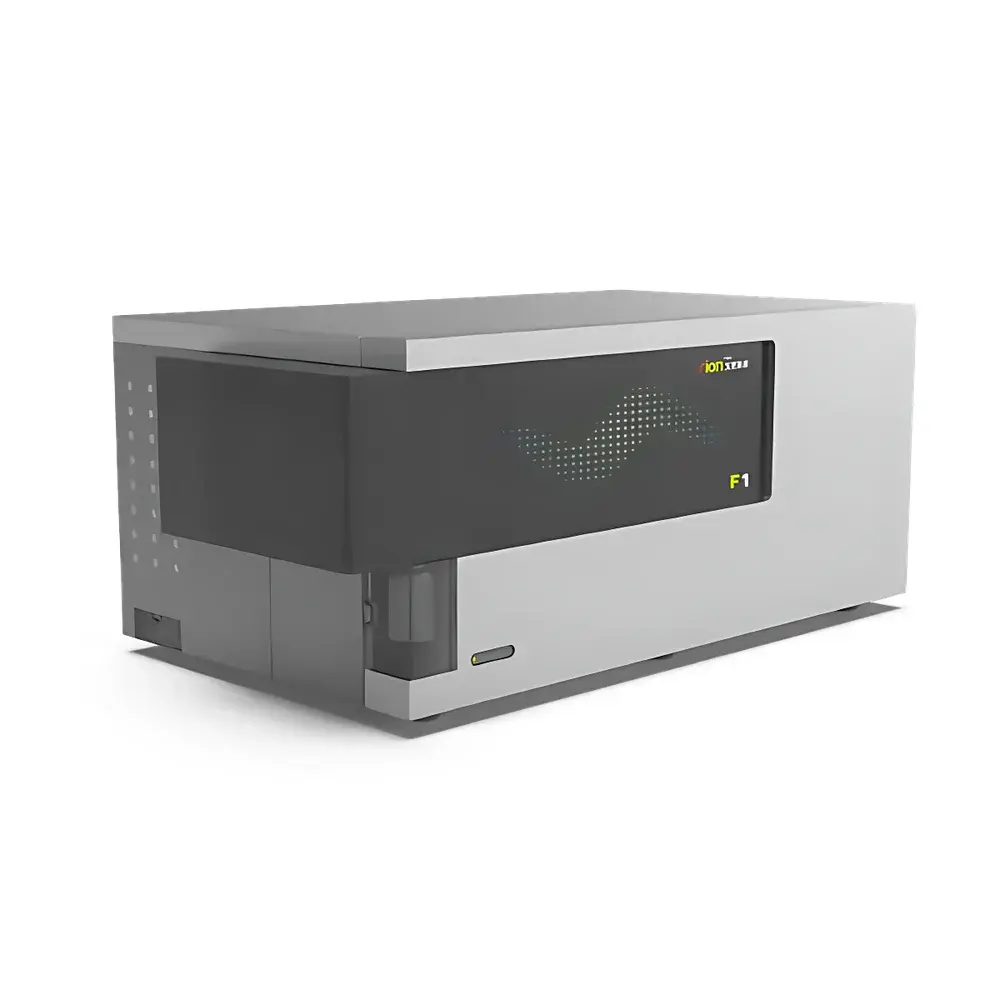
Ion Tec F1 Triple Quadrupole Liquid Chromatography Mass Spectrometer
| Brand | Ion Tec Co., Ltd. |
|---|---|
| Origin | Shanghai, China |
| Manufacturer Type | Original Equipment Manufacturer (OEM) |
| Instrument Type | Triple Quadrupole (QqQ) LC-MS/MS |
| Mass Range | m/z 15–2000 |
| Sensitivity | ≤0.5 pg on-column injection of reserpine (S/N ≥ 100:1 in MRM mode) |
| Resolution | >2000 (full width at half maximum, FWHM) |
Overview
The Ion Tec F1 Triple Quadrupole Liquid Chromatography Mass Spectrometer is a fully domestically engineered LC-MS/MS system designed for high-precision quantitative analysis in regulated and research-intensive environments. Built upon a tandem quadrupole (QqQ) architecture operating in multiple reaction monitoring (MRM) and selected reaction monitoring (SRM) modes, the F1 leverages collision-induced dissociation (CID) within a linear collision cell to deliver exceptional specificity, selectivity, and signal-to-noise performance. Its core measurement principle relies on mass filtering in Q1, fragmentation in the collision cell (q2), and subsequent mass analysis in Q3—enabling unambiguous identification and reproducible quantification of target analytes even in highly complex biological matrices. Engineered for robustness and long-term operational stability, the F1 meets the analytical rigor required for clinical assay validation, pharmaceutical bioanalysis, and high-throughput environmental screening.
Key Features
- Fully integrated self-developed hardware stack: Ion source (electrospray ionization, ESI; optional APCI), RF-driven quadrupole mass filters, high-voltage RF power supply, and linear collision cell are all designed and manufactured in-house—ensuring full supply chain control and technology sovereignty.
- High-sensitivity detection: Achieves ≤0.5 pg on-column sensitivity for reserpine under standard MRM conditions (S/N ≥ 100:1), enabling reliable quantification of low-abundance biomarkers and trace contaminants.
- Mass accuracy and resolution: Delivers mass resolution >2000 (FWHM) across the full m/z 15–2000 range, supporting confident ion separation in co-eluting chromatographic peaks.
- Intuitive operation and intelligent automation: Integrated workstation provides one-click auto-tuning, method optimization, and calibration routines. Preloaded application-specific method libraries accelerate assay development for clinical, pharmaceutical, and food safety workflows.
- Modular, service-oriented mechanical design: Ion source features tool-free, atmospheric-pressure removable assembly—allowing cleaning or replacement without breaking vacuum. Transparent thermal-shielded enclosure with interlocked safety latches ensures operator protection during active acquisition.
Sample Compatibility & Compliance
The F1 supports standard reversed-phase, HILIC, and ion-pairing LC configurations compatible with common C18, phenyl-hexyl, and porous graphitic carbon columns (ID 2.1 mm × 50–150 mm). It accommodates flow rates from 0.2 to 1.0 mL/min and interfaces seamlessly with UHPLC systems operating up to 1300 bar. The instrument complies with ISO/IEC 17025 requirements for testing laboratories and supports audit-ready data integrity through secure user authentication, electronic signatures, and full 21 CFR Part 11–compliant audit trails when deployed with validated software configurations. Method transfer studies confirm compatibility with established USP, EP, and ASTM protocols for vitamin quantification, steroid hormone profiling, pesticide residue analysis, and small-molecule PK/PD assays.
Software & Data Management
The F1 is operated via IonTec ControlSuite™, a dual-language (English/Chinese) platform supporting GLP/GMP-aligned workflow management. The software includes built-in spectral library creation tools, retention time alignment algorithms, peak integration with customizable baseline correction, and batch processing for large-scale cohort studies. All raw data files adhere to open mzML format, ensuring interoperability with third-party quantification engines (e.g., Skyline, MultiQuant™, OpenMS). Audit logs record every parameter change, sequence modification, and calibration event—including timestamps, operator ID, and IP address—facilitating full traceability during regulatory inspections.
Applications
- Clinical Diagnostics & Life Sciences: Quantitative analysis of vitamins (B12, D2/D3), steroid hormones (cortisol, testosterone), acylcarnitines and amino acids in newborn screening, and targeted verification of proteomic/metabolomic biomarkers.
- Pharmaceutical R&D: Pharmacokinetic and toxicokinetic (PK/TK) studies, metabolite identification support, impurity profiling per ICH Q3 guidelines, and bioequivalence testing in accordance with FDA and EMA bioanalytical method validation requirements.
- Food Safety & Environmental Monitoring: Multi-residue screening of pesticides, veterinary drug residues, mycotoxins (aflatoxins, ochratoxin A), and persistent organic pollutants (POPs) in compliance with EU SANTE/2023/2022 and USDA AMS standards.
- Systems Biology Research: Targeted metabolomics, lipidomics, and exposomics workflows requiring high dynamic range, low CVs (<8% RSD across 500 injections), and cross-platform reproducibility.
FAQ
Is the F1 compliant with 21 CFR Part 11 for regulated laboratory use?
Yes—when configured with validated ControlSuite™ v3.2+ and deployed on a domain-controlled Windows environment with role-based access, the system supports electronic records, digital signatures, and immutable audit trails meeting FDA 21 CFR Part 11 requirements.
What LC systems are certified for integration with the F1?
The F1 has been verified for seamless operation with Thermo Vanquish, Waters ACQUITY UPLC, Agilent 1290 Infinity II, and Shimadzu Nexera X2 platforms using standard ESI interface kits and vendor-neutral timing synchronization protocols.
Does the F1 support scheduled maintenance alerts and remote diagnostics?
Yes—the embedded system health monitor tracks detector gain, vacuum levels, RF stability, and ion transmission efficiency, triggering configurable notifications and generating diagnostic reports accessible via secure web portal or local export.
Can users import third-party spectral libraries or export data for external processing?
Absolutely—all spectral libraries are stored in open SQLite format and support import/export via .csv or .msp. Raw data exports comply with HUPO-PSI mzML 1.2 specification, enabling downstream analysis in R/Bioconductor, Python (pyOpenMS), or commercial platforms.
What is the typical installation footprint and utility requirement?
The F1 occupies 85 cm (W) × 65 cm (D) × 60 cm (H) and requires stable 230 V ±10%, 50/60 Hz single-phase power, dry nitrogen (≥99.999%), and compressed air (6–8 bar, oil-free, dew point ≤−40°C). No chilled water or external chiller is needed due to integrated thermoelectric cooling.





