
IP Rating Rain Test Chamber LS-1000
| Key Features | Stainless steel SUS304B interior |
|---|
Overview
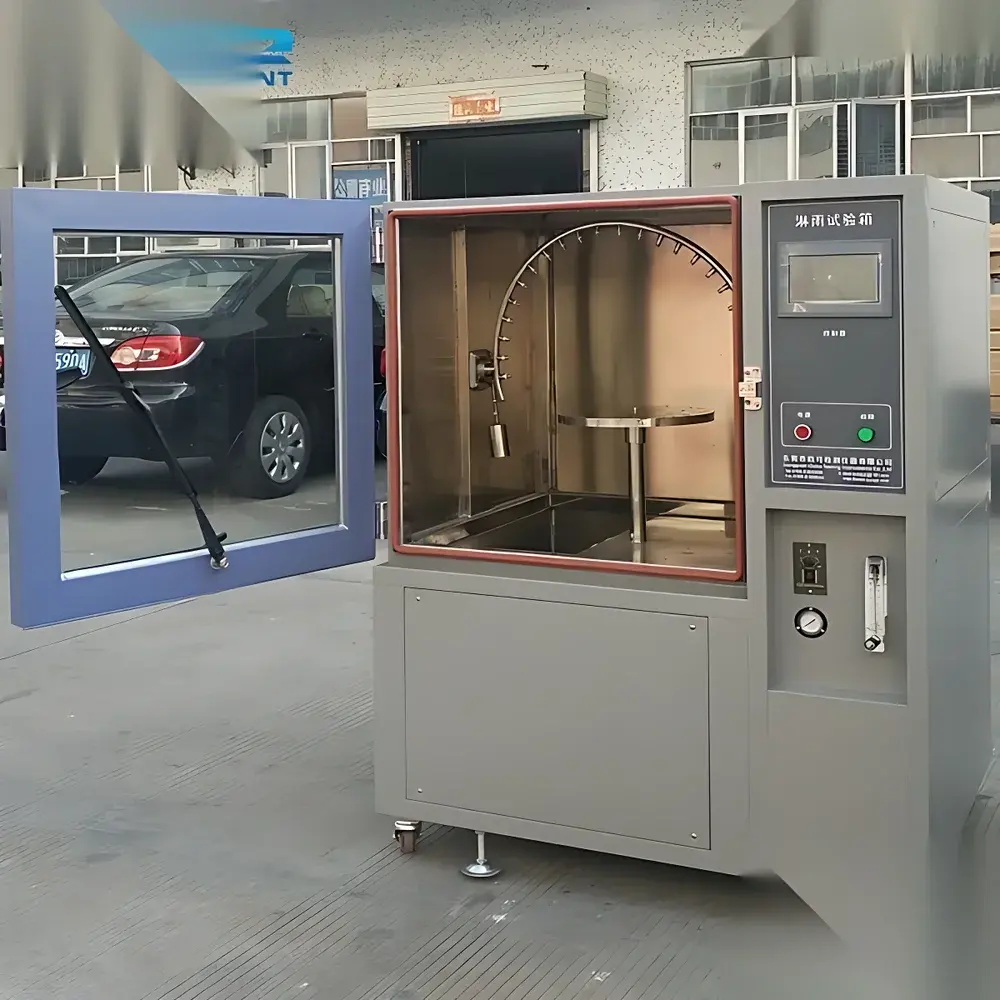
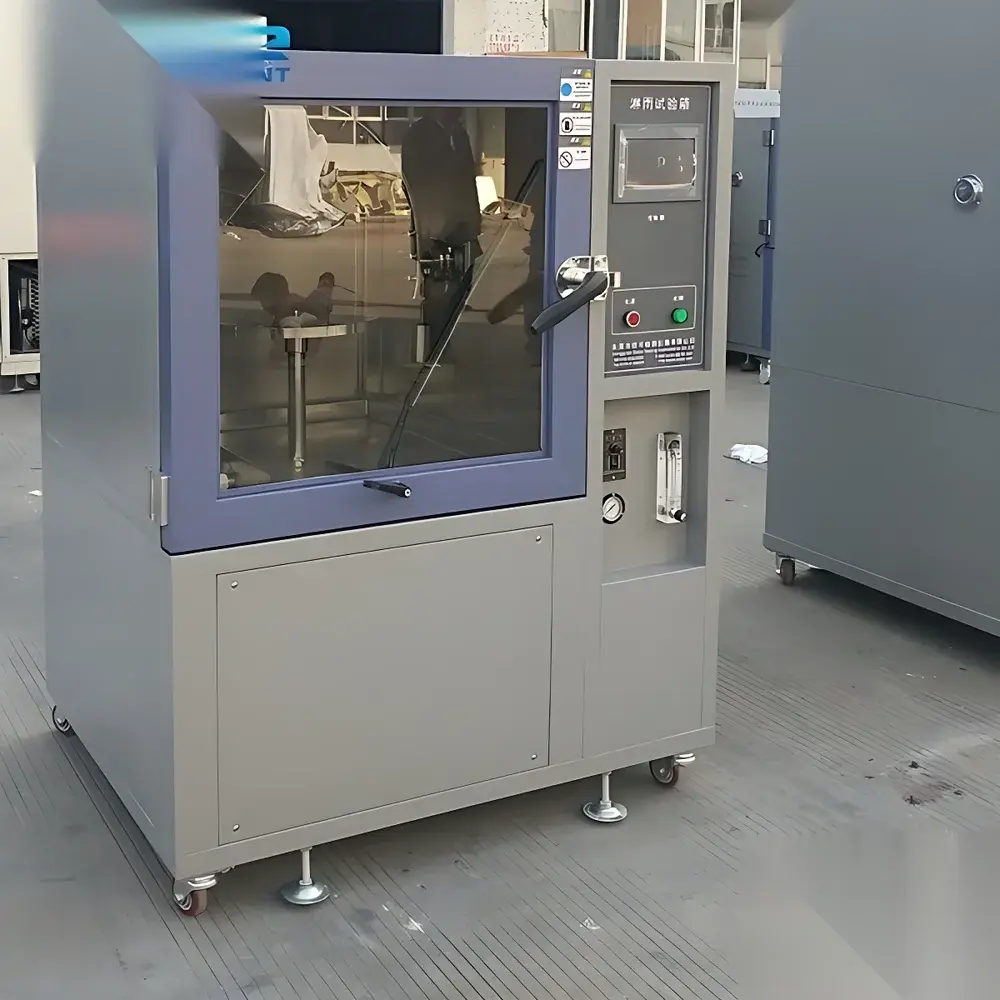
The LS-1000 IP Rating Rain Test Chamber is an engineered environmental test system designed to evaluate the ingress protection (IP) performance of electrical and electronic enclosures under controlled simulated rainfall conditions, in strict accordance with international and national standards including IEC 60529, GB/T 2423.38–2008, GB 4208–2008, and GB 10485–1989. Based on the principle of directional oscillating spray and rotating sample exposure, the chamber replicates real-world rain exposure scenarios—including vertical dripping (IPX1), tilted dripping (IPX2), splashing (IPX3–IPX4), and powerful water jets (IPX5–IPX6)—by precisely regulating nozzle geometry, water pressure, oscillation dynamics, and sample rotation kinematics. Its monolithic three-zone architecture—comprising an upper test compartment, central mechanical bay, and right-side electrical control cabinet—ensures thermal and hydraulic isolation, structural rigidity, and service accessibility. Constructed for long-term laboratory use, the chamber integrates corrosion-resistant materials, traceable calibration interfaces, and deterministic motion control to support repeatable, auditable, and GLP-compliant validation protocols.
Key Features
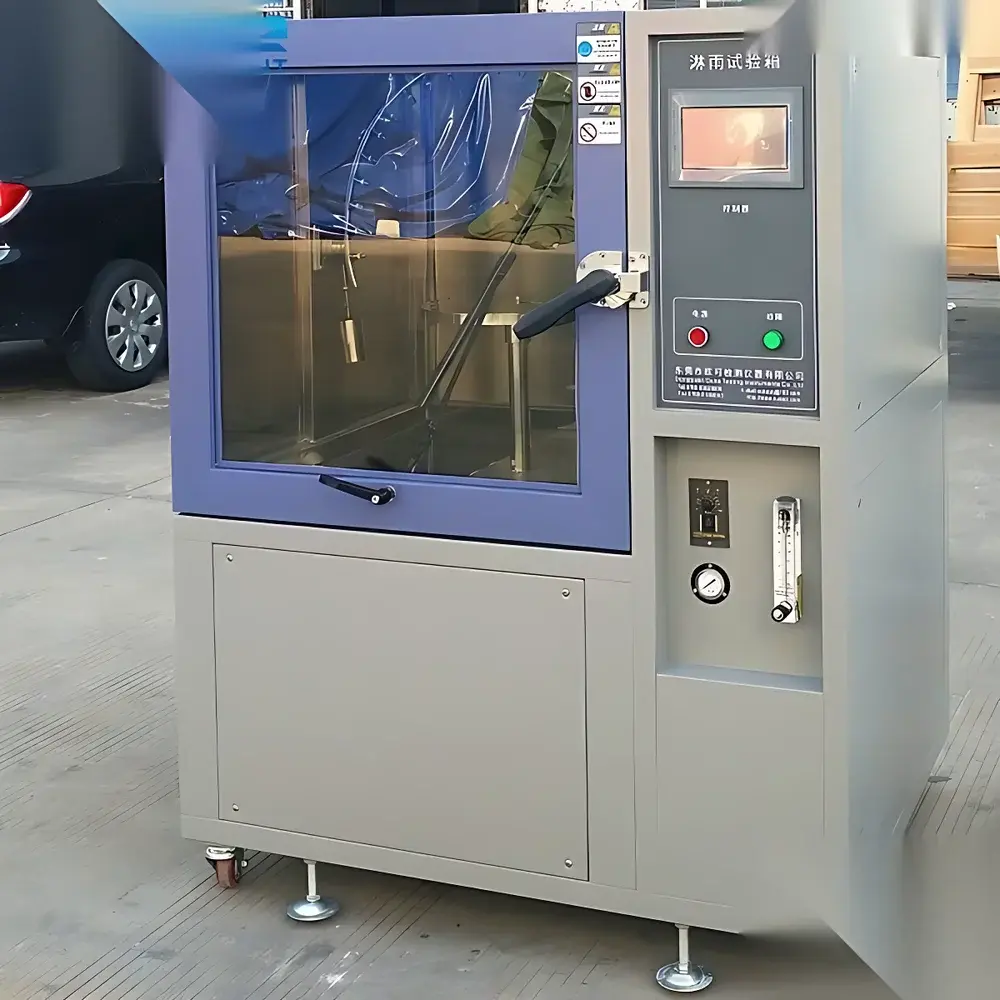
- Robust dual-material construction: Interior chamber lined with polished SUS304B stainless steel; exterior enclosure fabricated from A3 carbon steel with electrostatic powder coating for enhanced durability and chemical resistance.
- Full-visibility observation window integrated into the silicone-rubber-sealed access door, enabling real-time visual monitoring of spray patterns, droplet impact behavior, and sample wetting dynamics without interrupting test cycles.
- Precision-engineered oscillating pipe assembly: 400 mm radius stainless steel arm fitted with laser-drilled, copper-alloy nozzles (φ0.4 mm), spaced at exact 50 mm intervals along the full 360° arc; each nozzle independently adjustable within ±45° to converge spray onto a single central reference point.
- Stepper motor-driven oscillation mechanism with HMI-based parameter input—enabling precise, repeatable control over swing angle (0–180°) and angular velocity (0–60°/s), with position feedback for closed-loop verification.
- Motorized turntable featuring PVC-hardboard platform (chemically inert, non-conductive, and UV-stable), driven via worm-gear reduction and frequency-inverter-controlled AC motor for smooth, low-vibration rotation across 1–9.6 rpm (infinitely variable).
- Integrated water management subsystem: 304 stainless steel reservoir with inline particulate filter (5 µm rating), manual drain valve, and bottom-mounted rapid-discharge sump channeling—eliminating standing water accumulation and ensuring consistent supply pressure (~80 kPa) throughout extended test durations.
Sample Compatibility & Compliance
The LS-1000 accommodates samples up to 1000 mm × 1000 mm × 1000 mm (W×H×D) in internal volume, supporting both stationary and rotating configurations per test method requirements. It is validated for conformance to IPX1 through IPX6 classifications as defined in IEC 60529 and mirrored in GB 4208–2008. The system supports full-cycle execution of standardized procedures—including steady-state drip tests (GB/T 2423.38, Method Ra), oscillating tube exposures (Method Rb), and nozzle-based jet testing (Methods Rc–Re). All operational parameters—including timing, pressure, angle, speed, and dwell duration—are digitally logged and exportable to support ISO/IEC 17025-compliant test reporting, FDA 21 CFR Part 11 audit trails (when paired with compliant data acquisition software), and internal quality assurance documentation per GMP/GLP frameworks.
Software & Data Management
The embedded HMI controller provides intuitive touch-based operation with password-protected user levels (Operator, Technician, Administrator), real-time parameter visualization, and automatic event logging (start/stop timestamps, setpoint deviations, fault codes). Test programs can be saved, recalled, duplicated, and version-controlled directly on device memory. Optional RS-485 or Ethernet communication modules enable integration with centralized laboratory information management systems (LIMS) or SCADA platforms. Data export is supported in CSV format for post-test analysis in MATLAB, Excel, or statistical process control (SPC) tools. Firmware updates are performed via USB—ensuring traceability, revision control, and alignment with evolving regulatory expectations for environmental test instrumentation.
Applications
- Verification of IP-rated enclosures for industrial control panels, outdoor lighting fixtures, automotive ECUs, and telecom junction boxes.
- Pre-certification validation for CE marking (EN 60529), UL 50E, and CCC certification submissions.
- Reliability screening of consumer electronics housings, medical device casings, and battery packs prior to field deployment.
- Material compatibility assessment—e.g., evaluating sealant adhesion loss, gasket compression set, or housing warpage under cyclic wetting.
- Root cause analysis of moisture-induced failure modes such as corrosion, tracking, or insulation breakdown in high-humidity environments.
FAQ
What IP ratings can the LS-1000 validate?
The LS-1000 is configured and calibrated to perform all test methods required for IPX1 through IPX6 classification per IEC 60529 and GB 4208–2008.
Is water temperature control available?
Standard configuration delivers ambient-temperature water supply; optional thermostatic mixing valve kits (±1°C stability) are available for temperature-sensitive applications requiring controlled thermal gradients.
Can the chamber be integrated into an automated test line?
Yes—via Modbus RTU (RS-485) or TCP/IP protocol support, the LS-1000 accepts remote start/stop commands, parameter uploads, and status polling for synchronized operation within larger test automation ecosystems.
What maintenance is required for long-term reliability?
Routine tasks include quarterly nozzle inspection/cleaning, biannual filter replacement, annual calibration of pressure transducer and timer circuitry, and periodic verification of oscillation angle repeatability using certified protractor gauges.
Does the system meet GLP or ISO/IEC 17025 documentation requirements?
When operated with enabled audit trail logging and timestamped digital records, the LS-1000 satisfies core data integrity provisions of GLP and ISO/IEC 17025; full compliance requires site-specific SOPs, personnel training records, and third-party calibration certificates for ancillary sensors.



