
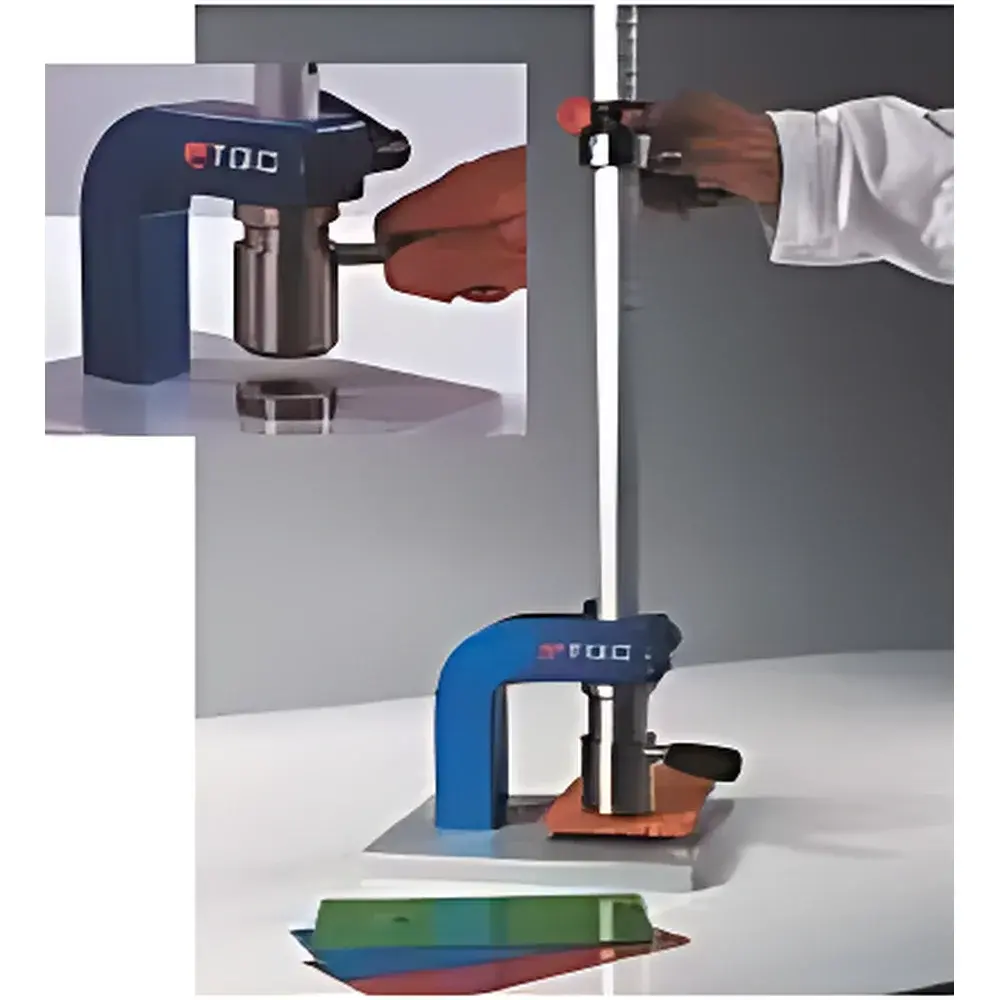
IP2000 Impact Tester for Coating Films
| Origin | Imported |
|---|---|
| Manufacturer Type | Distributor |
| Origin Region | Netherlands |
| Model | IP2000 |
| Pricing | Upon Request |
| Standards Compliance | ISO 6272, ASTM D2794 |
| Optional Accessories | 1 kg and 2 kg Additional Weights |
Overview
The IP2000 Impact Tester for Coating Films is a precision-engineered mechanical testing instrument designed to quantitatively evaluate the resistance of thin protective layers—including paints, varnishes, electroplated finishes, and surface-treated substrates—to sudden mechanical deformation. Based on the principle of controlled free-fall impact, the device delivers reproducible kinetic energy to a standardized indenter striking a horizontally mounted test specimen. The resulting damage—typically assessed as cracking, delamination, or substrate exposure—is correlated to impact energy (J) via calibrated drop height and weight combinations. As a physically robust, manually operated tester with no electronic actuators or software dependencies, the IP2000 ensures long-term measurement stability and traceability under routine QC laboratory conditions. Its design conforms strictly to the geometric, mass, and procedural requirements specified in ISO 6272-1:2023 (Paints and varnishes — Determination of resistance to impact) and ASTM D2794-22 (Standard Test Method for Resistance of Organic Coatings to Mechanical Shock (Impact)), making it suitable for use in GLP-compliant quality control environments and third-party certification laboratories.
Key Features
- True dual-scale graduated scale aligned with both ISO 6272 and ASTM D2794 nominal impact energy values—enabling direct reading without conversion tables
- Rapid-action specimen clamp with spring-loaded parallel jaws and adjustable pressure—ensuring consistent substrate fixation across variable thicknesses (0.5–3 mm) and material stiffness (metals, plastics, composite panels)
- Integrated precision level bubble and adjustable leveling feet—guaranteeing strict vertical alignment of the impact rod and perpendicularity of the indenter strike relative to the coated surface
- Stainless-steel impact rod and hardened steel hemispherical indenter (Ø 15.9 mm per ISO/ASTM)—minimizing plastic deformation of the test tool during repeated use
- Modular weight system supporting standard 1.0 kg hammer mass, with optional certified 1.0 kg and 2.0 kg auxiliary weights for extended energy range validation (up to 20 J at 2 m drop height)
- Compact benchtop footprint (W × D × H: 280 × 220 × 540 mm) and corrosion-resistant powder-coated frame—optimized for integration into constrained QC labs and production line inspection stations
Sample Compatibility & Compliance
The IP2000 accommodates rigid flat specimens up to 150 mm × 70 mm × 6 mm, including cold-rolled steel panels (e.g., Q-panel SPCC), aluminum alloy sheets (AA1050), PVC and PETG substrates, and fiber-reinforced composites. Specimen preparation follows ISO 1514 and ASTM D609 protocols: coatings must be fully cured, conditioned at 23 ± 2 °C and 50 ± 5 % RH for ≥24 h prior to testing. All test reports generated using the IP2000 may be documented in accordance with ISO/IEC 17025:2017 clause 7.8 (Reporting of results), supporting audit readiness for automotive OEMs (e.g., Ford WSS-M2P177-A2, GMW14872), aerospace suppliers (AS9100), and FDA-regulated medical device coating validations where mechanical durability is part of biocompatibility assessment.
Software & Data Management
The IP2000 operates as a standalone mechanical instrument with no embedded firmware, digital display, or data logging capability. This architecture eliminates calibration drift associated with electronic sensors and ensures compliance with environments requiring minimal validation burden—such as ISO 9001-certified manufacturing sites or regulated pharmaceutical packaging QC labs. All test parameters (drop height, hammer mass, substrate type, curing conditions) and pass/fail outcomes are recorded manually in paper-based or LIMS-integrated electronic lab notebooks. For laboratories implementing 21 CFR Part 11-compliant systems, metadata fields—including operator ID, timestamp, environmental monitoring logs, and photographic evidence of impact damage—can be appended to structured test records without reliance on proprietary software.
Applications
- Automotive OEM paint shops: validation of basecoat/clearcoat adhesion after stone-chip simulation and post-bake impact resistance
- Electroplating facilities: verification of nickel/chromium layer integrity on ABS plastic trim components subjected to assembly-line handling stresses
- Aerospace MRO centers: periodic assessment of thermal barrier coating (TBC) resilience on turbine blade substrates following refurbishment cycles
- Packaging R&D labs: comparative evaluation of UV-curable ink adhesion on flexible laminates used in sterile barrier systems
- Academic polymer research: correlation of crosslink density (measured via FTIR or DSC) with macroscopic impact failure modes in novel acrylic and polyurethane formulations
FAQ
What is the maximum recommended drop height for the IP2000?
The mechanical stop limits drop height to 1000 mm; however, ISO 6272 specifies a practical upper limit of 600 mm for most industrial coatings to avoid excessive substrate deformation unrelated to film performance.
Can the IP2000 be used for curved substrates?
No—per ISO 6272 Clause 6.2, only flat, rigid panels meeting dimensional tolerances (±0.1 mm flatness over 100 mm) are valid test specimens.
Is calibration traceable to national standards?
Yes—hammer mass certification is provided with NIST-traceable certificates (Class M1 tolerance, ±0.1 %); scale graduation accuracy is verified annually using certified gauge blocks and optical alignment tools.
Does the IP2000 require electrical power or compressed air?
No—it is a purely mechanical, gravity-driven system requiring no external utilities.
How frequently should the indenter be inspected for wear?
Visual inspection and profilometric verification of the hemispherical tip radius (15.9 mm ± 0.05 mm) are recommended after every 500 impacts or quarterly—whichever occurs first.



