
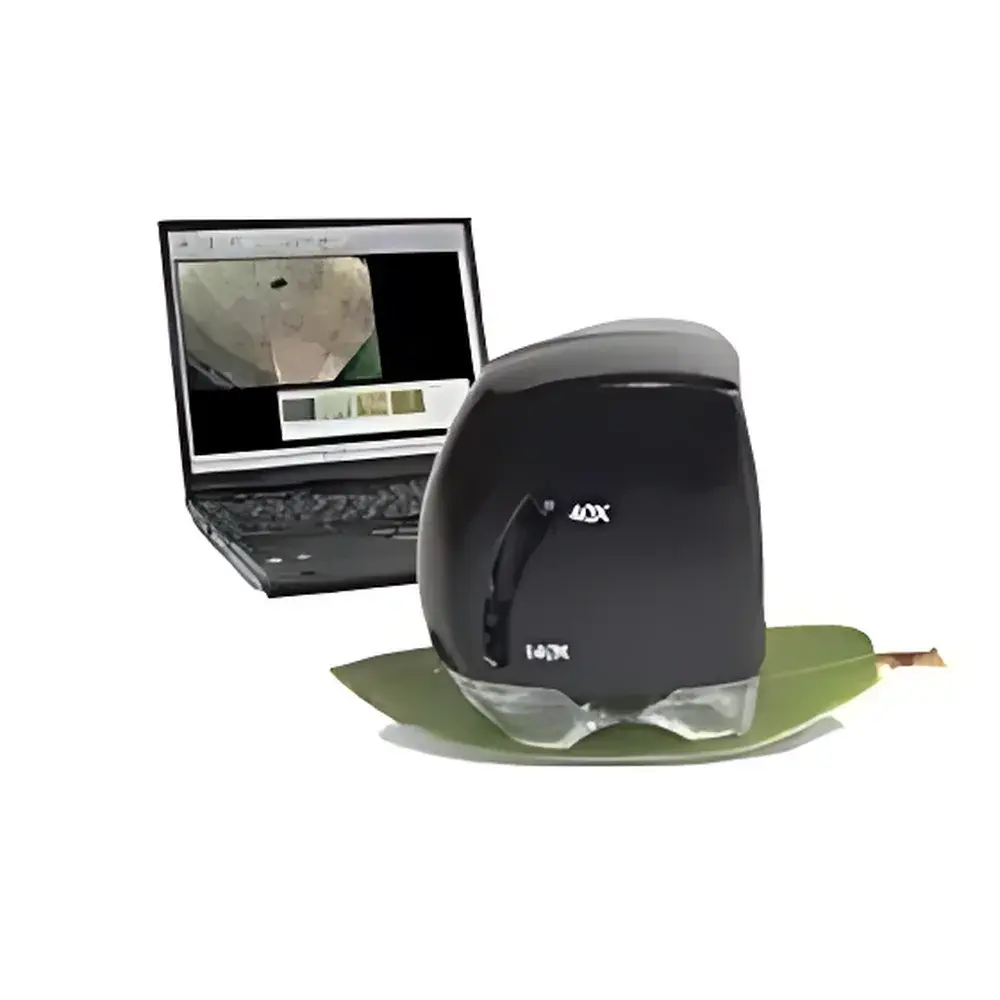
IPM Scope Handheld Digital Microscope
| Brand | Spectrum Technologies |
|---|---|
| Origin | USA |
| Model | 2860 |
| Magnification Range | 40×–140× |
| Interface | USB 2.0 |
| Illumination | Integrated LED |
| Software Included | Basic Imaging Suite (Labeling, Annotation, Timestamping, Scale Calibration) |
| Optional Upgrades | Real-time Video Capture Module (2860V), UV Illumination Variant (2860UV), Megapixel Sensor Version (2860MP), 3D Stereo Mount (2860HS), macOS-Compatible Software (2860MAC) |
| Compliance | CE, FCC, RoHS |
Overview
The IPM Scope Handheld Digital Microscope is a compact, USB-powered optical imaging instrument engineered for rapid, non-destructive surface inspection and documentation in field and laboratory environments. Unlike traditional compound microscopes requiring fixed staging and complex alignment, the IPM Scope employs a coaxial LED-illuminated macro-optical path with a fixed-focus lens system optimized for working distances between 15 mm and 50 mm. Its core measurement principle relies on real-time digital image capture via a CMOS sensor, with magnification achieved through optical zoom combined with software-based digital interpolation—ensuring stable, low-latency visualization at 40× to 140× effective magnification on host monitors. Designed for industrial quality control, educational microscopy, entomological fieldwork, electronics PCB inspection, and materials surface analysis, the device delivers immediate visual feedback without sample preparation or immersion media. Its ruggedized polycarbonate housing, ergonomic grip, and plug-and-play USB 2.0 interface enable seamless integration into existing Windows- or macOS-based workflows.
Key Features
- Optically calibrated magnification range of 40× to 140×, validated using NIST-traceable stage micrometers
- Integrated high-CRI white LED illumination with adjustable intensity, minimizing specular glare on reflective surfaces
- USB 2.0 interface with no external power supply required—draws full operational power from host computer
- Built-in annotation toolkit: supports on-screen labeling, freehand sketching, timestamp overlay, and user-defined scale bar calibration (µm/mm)
- Native support for still-image capture in BMP, JPEG, and TIFF formats; metadata embedding includes exposure time, magnification setting, and date/time stamp
- Modular upgrade architecture: optional firmware-compatible modules include real-time video streaming (2860V), ultraviolet (365 nm) excitation for fluorescence screening (2860UV), enhanced 5 MP sensor resolution (2860MP), stereoscopic 3D imaging mount (2860HS), and macOS-native driver suite (2860MAC)
Sample Compatibility & Compliance
The IPM Scope accommodates a broad range of opaque and semi-transparent specimens—including printed circuit boards, metal fatigue fractures, textile weaves, botanical epidermal layers, insect exoskeletons, and polymer coatings—without requiring vacuum chambers, conductive sputtering, or mounting resins. Its working distance and depth of field (±1.2 mm at 100×) allow in situ examination of irregularly shaped or large-format objects. The instrument complies with electromagnetic compatibility standards per FCC Part 15 Subpart B and EU Directive 2014/53/EU (Radio Equipment Directive), carries CE marking for safety (EN 62368-1), and conforms to RoHS 2011/65/EU restrictions on hazardous substances. While not certified for GLP or GMP-regulated environments out-of-the-box, audit-ready data export (CSV log files, embedded EXIF metadata) and optional 21 CFR Part 11-compliant software add-ons (via third-party validation packages) support integration into regulated QA/QC pipelines.
Software & Data Management
The bundled imaging software provides a lightweight, installer-free runtime environment compatible with Windows 7–11 (64-bit) and macOS 12–14. Core functions include live histogram display, contrast/gamma adjustment, auto-exposure lock, and batch export with customizable naming conventions. All annotated images retain editable layer information within proprietary .ipm project files, while exported raster files embed calibration metadata for traceability. The optional 2860V video module enables frame-rate-configurable recording (up to 30 fps at 1280×960), motion-triggered capture, and time-lapse sequencing—particularly valuable for documenting dynamic biological behavior (e.g., arthropod locomotion, hydrosol particle aggregation). Data integrity is reinforced through SHA-256 checksum generation for archived sessions and optional password-protected project encryption.
Applications
- Electronics manufacturing: solder joint inspection, pad coplanarity verification, conformal coating uniformity assessment
- Agricultural extension: pest identification, leaf lesion morphology mapping, seed coat microstructure evaluation
- Forensic document examination: ink differentiation, paper fiber orientation analysis, latent mark enhancement
- Mechanical maintenance: wear scar quantification on bearing surfaces, corrosion pitting depth estimation, thread pitch verification
- Classroom STEM instruction: real-time projection of microscopic phenomena, student-led measurement exercises aligned with NGSS performance expectations
- Field-based conservation biology: non-invasive monitoring of lichen thallus microcracks, fungal hyphal network distribution on bark substrates
FAQ
Is the IPM Scope compatible with Linux operating systems?
Basic UVC-compliant video streaming is supported on kernel 5.4+ via v4l2, though advanced annotation and calibration features require Windows/macOS-specific binaries.
Can measurements be exported to CSV for statistical analysis?
Yes—scale-calibrated length/area measurements are logged in UTF-8 CSV format with ISO 8601 timestamps and operator ID fields.
What is the minimum resolvable feature size at 140× magnification?
Based on Rayleigh criterion and sensor Nyquist limit, theoretical resolution is approximately 3.2 µm under optimal lighting and focus conditions.
Does the device support hardware triggering for synchronized multi-instrument setups?
No native TTL trigger input is provided; synchronization must be implemented via software-level timecode alignment or external frame-grabber integration.
Is calibration certification available for ISO/IEC 17025-accredited laboratories?
Factory calibration reports (traceable to NIST SRM 1963) are supplied with each unit; full accreditation requires on-site verification by an ILAC-recognized body.



