
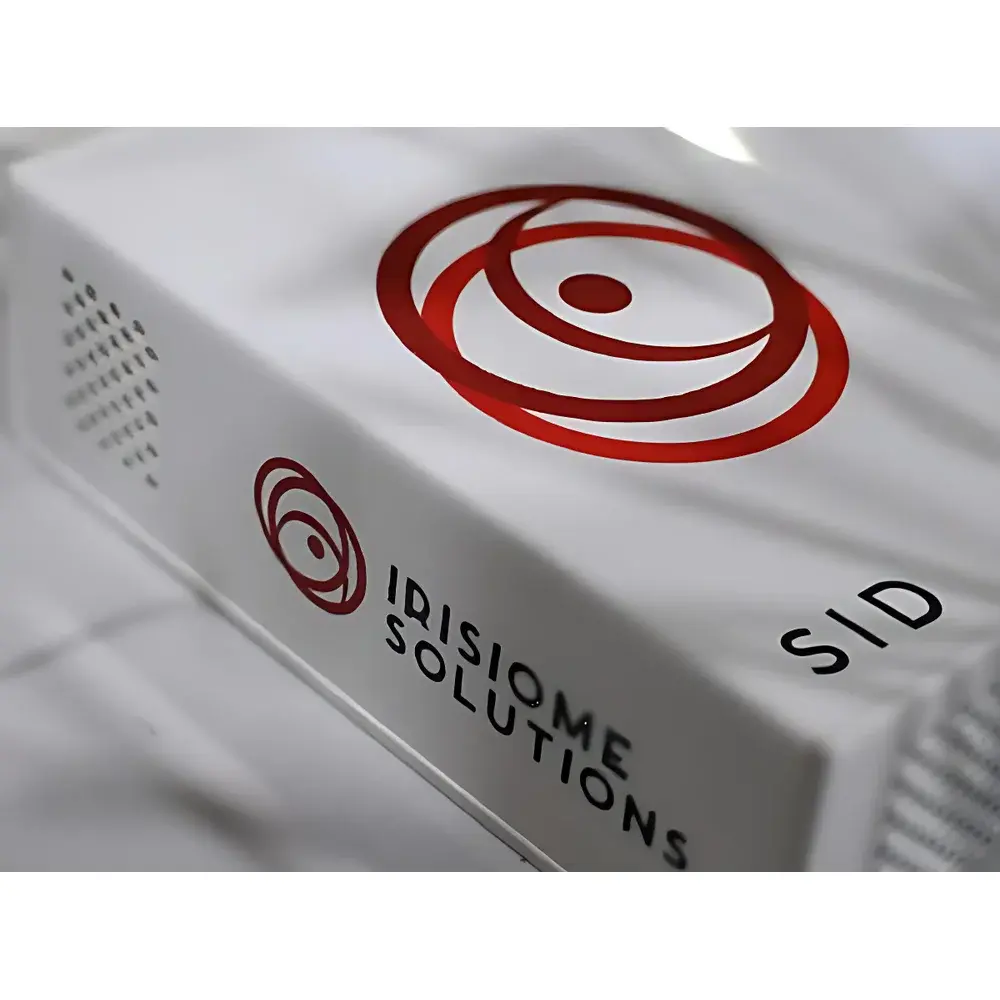
IRISIOME SID Series Compact Picosecond Laser System
| Brand | IRISIOME |
|---|---|
| Origin | France |
| Model | SID Series |
| Wavelength Options | 515/532/775/780/1030/1064/1550/1560 nm |
| Average Output Power | 10 mW – 20 W |
| Pulse Width | 15–35 ps (FWHM) |
| Repetition Rate | 1 Hz – 2 GHz (continuous & burst mode) |
| Spectral Bandwidth | <1 nm (FWHM) |
| Pulse Energy | >1 µJ |
| Power Stability | <2% RMS |
| Timing Jitter | <10 ps RMS |
| Polarization | Linear, >20 dB |
| Beam Quality | M² <1.3 (free-space), fiber-coupled options available |
| Cooling | Air-cooled |
Overview
The IRISIOME SID Series Compact Picosecond Laser System is a turnkey, OEM-ready ultrafast laser platform engineered for precision scientific and industrial applications requiring high temporal resolution, spectral flexibility, and operational robustness. Based on monolithic semiconductor laser architecture and advanced mode-locking techniques, the SID system delivers transform-limited picosecond pulses with exceptional amplitude and timing stability. Its core design leverages gain-switched or passively mode-locked semiconductor oscillators, enabling direct electrical control over repetition rate without mechanical tuning—making it uniquely suited for time-resolved spectroscopy, pump-probe experiments, and gated detection systems where synchronization fidelity and jitter minimization are critical. Unlike bulk solid-state or fiber-based picosecond sources, the SID series achieves sub-35 ps pulse widths while maintaining compact footprint (<250 × 180 × 80 mm), air-cooled operation, and full integration of driver electronics, thermal management, and optical isolation—eliminating the need for external chillers, RF amplifiers, or alignment-sensitive cavity optics.
Key Features
- Continuously tunable repetition rate from single-shot (1 Hz) up to 2 GHz, including programmable burst-mode sequences for multi-pulse excitation protocols
- Pulse duration tightly controlled between 15 ps and 35 ps (FWHM), with RMS timing jitter <10 ps—essential for time-of-flight measurements and asynchronous optical sampling
- Multiple wavelength configurations across visible (515 nm, 532 nm), near-infrared (775 nm, 780 nm, 1030 nm, 1064 nm), and telecom bands (1550 nm, 1560 nm), all sharing identical temporal and stability specifications
- Scalable average power output: SID-IR/SID-VIS variants span 10 mW to 20 W, supporting both low-fluence bioimaging and high-energy nonlinear conversion applications
- Integrated beam delivery options: polarization-maintaining fiber output (PM980/PM1550) or collimated free-space beam (M² <1.3, ellipticity <1.1), both with built-in isolators and adjustable attenuation
- Fully compliant with IEC 60825-1:2014 Class 4 laser safety requirements; includes interlock-ready connectors, shutter control interface, and embedded temperature and current monitoring
Sample Compatibility & Compliance
The SID laser system is designed for seamless integration into regulated research environments. Its stable pulse-to-pulse energy and low RMS power drift (<2%) meet the baseline repeatability requirements for GLP-compliant photophysical characterization and ISO/IEC 17025-accredited optical testing laboratories. While not certified for medical device use per FDA 21 CFR Part 820, its deterministic trigger interface (SMA TTL sync input/output), low-jitter RF output, and deterministic burst timing make it suitable for preclinical instrumentation development under ISO 13485-aligned R&D workflows. The system conforms to CE marking directives (EMC 2014/30/EU, LVD 2014/35/EU) and RoHS 2011/65/EU material restrictions. All optical outputs comply with EN 60825-1:2014 safety classification protocols, and optional OEM modules support integration with third-party motion controllers and data acquisition systems adhering to IEEE 1588 (PTP) time synchronization standards.
Software & Data Management
IRISIOME provides the SID Control Suite—a cross-platform (Windows/Linux/macOS) application built on Qt and Python-based backend drivers—enabling full parameter configuration via USB-C or Ethernet (TCP/IP). The software supports real-time monitoring of diode current, heatsink temperature, output power, and internal diagnostics logs. All settings—including repetition rate sweeps, burst pattern definition, and analog modulation profiles—are scriptable via ASCII command protocol (SCPI-compatible), facilitating integration into LabVIEW, MATLAB, or Python-based automation frameworks. Audit trails record timestamped parameter changes, firmware versions, and error events in CSV format, satisfying basic traceability requirements for ISO/IEC 17025 Clause 7.7 (result reporting) and internal QA documentation. No cloud connectivity or proprietary cloud services are implemented; all data remains local unless explicitly exported by the user.
Applications
- STED Nanoscopy: Sub-diffraction resolution imaging enabled by synchronized depletion pulses at 775/780 nm with <10 ps jitter relative to excitation, minimizing residual fluorescence and improving contrast
- Time-Resolved Fluorescence Spectroscopy: High-repetition-rate capability (up to 2 GHz) supports TCSPC with picosecond excitation and nanosecond decay capture using standard MCP-PMTs or SPAD arrays
- Nonlinear Frequency Conversion: High peak power (>10 kW) and narrow spectral bandwidth (<1 nm FWHM) enable efficient SHG, SFG, and OPO pumping in BBO, LBO, or PPLN crystals
- Optical Pump–Probe Metrology: Dual-wavelength variants (e.g., 1030 nm pump + 515 nm probe) allow carrier dynamics studies in 2D materials, perovskites, and quantum dots with femtosecond-level synchronization accuracy
- Industrial Micromachining: Burst-mode operation enables controlled ablation thresholds in transparent dielectrics and thin-film patterning with minimal heat-affected zones
FAQ
Is the SID laser compatible with third-party pulse pickers or delay stages?
Yes—the system provides TTL-sync output with <50 ps edge rise time and accepts external gate signals for precise external triggering. All timing interfaces adhere to LVCMOS logic levels and 50 Ω impedance matching.
Can the repetition rate be locked to an external RF reference?
The SID series supports PLL-based frequency locking to external 10 MHz or user-defined reference clocks via its phase-locked loop input port, enabling long-term drift compensation in metrology-grade setups.
What maintenance is required during normal operation?
No consumables or periodic optical realignment are required. Recommended preventive maintenance includes quarterly verification of heatsink thermal paste integrity and annual calibration of internal power sensor against NIST-traceable standards.
Are custom wavelengths outside the standard catalog available?
Custom center wavelengths between 450 nm and 2000 nm may be developed under NRE agreement, subject to semiconductor gain medium availability and minimum order quantity constraints.
Does IRISIOME provide OEM integration support?
Yes—full mechanical drawings (STEP/IGES), electrical interface schematics, SDK documentation, and application engineering consultation are included with volume OEM contracts.





