
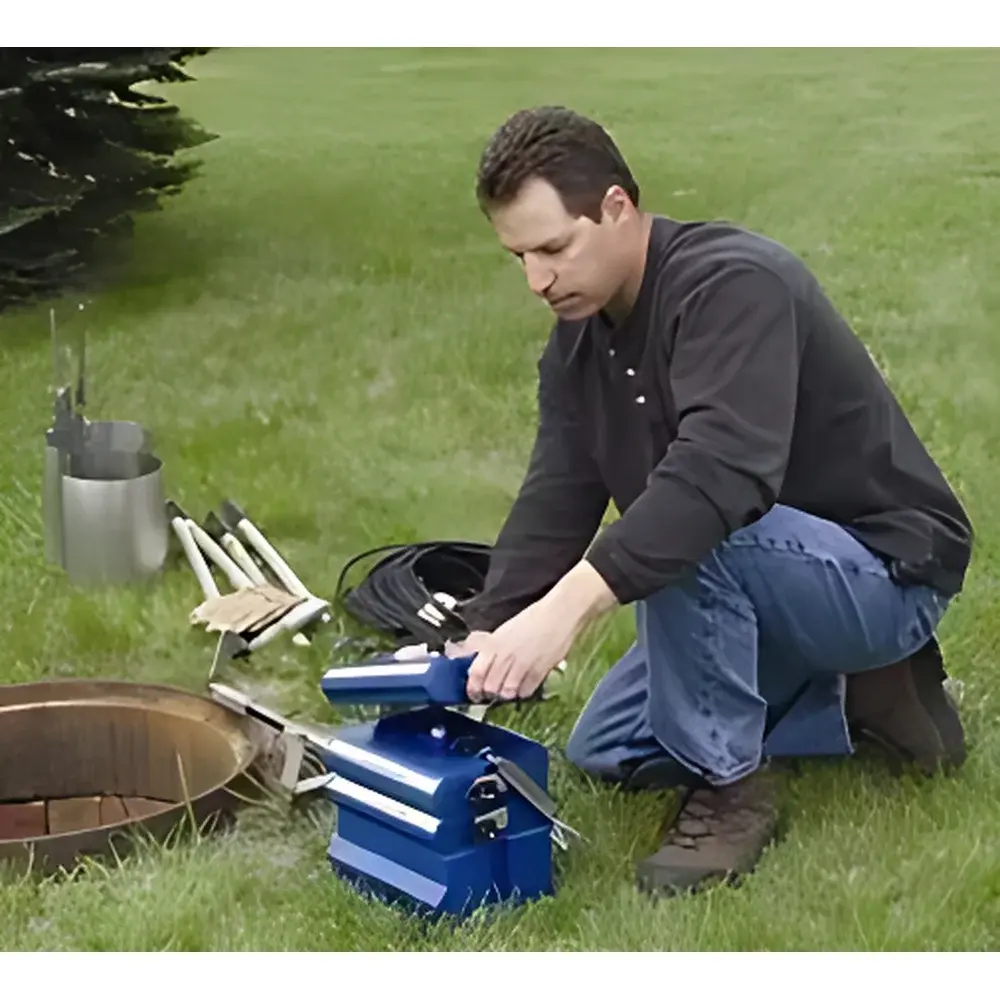
ISCO 2150 Doppler Ultrasonic Flow Meter
| Brand | ISCO |
|---|---|
| Origin | USA |
| Manufacturer Type | Authorized Distributor |
| Origin Category | Imported |
| Model | ISCO 2150 |
| Pricing | Upon Request |
Overview
The ISCO 2150 Doppler Ultrasonic Flow Meter is an engineered solution for accurate, long-term open-channel and partially filled pipe flow measurement in environmental monitoring applications. It operates on the continuous-wave Doppler principle: a high-frequency ultrasonic transducer emits a stable acoustic beam into the flow stream; suspended particles or entrained air bubbles act as reflective scatterers, and the frequency shift (Doppler shift) between transmitted and reflected signals is directly proportional to the average axial velocity of the flowing medium. This velocity, combined with real-time cross-sectional area derived from integrated digital water level sensing, yields volumetric flow rate via the area-velocity method. Designed for deployment in wastewater collection systems, stormwater outfalls, infiltration/inflow studies, and low-flow surface water channels, the 2150 delivers field-proven reliability under variable hydraulic conditions—including shallow flows down to 25 mm depth—without requiring structural modifications to the channel.
Key Features
- Robust NEMA 4X/6P and IP68-rated enclosure for submersion and harsh outdoor environments
- Epoxy-potted Doppler sensor probe resistant to corrosion, oil fouling, and biofilm accumulation—minimizing maintenance intervals
- Integrated desiccant tube and hydrophobic membrane system to prevent moisture ingress into the pressure reference chamber, ensuring long-term barometric compensation integrity
- Vented absolute pressure sensor with automatic atmospheric pressure compensation for consistent stage-to-flow conversion accuracy
- Hot-swappable modular probe design: field replacement or reconfiguration without recalibration required
- Scalable architecture supporting up to four ISCO 2100-series flow modules via daisy-chained cabling or stacking interface
- Digital water level signal processing within the probe head—eliminating analog signal degradation and EMI susceptibility
- Factory-calibrated across 120 points spanning 3-meter depth range and multiple temperature conditions, enabling drift-free stage measurement over extended deployment periods
Sample Compatibility & Compliance
The ISCO 2150 is optimized for natural and engineered water matrices containing sufficient acoustic scatterers (e.g., suspended solids ≥20 mg/L or microbubbles), typical of municipal wastewater, combined sewer overflows (CSOs), stormwater runoff, and irrigation return flows. It complies with relevant sections of ASTM D5941 (Standard Test Method for Determining Flow Rates in Open Channels Using Acoustic Velocity Meters) and supports data integrity requirements aligned with EPA-approved monitoring protocols for NPDES permit compliance. Its non-intrusive installation method avoids hydraulic disturbance and meets ISO 748:2022 (Liquid flow measurement in open channels — Velocity-area method) guidelines for area-velocity instrumentation. The device’s firmware and data logging architecture support audit-trail functionality compatible with GLP/GMP documentation frameworks where required.
Software & Data Management
Data are stored continuously in non-volatile flash memory—preserving all records through power loss or battery replacement. Firmware updates are deployed directly to flash memory without erasing existing configuration files or historical datasets. The meter logs auxiliary parameters including internal temperature and supply voltage, enabling diagnostic trending and power management verification. Programmable event-triggered sampling allows dynamic adjustment of logging intervals—for example, increasing resolution during overflow events while conserving memory and battery life during quiescent periods. Communication occurs via RS-232 at up to 38,400 bps, facilitating rapid setup, remote diagnostics, and bulk data retrieval using ISCO’s proprietary HydroView™ software or third-party SCADA-compatible drivers. All stored data include timestamped metadata (UTC-synchronized when GPS-enabled), supporting traceability per ISO/IEC 17025:2017 clause 7.5.2.
Applications
- Real-time inflow/infiltration (I/I) quantification in sanitary sewer networks
- Combined sewer overflow (CSO) event monitoring and volume accounting
- Shallow-flow measurement in grassed swales, curb inlets, and low-gradient ditches (down to 25 mm depth)
- Wastewater treatment plant influent/effluent flow verification
- Stormwater detention basin release rate validation
- Regulatory compliance reporting for NPDES, SPDES, and local watershed management authorities
- Long-term unattended deployment in remote catchments powered by optional solar-charging kits or rechargeable lead-acid batteries (Model 2191)
FAQ
Does the ISCO 2150 require periodic recalibration?
No—its factory-applied 120-point water level calibration eliminates span drift and reduces the need for field recalibration to only extreme mechanical damage or long-term sensor fouling beyond cleaning thresholds.
Can it operate in completely clear water with no suspended solids?
Not reliably—Doppler-based velocity measurement requires acoustic reflectors; applications involving filtered or distilled water necessitate alternative technologies such as electromagnetic or transit-time ultrasonic flow meters.
What is the expected battery life in continuous operation?
With two alkaline D-cell batteries and 15-minute logging intervals, operational life exceeds 15 months; use of the ISCO 2191 rechargeable battery module extends deployment duration further, especially when paired with solar charging accessories.
Is the device compatible with Modbus or other industrial communication protocols?
Native communication is RS-232 ASCII; Modbus RTU integration is achievable via external protocol converters certified for use with ISCO hardware.
How is temperature compensation handled?
Internal temperature sensing is embedded in both the Doppler transducer and pressure sensor assemblies, with compensation algorithms applied in real time during signal processing—no user intervention required.
Related Products







