
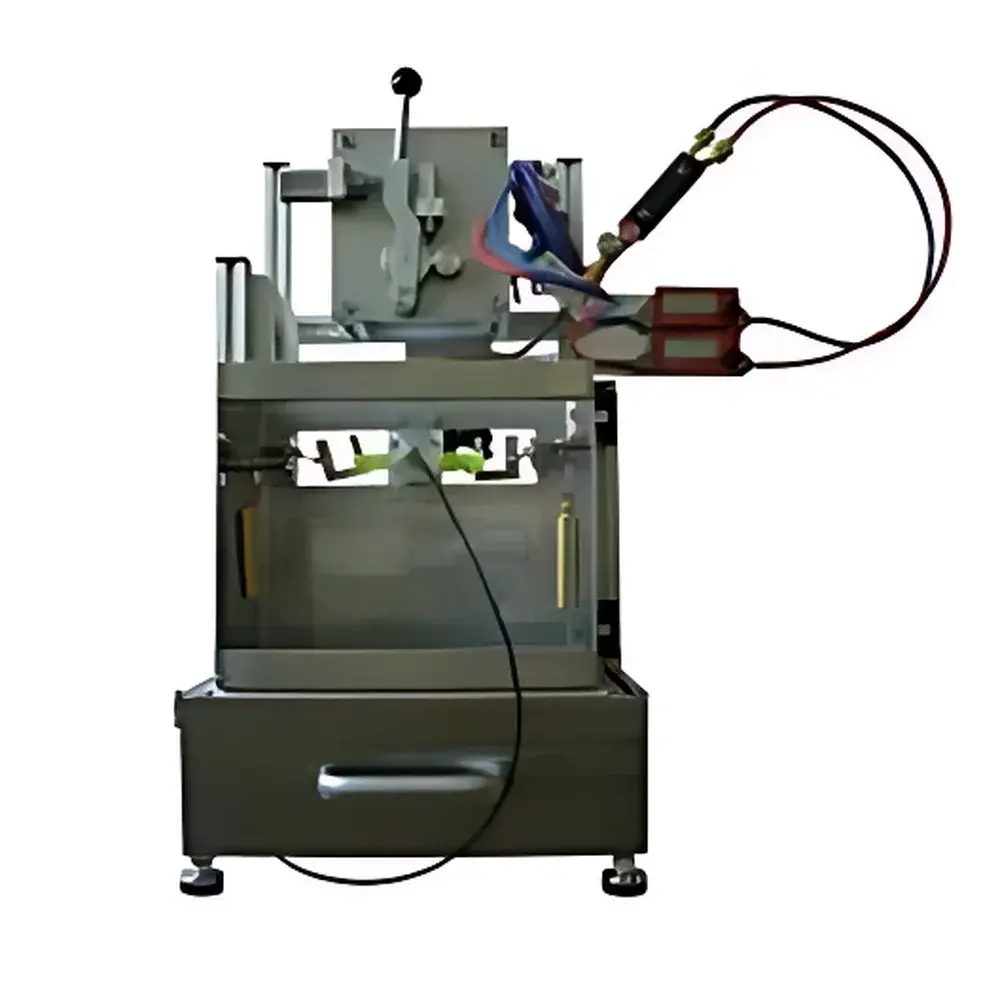
ISO 9150 Anti-Molten Metal Droplet Impact Tester
| Origin | Tianjin, China |
|---|---|
| Manufacturer Type | Authorized Distributor |
| Origin Category | Domestic (China) |
| Model | ISO 9150 |
| Pricing | Available Upon Request |
Overview
The ISO 9150 Anti-Molten Metal Droplet Impact Tester is a precision-engineered thermal protective performance evaluation system designed to quantify the resistance of flame-resistant (FR) textiles and laminated fabric composites against localized thermal insult from molten metal droplets—specifically simulating hazards encountered in foundry, metallurgical, welding, and metal casting environments. The instrument operates on the standardized principle defined in ISO 9150:2022, EN 348:1993, GB/T 17599–2019, AQ 6103–2006, and GB 8965.2–2019: a controlled stream of molten metal droplets (typically aluminum or iron) is directed at a horizontally mounted fabric specimen at a fixed 45° impact angle; the number of droplets required to induce a 40 K temperature rise on the specimen’s reverse side—measured via calibrated armored platinum resistance thermometers—is recorded as the primary performance metric. This test method directly correlates with real-world thermal barrier efficacy under transient, high-enthalpy impingement conditions, making it indispensable for validating compliance with occupational safety standards for arc-flash and molten metal splash protection.
Key Features
- Integrated oxy-acetylene torch assembly with precision mass-flow controllers for O₂ and C₂H₂, enabling stable, repeatable flame generation and consistent metal melting kinetics
- Dual-stage pressure regulation system: maintains inlet O₂ pressure at 250 kPa ± 5 kPa and C₂H₂ pressure at 50 kPa ± 2 kPa for optimal combustion stoichiometry and droplet formation uniformity
- Standardized 1.2 mm ± 0.1 mm nozzle tip (EN 348-compliant), ensuring reproducible droplet size distribution and kinetic energy per impact event
- Computer-controlled stepper motor drive for linear feed of metal consumables (e.g., Al 99.5 or Fe rods), adjustable speed range 0.5–5.0 mm/s to accommodate varying melt viscosity and droplet frequency requirements
- 45° gravity-assisted droplet guidance channel with high-temperature anti-adhesion coating (≥1200 °C service life), minimizing droplet deformation and trajectory deviation
- Backside thermal sensing module comprising ASTM E230-compliant armored Pt100 RTD sensors embedded in low-conductivity, refractory ceramic fiber insulation blocks (density ≥128 kg/m³), ensuring accurate, low-inertia surface temperature measurement
- Calibrated mechanical preload system applying 175 g ± 0.5 g tension to the test specimen—aligned with ISO 9150 clamping geometry—to simulate realistic fabric drape and thermal contact resistance during exposure
- Real-time droplet counting and timing circuitry synchronized with thermal acquisition, supporting statistical analysis of impact interval, cumulative droplet count, and threshold determination
- Industrial-grade IP65-rated touchscreen HMI (10.1″ capacitive display) running embedded Linux-based control firmware with audit-trail-enabled operation logging
- Full-enclosure interlocked safety housing with polycarbonate viewing window (EN 166-compliant), emergency stop circuitry, and automatic gas shutoff upon door opening or thermal anomaly detection
Sample Compatibility & Compliance
The tester accommodates flat textile specimens measuring 100 mm × 100 mm (minimum), including single-layer FR fabrics (e.g., aramid, modacrylic, PBI blends), multi-layer laminates, coated substrates, and metallized composites. Specimen mounting conforms strictly to ISO 9150 Annex A and EN 348 Clause 6. All hardware and software components meet CE marking requirements under the EU Machinery Directive 2006/42/EC and Pressure Equipment Directive 2014/68/EU. Data acquisition and reporting functions support 21 CFR Part 11-compliant electronic signatures and ALCOA+ data integrity principles when operated with optional validation packages. Test reports include full traceability to NIST-traceable RTD calibration certificates and flowmeter verification records.
Software & Data Management
The proprietary ISO 9150 TestSuite™ software provides real-time visualization of backside temperature vs. time curves, droplet count histograms, and pass/fail status per standard-defined thresholds. It supports automated report generation in PDF/A-1b format compliant with ISO/IEC 19794-5 for forensic documentation. Raw thermal and timing data are exported in CSV and HDF5 formats for post-test statistical analysis (e.g., Weibull reliability modeling). Audit logs record user ID, timestamp, parameter settings, calibration events, and system faults—retained for ≥36 months. Optional integration with LIMS platforms (via OPC UA or REST API) enables centralized quality data management aligned with ISO/IEC 17025 laboratory accreditation requirements.
Applications
- Qualification testing of heat-resistant workwear for foundry personnel (ASTM F2703, ISO 11612 Type B)
- R&D validation of next-generation metallized textile barriers for arc-flash suits (IEEE 1584, NFPA 70E)
- Comparative assessment of coating durability under repeated molten metal exposure
- Regulatory submission support for CE marking of personal protective equipment (PPE) under EU Regulation 2016/425
- Internal QA/QC protocol execution in textile mills producing certified FR fabrics (e.g., UL Verified, OEKO-TEX Standard 100 Class III)
- Third-party certification testing by ILAC-accredited laboratories (e.g., SGS, TÜV Rheinland, UL Solutions)
FAQ
What metals are typically used for droplet generation in ISO 9150 testing?
Aluminum (99.5% purity, melting point ≈ 660 °C) and iron (melting point ≈ 1538 °C) are the two reference materials specified in ISO 9150:2022 Annex B.
Is the instrument capable of automated pass/fail decision logic?
Yes—the software applies the 40 K temperature rise criterion per ISO 9150 Section 8.2 and flags results against user-configurable acceptance limits (e.g., minimum droplet count ≥15 for Class 2 protection).
Does the system include calibration tools and documentation?
Each unit ships with factory calibration certificates for RTDs, pressure transducers, and mass flow controllers, plus a traceable calibration kit for on-site verification of droplet angle, specimen tension, and thermal response latency.
Can the tester be integrated into an existing laboratory network?
Yes—standard Ethernet connectivity supports DHCP, static IP assignment, and TLS-encrypted remote monitoring via secure web interface or SCADA protocols.
What maintenance intervals are recommended for long-term measurement stability?
Quarterly verification of torch alignment and nozzle wear; biannual recalibration of all sensor channels; annual replacement of high-temperature gaskets and insulation blocks—documented in the included Maintenance Logbook per ISO/IEC 17025 Clause 6.4.10.



