
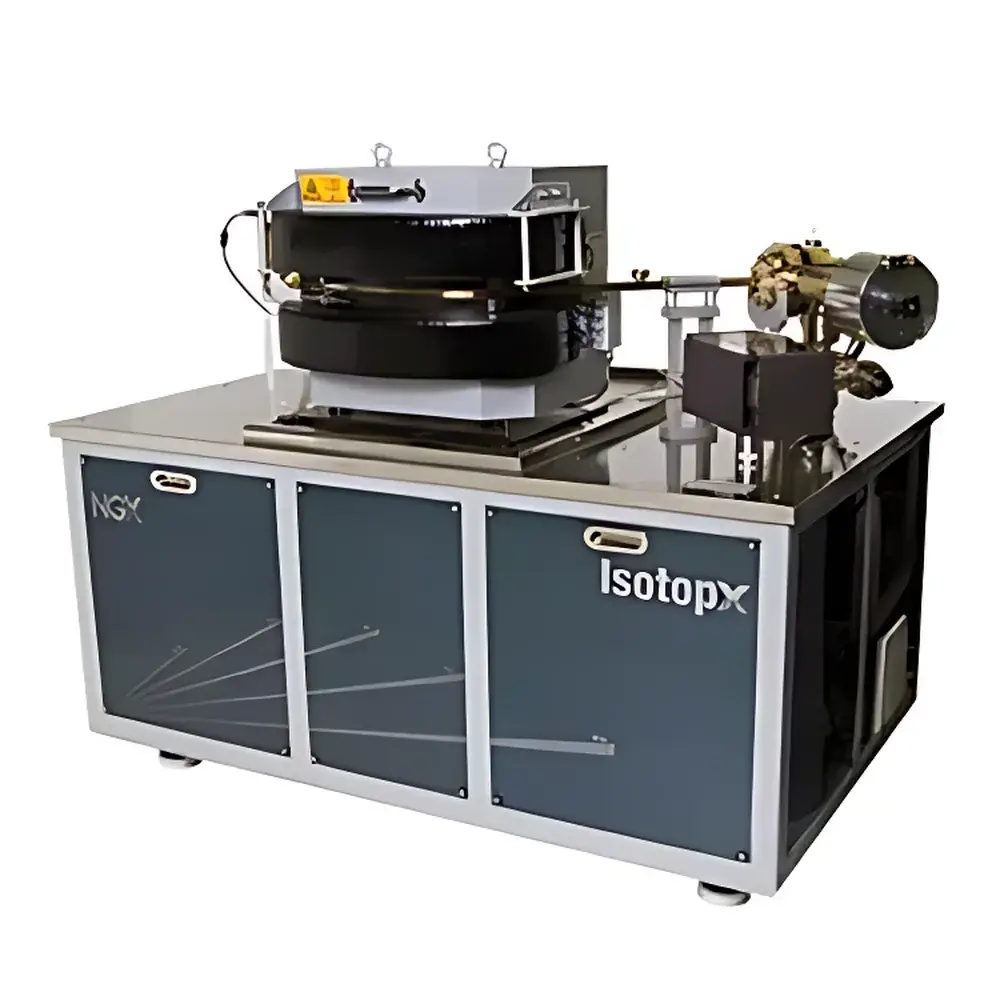
ISOTOPX NGX-600 Rare Gas Isotope Ratio Mass Spectrometer
| Brand | ISOTOPX |
|---|---|
| Origin | United Kingdom |
| Model | NGX-600 |
| Instrument Type | Rare Gas Isotope Ratio Mass Spectrometer |
| Mass Range | 1–200 Da |
| Resolution | 400–600 |
| Detection System | Configurable Faraday Cup and Ion Counter Electron Multiplier Array |
| Standard Amplifier | ATONA Amplifier |
| Vacuum System | Compact Static Vacuum Gauge |
| Ion Source | High-Sensitivity Nier-Type Source |
Overview
The ISOTOPX NGX-600 is a high-precision, fully automated multi-collector isotope ratio mass spectrometer (IRMS) specifically engineered for the quantitative analysis of noble gas isotopes—helium (He), neon (Ne), argon (Ar), krypton (Kr), and xenon (Xe). Operating on magnetic sector mass separation principles, the NGX-600 employs double-focusing geometry (electric + magnetic sectors) to achieve high mass resolution and exceptional ion transmission efficiency. Its core measurement capability centers on precise isotope ratio determination at sub-permil precision levels, enabling robust geochronological, cosmochemical, and thermochronological investigations where isotopic signatures carry critical age, source, or process information.
Key Features
- High-Resolution Magnetic Sector Design: Features a large-radius magnet (≥1.2 m effective path) optimized for ion optical stability, improved mass peak flatness, and enhanced signal-to-noise ratio across the full 1–200 Da range.
- Rotatable Ion Focal Plane: A mechanically adjustable focal plane ensures orthogonal alignment between ion trajectories and detector array surfaces—eliminating angular sensitivity in peak shape and maximizing reproducibility across all isotopic masses.
- ATONA Amplifier Integration: Standard-fitted ATONA (Analog-to-Digital Transimpedance Optimized Null Amplifier) technology delivers real-time gain stabilization and ultra-low noise performance for all Faraday cup channels, compliant with long-term drift requirements under GLP/GMP-aligned operation.
- Modular Detector Array: Supports customizable configurations of Faraday cups and discrete-dynode electron multipliers (EMs), enabling simultaneous detection of up to nine xenon isotopes (e.g., 124Xe–136Xe) without scanning.
- Nier-Type High-Sensitivity Ion Source: Optimized for low-volume, high-efficiency ionization of noble gases with minimized memory effects and rapid sample-to-sample washout—critical for high-throughput geological sample batches.
- Compact Ultra-High Vacuum Architecture: Integrated static vacuum gauge and low-outgassing chamber design maintain base pressures ≤5×10⁻¹⁰ mbar, minimizing background interferences from residual hydrocarbons and water clusters.
Sample Compatibility & Compliance
The NGX-600 interfaces seamlessly with standard noble gas extraction lines (e.g., furnace-based, laser-probe, or noble gas purification systems) via UHV-compatible CF-40 or ISO-KF flanges. It complies with ISO/IEC 17025 analytical validation requirements for isotope ratio measurements and supports audit-ready data acquisition under FDA 21 CFR Part 11-compliant software environments. All calibration protocols—including bracketing with certified reference materials (e.g., HESJ, ACME, NBL-1)—are traceable to SI units through NIST-traceable standards. The system meets ASTM D7922–22 (Standard Test Method for Isotopic Analysis of Noble Gases by Multi-Collector IRMS) and supports USP and ISO 17034 quality assurance frameworks for certified reference material producers.
Software & Data Management
Control and data reduction are managed via ISOTOPX’s proprietary NGX Control Suite v4.x—a Windows-based application supporting real-time spectral visualization, automatic peak centering, dynamic baseline correction, and multi-point mass calibration. Raw data files (.ngd) are structured in HDF5 format, ensuring long-term archival integrity and compatibility with third-party processing tools (e.g., Iolite, Squid2, or custom Python-based reduction pipelines). Audit trails record operator actions, instrument parameters, calibration events, and file modifications with timestamped digital signatures. Export modules support direct integration into LIMS platforms via ODBC or RESTful API endpoints.
Applications
- Geochronology: 40Ar/39Ar step-heating and laser microprobe dating; 3He/4He thermochronology in apatite and zircon; U-Th/He age modeling with atmospheric correction.
- Cosmochemistry: Measurement of nucleogenic and radiogenic isotopes (e.g., 21Ne/20Ne, 129Xe/130Xe) in meteorites and lunar samples to constrain irradiation history and planetary volatile evolution.
- Hydrogeology & Volcanology: Noble gas fingerprinting of groundwater recharge sources, mantle-derived volatiles in volcanic gases, and crustal degassing pathways using He–Ne–Ar ternary diagrams.
- Environmental Tracer Studies: Quantification of anthropogenic Kr-85 and Xe-133 in atmospheric monitoring networks; dual-isotope tracing (e.g., 3He/4He + 20Ne/22Ne) in nuclear facility effluent verification.
FAQ
What vacuum level does the NGX-600 require for optimal rare gas analysis?
The instrument achieves stable operation at base pressures ≤5×10⁻¹⁰ mbar, maintained by a combination of turbomolecular pumping and non-evaporable getter (NEG) panels—ensuring minimal interference from residual H2O, CO, and hydrocarbon species.
Can the NGX-600 resolve 3He from HD and 20Ne from doubly charged 40Ar2+?
Yes. With mass resolution (M/ΔM) ≥400 at 10% valley definition, the NGX-600 cleanly separates 3He (3.016 Da) from HD (3.022 Da) and 20Ne (19.992 Da) from 40Ar2+ (19.963 Da), eliminating major isobaric overlaps common in low-resolution quadrupole systems.
Is the ATONA amplifier compatible with all Faraday detectors in the array?
Yes. The patented ATONA architecture (GB2552233) is factory-integrated across all Faraday cup channels, providing matched gain stability, sub-femtoamp current resolution, and automatic offset compensation without manual recalibration.
Does the NGX-600 support compliance with regulatory data integrity standards?
Yes. Full 21 CFR Part 11 functionality—including electronic signatures, role-based access control, immutable audit logs, and secure data archiving—is implemented at the firmware and software layer, supporting FDA, EMA, and ISO 17025 laboratory accreditation.





