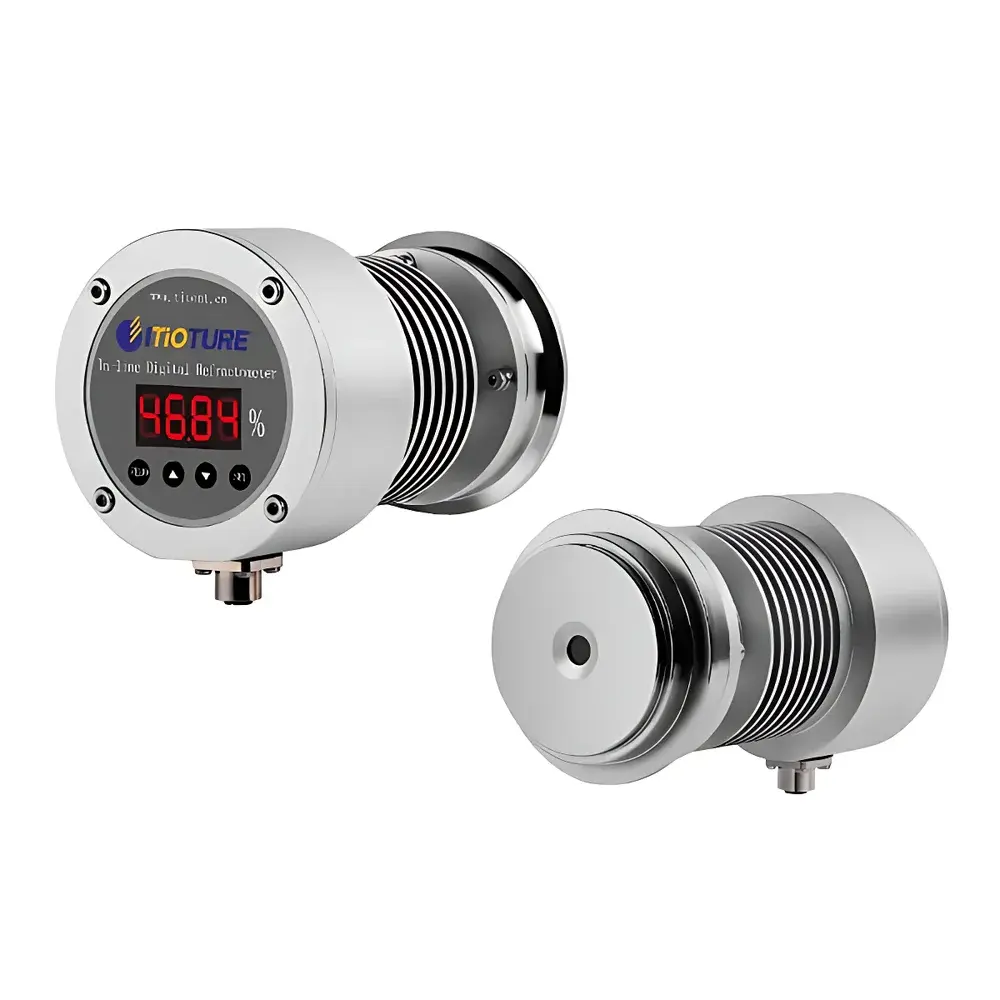
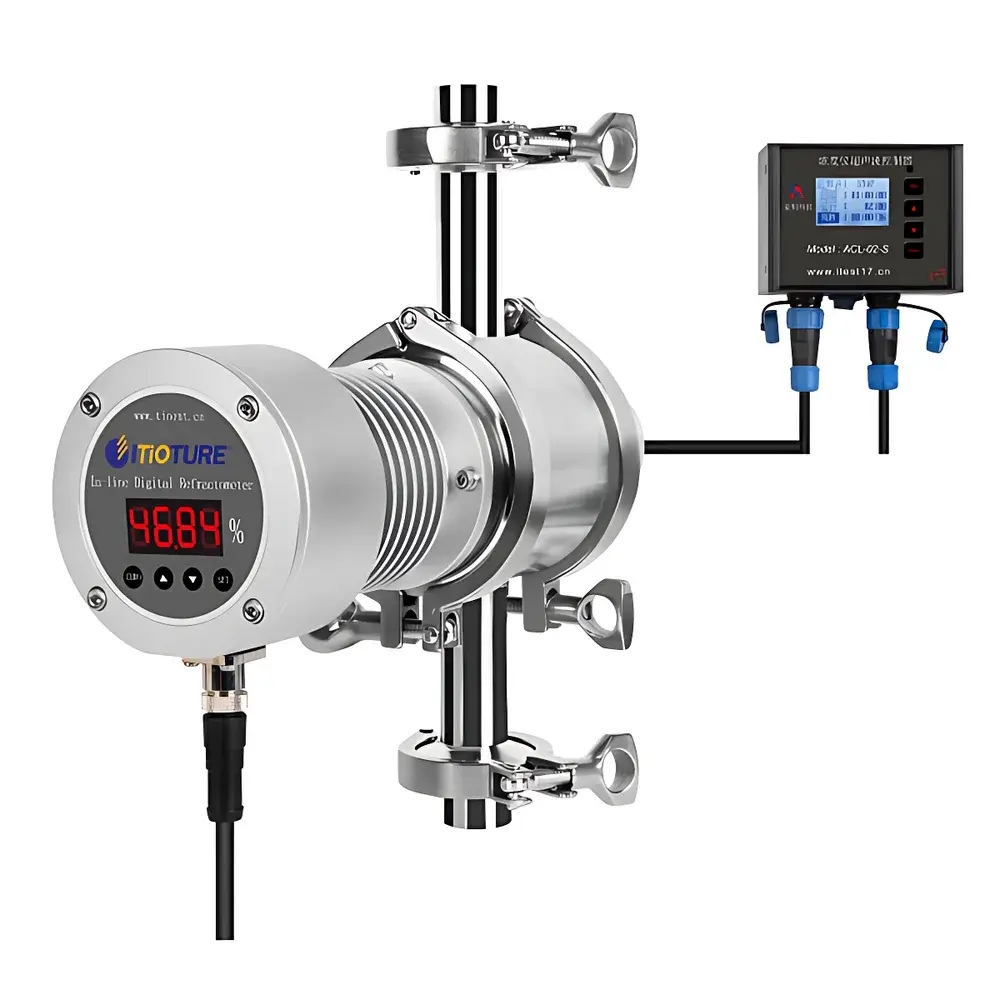
Itioture ACDR-B85 Advanced In-Line Refractometer for Real-Time Brix and Concentration Monitoring
| Brand | Itioture |
|---|---|
| Model | ACDR-B85 |
| Measurement Range | Brix 0–85%, Temperature 0–60°C |
| Accuracy | ±0.1% Brix |
| Resolution | 0.01% Brix |
| Output | 4–20 mA (concentration), RS485 Modbus RTU |
| Power Supply | DC 24 V, 5 VA |
| Pressure Rating | 1.5 MPa (max) |
| Temperature Limit | 100°C (process fluid) |
| Enclosure Rating | IP67 |
| Installation | Clamp-type inline (standard), optional threaded or flanged mounting |
| Optional Accessories | ACL-02S pipe adapter, ACL-03S ultrasonic cleaning module |
Overview
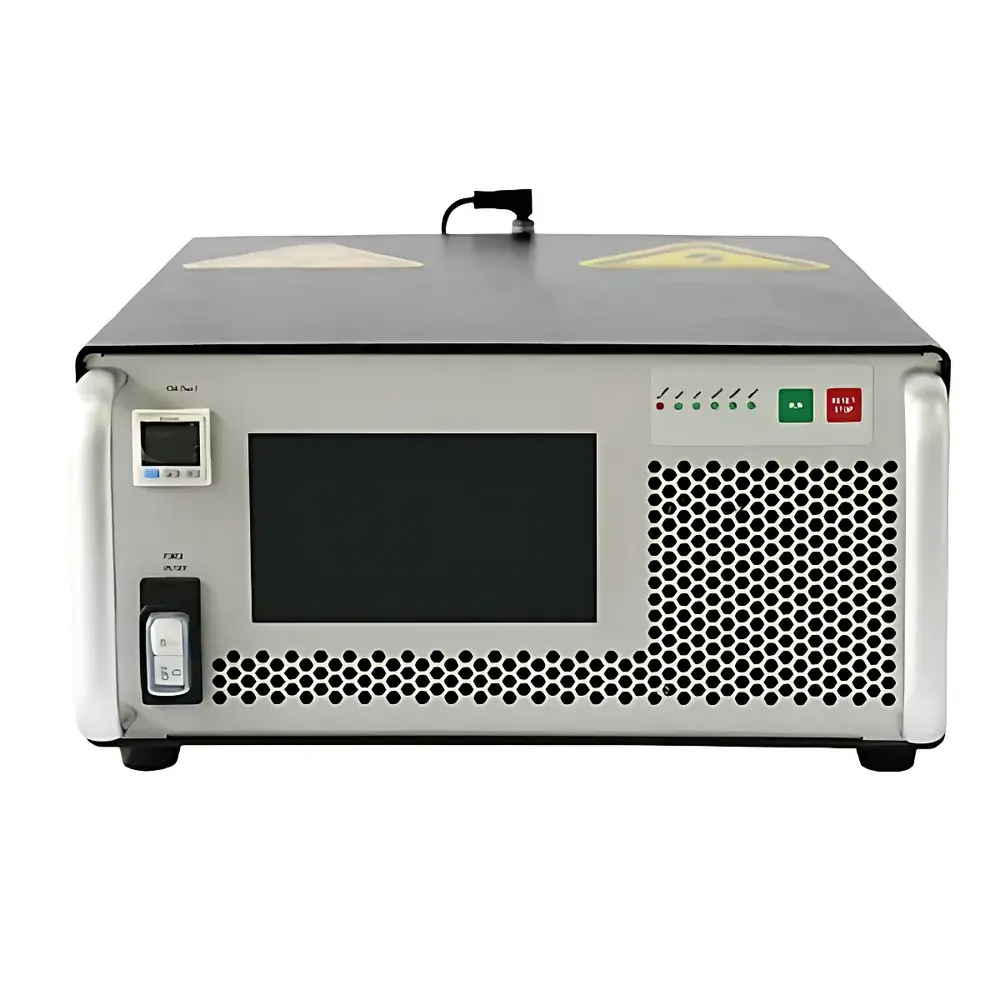
The Itioture ACDR-B85 is a high-stability, industrial-grade in-line refractometer engineered for continuous, real-time measurement of soluble solids concentration—expressed as Brix (%)—in liquid process streams. Based on the fundamental optical principle of critical angle refractometry, the sensor projects a collimated light beam onto the interface between sapphire prism and process fluid; the resulting shift in critical angle is precisely correlated to the solution’s refractive index, which is then converted to Brix, mass fraction (% w/w), or refractive index (nD) using calibrated polynomial algorithms. Designed for integration into hygienic and non-hygienic production lines—including food & beverage, pharmaceutical intermediates, chemical synthesis, and biofermentation—the ACDR-B85 delivers metrologically traceable concentration data with minimal process intrusion. Its compact, modular architecture enables direct insertion into pressurized flow paths without bypass loops or sample extraction, eliminating sampling lag and preserving process integrity.
Key Features
- Real-time measurement cycle configurable from 1 to 10 seconds—optimized for dynamic concentration control loops
- Sapphire optical prism with high chemical resistance and abrasion tolerance—suitable for abrasive slurries, viscous emulsions, and caustic cleaning-in-place (CIP) media
- Integrated Pt1000 temperature sensor with automatic temperature compensation (ATC) per ISO 21542 and ICUMSA standard protocols
- Robust stainless steel (316L) wetted housing rated to 1.5 MPa working pressure and 100°C transient thermal exposure
- IP67-rated electronics enclosure with dual-sealed optical window—certified for washdown environments per EN 60529
- Field-configurable analog output (4–20 mA) and digital communication via RS485 Modbus RTU—compatible with DCS, PLC, and SCADA systems
Sample Compatibility & Compliance
The ACDR-B85 is validated for use with aqueous solutions containing sugars, organic acids, alcohols, glycols, salts, and polymer dispersions—provided turbidity remains below 5 NTU and suspended solids content does not exceed 5% v/v. It complies with electromagnetic compatibility standards IEC 61326-1 (industrial environment) and meets functional safety requirements for SIL 2-capable systems when integrated with certified logic solvers. While not intrinsically safe, it may be deployed in Zone 2/Class I Div 2 areas with appropriate barrier certification. The instrument supports audit-ready operation under GLP and GMP frameworks through optional time-stamped data logging and Modbus register access to raw refractive index, temperature, and diagnostic flags—enabling alignment with FDA 21 CFR Part 11 data integrity expectations when paired with compliant host software.
Software & Data Management
No proprietary PC software is required for basic operation; configuration is performed via Modbus register mapping or handheld HART-compatible configurators. For advanced diagnostics and trend analysis, the ACDR-B85 supports seamless integration into industry-standard platforms including Siemens Desigo CC, Emerson DeltaV, Rockwell FactoryTalk, and Ignition SCADA. All measurement outputs—including Brix, temperature, refractive index, signal quality index (SQI), and cleaning status—are accessible as discrete Modbus holding registers. Optional firmware updates enable future expansion of calibration models (e.g., ethanol-water, NaOH concentration) and enhanced drift-correction algorithms based on long-term stability profiling.
Applications
- Continuous Brix monitoring in juice concentration, syrup blending, and dairy evaporation lines
- Real-time control of sugar content in confectionery cooking kettles and caramelization reactors
- Concentration verification during CIP return streams and solvent recovery distillation columns
- In-process validation of API crystallization endpoints in pharmaceutical batch manufacturing
- Monitoring of glycol concentration in heat transfer fluids and antifreeze production
- Stabilization of fermentation broth density in ethanol and organic acid bioprocesses
FAQ
Can the ACDR-B85 measure non-sugar solutes such as sodium chloride or sodium hydroxide?
Yes—while factory-calibrated for sucrose-based Brix, the device outputs raw refractive index (nD) and temperature values, enabling user-defined calibration curves for alternative solutes per ASTM D1218 or ISO 1042. Custom calibration services are available upon request.
Is the sapphire prism susceptible to fouling in high-fat or protein-rich streams?
Fouling mitigation is addressed via optional ACL-03S ultrasonic cleaning modules or motorized brush assemblies, both programmable via Modbus or external PLC triggers. Cleaning intervals can be scheduled or triggered by SQI degradation thresholds.
Does the instrument support temperature-compensated density calculation?
Yes—by combining real-time nD and temperature inputs, the device can compute compensated density estimates using empirical correlations aligned with ISO 17025-accredited reference methods.
What is the minimum flow velocity required for stable measurement?
A minimum linear velocity of 0.3 m/s is recommended to ensure laminar flow across the prism surface and avoid boundary layer artifacts; lower velocities may be accommodated with flow conditioning inserts.