
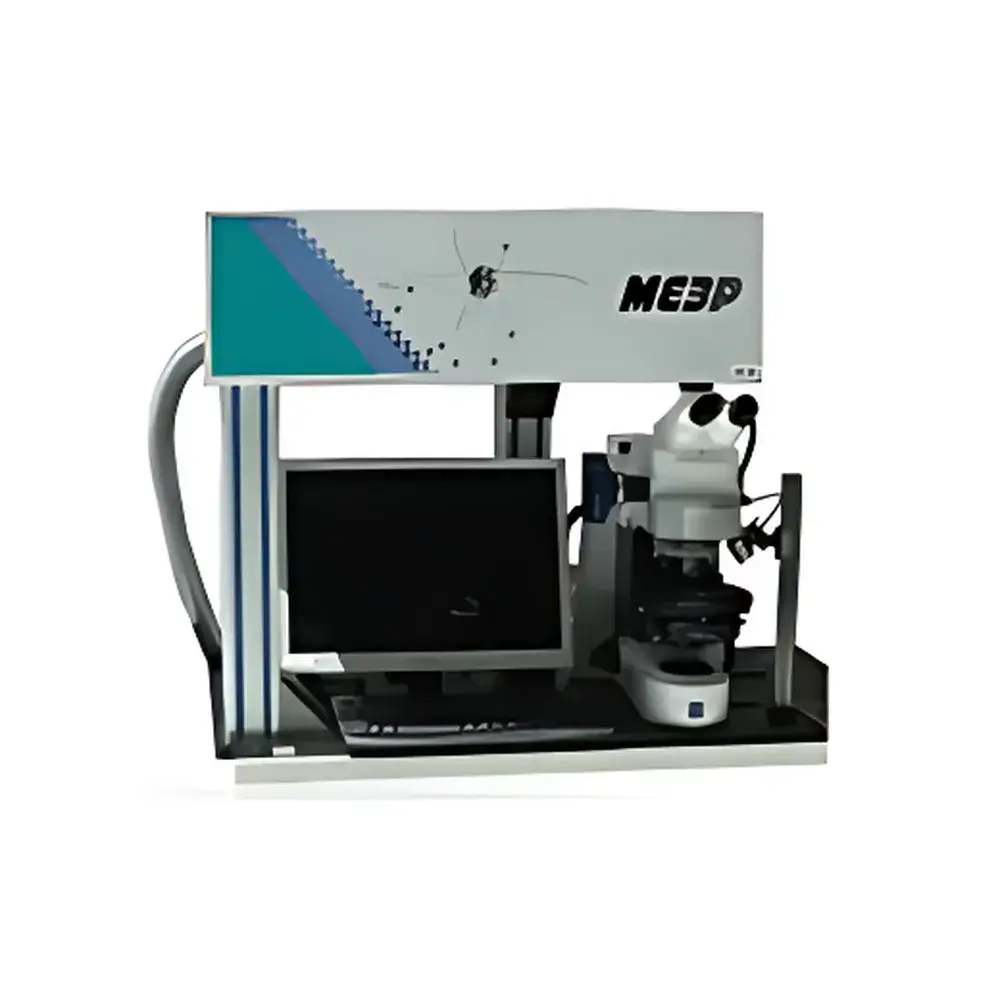
IVEA MEEPLIBS Microscale Spatial-Resolution Laser-Induced Breakdown Spectroscopy System
| Brand | IVEA |
|---|---|
| Origin | France |
| Model | MEEPLIBS |
| Instrument Type | Online LIBS System |
| Integration | Fully Integrated |
| Spatial Resolution | Down to 4 µm (Standard Apertures: 15 µm and 18 µm) |
| Operating Environment | Ambient Air at Room Temperature (Configurable for Controlled Atmospheres) |
| Laser Source | Q-Switched Nd:YAG, 266 nm UV, Software-Tunable Pulse Energy with Beam Shaping & Attenuation |
| Sample Handling | Motorized XYZ Translation Stage with Real-Time CCD Imaging Feedback |
| Elemental Coverage | H to U (All Elements, Including Light Elements) |
| Sample Preparation | None Required |
Overview
The IVEA MEEPLIBS is a fully integrated, online-capable microscale spatial-resolution Laser-Induced Breakdown Spectroscopy (LIBS) system engineered for quantitative elemental mapping at the micrometer level. It combines a high-stability 266 nm ultraviolet pulsed laser source with precision optical coupling to a high-magnification microscope objective and a high-sensitivity echelle spectrometer. The system operates on the fundamental principle of laser ablation: a focused UV pulse generates a transient microplasma on the sample surface; emitted atomic/ionic line spectra from the plasma are dispersed and resolved by the spectrometer, enabling simultaneous multi-element detection without spectral overlap interference typical in broadband LIBS systems. Unlike conventional benchtop LIBS instruments, MEEPLIBS achieves true microscale spatial resolution—down to 4 µm spot size—by integrating diffraction-limited beam delivery, active thermal stabilization of optical paths, and real-time visual feedback via a co-aligned CCD camera. This architecture ensures reproducible ablation geometry and precise correlation between acquired spectra and physical sample coordinates—critical for failure analysis in advanced semiconductor manufacturing and compositional grading in display panel substrates.
Key Features
- UV 266 nm Q-switched Nd:YAG laser with software-controlled pulse energy attenuation and beam homogenization optics—enabling stable ablation across diverse material classes (dielectrics, metals, thin films) while minimizing thermal diffusion and crater distortion.
- Motorized XYZ translation stage with sub-micron repeatability (< ±0.2 µm) and programmable raster scanning capability for automated elemental mapping over mm²–cm² areas.
- Integrated coaxial CCD imaging system providing live video feed synchronized with laser firing position—allowing accurate region-of-interest (ROI) selection, focus verification, and post-acquisition spatial registration of spectral data.
- Active temperature regulation of spectrometer and detector assembly to maintain wavelength calibration stability (< 0.005 nm drift over 8 h), essential for long-duration mapping and inter-session comparability.
- Zero-sample-prep workflow: direct solid analysis in ambient air or configurable gas environments (e.g., Ar, He, N₂) to enhance signal-to-background ratio for light elements (Li, Be, B, C, N, O, F).
- Fully integrated hardware control via IVEA’s proprietary acquisition software—supporting trigger synchronization between laser pulses, stage motion, and spectral acquisition with < 10 µs timing jitter.
Sample Compatibility & Compliance
MEEPLIBS accommodates flat, polished, or as-received solid samples up to 150 mm × 150 mm × 50 mm (W × L × H), including silicon wafers, OLED/TFT backplanes, ceramic substrates, metallized polymer films, and geological thin sections. No conductive coating or vacuum pumping is required. The system complies with CE marking requirements for electromagnetic compatibility (EN 61326-1) and laser safety (IEC 60825-1 Class 4, interlocked enclosure). Data acquisition workflows support audit-trail generation aligned with GLP and GMP documentation practices. While not pre-certified for FDA 21 CFR Part 11, the software architecture supports electronic signature implementation and user-access-level configuration—facilitating validation in regulated environments.
Software & Data Management
Acquisition and analysis are performed using IVEA’s MEEPLIBS Control Suite v4.x—a Windows-based application with modular architecture for instrument control, spectral processing, and spatial data visualization. Core functions include automatic background subtraction (iterative polynomial fitting), peak identification using NIST Atomic Spectra Database references, multivariate curve resolution (MCR) for overlapping emission lines, and pixel-wise univariate/multivariate quantification calibrated against certified reference materials (CRMs). Export formats include HDF5 (for FAIR-compliant metadata embedding), CSV (spectral traces), GeoTIFF (elemental maps), and MGF (mass-spec-like spectral exchange). All raw spectra, stage coordinates, laser parameters, and environmental logs are time-stamped and stored in a relational SQLite database—enabling traceable reprocessing and version-controlled analysis pipelines.
Applications
- Semiconductor process control: depth-resolved impurity profiling at gate oxide interfaces, dopant distribution mapping in FinFET structures, and contamination tracing in EUV mask blanks.
- Flat-panel display R&D: lateral uniformity assessment of indium tin oxide (ITO) layers, segregation analysis of Mg-doped GaN emitters, and interfacial reaction layer characterization in tandem OLED stacks.
- Advanced packaging: solder joint composition verification, void detection via localized stoichiometric deviation, and Cu/Ni diffusion barrier integrity evaluation.
- Materials science: grain-boundary segregation studies in high-entropy alloys, oxidation state mapping in transition-metal oxides, and inclusion analysis in single-crystal turbine blade superalloys.
- Forensics & cultural heritage: non-invasive pigment stratigraphy in painted artifacts and provenance determination of historical glass fragments.
FAQ
What is the minimum detectable spot size, and how is it verified?
The system achieves a nominal spot size of 4 µm (FWHM) under optimal focusing conditions, confirmed via knife-edge scanning and SEM cross-sectioning of ablation craters on Si standard wafers. Standard operational apertures are factory-calibrated at 15 µm and 18 µm for enhanced signal throughput in routine QA/QC applications.
Can MEEPLIBS perform depth profiling?
Yes—by combining single-pulse ablation with precise Z-axis stepping (50 nm increments), the system enables sequential layer removal and in situ spectral acquisition, supporting quantitative depth profiling with sub-10 nm axial resolution in homogeneous matrices.
Is vacuum operation supported?
No—the system is designed exclusively for atmospheric or gas-controlled environments. Vacuum compatibility would compromise the optical path integrity and thermal management architecture; alternative vacuum-compatible LIBS platforms are available from IVEA but are not part of the MEEPLIBS product line.
How is calibration traceability ensured?
Calibration is performed using NIST-traceable CRMs (e.g., NIST SRM 2782, 2783, 610) and validated per ISO 17025 procedures. Wavelength calibration uses internal Hg/Ar lamp references; intensity calibration employs certified photodiode standards traceable to PTB.
Does the system support automated pass/fail decision logic for inline inspection?
Yes—via customizable rule engines in the Control Suite, users can define threshold-based elemental ratios, spatial variance limits, or multivariate classification models (e.g., PLS-DA) that output binary pass/fail flags with confidence metrics—exportable to MES/SCADA systems via OPC UA or Modbus TCP.



