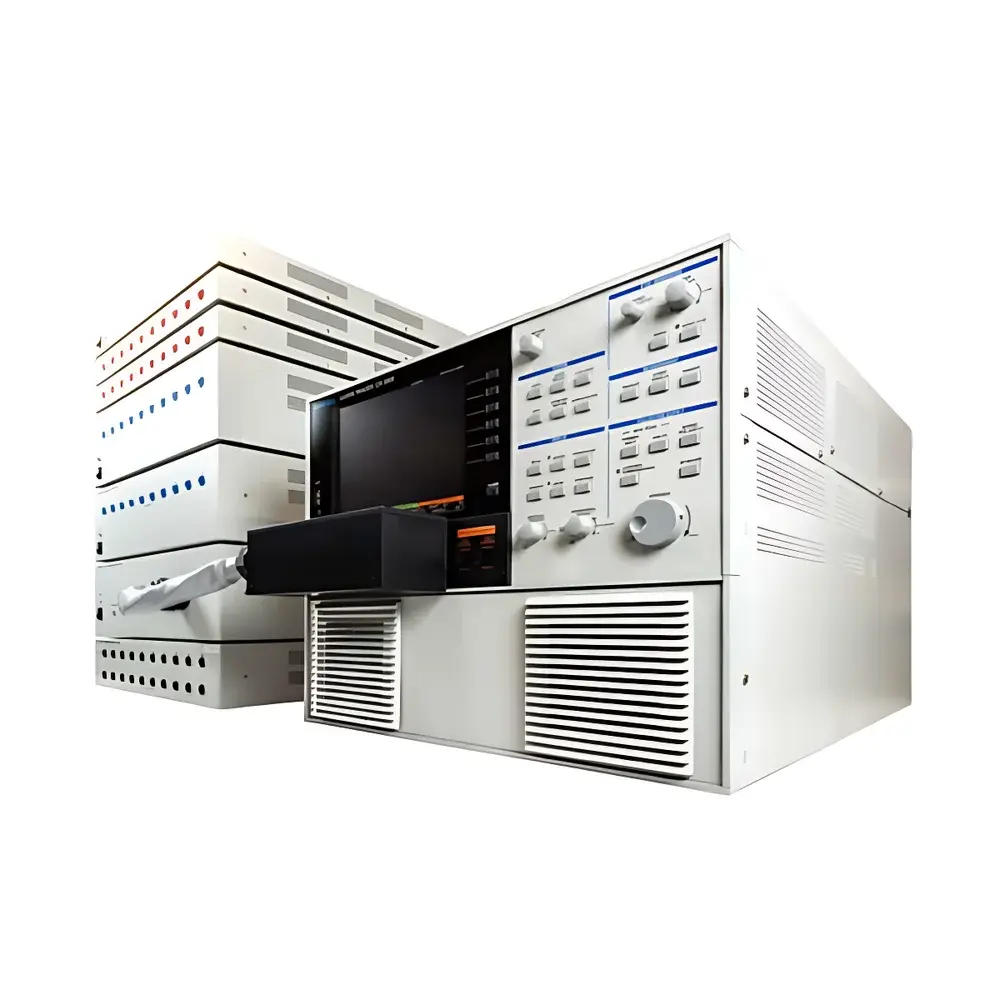
Iwatsu CS3000/5000/10000 Series Semiconductor Device Curve Tracer
| Brand | Iwatsu |
|---|---|
| Origin | Japan |
| Model Series | CS3000 (3 kV), CS5000 (5 kV), CS10000 (10 kV / 12 kV / 15 kV) |
| Compliance | IEC 61000-4-5, IEC 61010-1 CAT III 3 kV / CAT III 5 kV / CAT III 10 kV |
| Max Output Voltage | 3 kV / 5 kV / 15 kV |
| Max Output Current | 10 A (CS3000/CS5000), 50 A (CS10000-HC variant) |
| Sweep Modes | Linear, Logarithmic, Custom Segment, Bidirectional |
| Interface | USB 2.0, GPIB (optional), Analog Monitor Outputs |
| Software Support | CS-810 Automated Parameter Test Suite (optional), CS-800 Vth/hFE Auto-Detection & Limit Sweep Module (optional) |
Overview
The Iwatsu CS3000/5000/10000 Series Semiconductor Device Curve Tracer is a precision-engineered instrument designed for static and dynamic characterization of power semiconductor devices under controlled voltage and current stress conditions. Based on the fundamental principle of point-by-point or continuous swept-source I–V measurement—where a calibrated voltage ramp or current source is applied across device terminals while simultaneously monitoring resulting terminal currents—the system delivers traceable, repeatable, and high-fidelity device characteristic curves. Unlike general-purpose source-measure units (SMUs), the CS series integrates dedicated high-voltage isolation architecture, fast transient suppression circuitry, and real-time waveform monitoring to meet the stringent safety and fidelity requirements of power electronics R&D, qualification testing, and failure analysis labs. Each model is engineered for specific voltage-class applications: the CS3000 (3 kV) serves as the standard platform for discrete transistors (IGBTs, MOSFETs, BJTs, diodes); the CS5000 (5 kV) extends capability to medium-voltage power modules (e.g., 3.3 kV SiC and Si IGBT stacks); and the CS10000 series—with configurable 10 kV, 12 kV, and 15 kV output ratings—supports ultra-high-voltage (UHV) evaluation of thyristors (SCRs), high-voltage rectifiers, and emerging wide-bandgap devices under accelerated stress.
Key Features
- Configurable high-voltage output architecture with galvanically isolated HV amplifiers and optically triggered protection circuits—ensuring operator safety and measurement integrity per IEC 61010-1 CAT III ratings.
- Dual-mode display interface: “Configuration” mode visualizes internal signal routing and bias path selection in schematic format; “Wave” mode provides real-time oscilloscopic visualization of applied voltage and measured current waveforms at up to 1 MS/s sampling rate.
- Programmable sweep engine supporting linear, logarithmic, bidirectional, and user-defined segment sweeps—enabling resolution optimization for low-current leakage regions (<1 nA) and high-current conduction zones (>50 A) within a single test sequence.
- Dedicated hardware limit functions (via optional CS-800 module): voltage clamp, current limit, and auto-stop-on-threshold ensure device protection during parametric sweeps—critical for evaluating fragile gate oxides or thermally sensitive packaging.
- Constant-Voltage (CV) and Constant-Current (CC) bias modes—accessible via front-panel rotary controls or remote command—facilitate manual device probing, safe turn-on characterization, and step-stress reliability testing.
Sample Compatibility & Compliance
The CS series accommodates a broad spectrum of semiconductor packages—from TO-247 and D²PAK discretes to 62-mm and HPD power modules—via standardized high-voltage Kelvin probe fixtures and optional thermal chucks. All models comply with IEC 61000-4-5 (surge immunity), IEC 61010-1 (safety), and ISO/IEC 17025-aligned calibration traceability protocols. When integrated with environmental chambers and used with CS-810 software, the system supports multi-temperature parametric mapping compliant with JEDEC JESD22-A108 (temperature cycling) and JESD22-A110 (high-temperature operating life). Data acquisition meets GLP/GMP documentation standards when audit-trail logging and electronic signature features are enabled via CS-810’s FDA 21 CFR Part 11-compliant configuration.
Software & Data Management
The optional CS-810 Semiconductor Parameter Test Suite transforms the curve tracer into a fully automated test station. It enables script-driven fatigue testing (e.g., repeated VCE–IC sweeps over 10⁴ cycles), synchronized thermal profiling (via RS-485 or Ethernet-linked chamber control), and batch parameter extraction—including Vth, hFE, RDS(on), VF, and breakdown voltage (VBR). Measurement data exports natively to CSV, TXT, and binary formats; screen captures save in TIFF, PNG, or monochrome BMP with user-selectable background (black/white) and color depth. For secure environments where USB media is restricted, the included Remote Control Tool (freeware) permits full instrument control and data streaming over TCP/IP—retaining full timestamping, metadata tagging, and hierarchical folder structuring without physical media transfer.
Applications
This system is routinely deployed in power semiconductor development labs for: static DC parameter validation per JEDEC JESD22-B111 (leakage, gain, saturation); dynamic switching characterization (with external gate drivers and oscilloscope triggering); ruggedness evaluation (short-circuit withstand time, avalanche energy); gate oxide integrity screening; and comparative aging studies under combined electrical and thermal stress. It is also employed in university research for wide-bandgap device modeling (SiC, GaN), failure mechanism identification (hot carrier injection, TDDB), and teaching semiconductor physics through interactive I–V locus visualization.
FAQ
What safety certifications apply to the CS10000 series at 15 kV operation?
The CS10000-HV variant complies with IEC 61010-1 CAT III 15 kV and includes dual-redundant arc-detection circuitry, forced-air interlocked HV enclosure doors, and automatic discharge sequencing per IEEE 510-1983.
Can the CS-810 software perform statistical process control (SPC) on extracted parameters?
Yes—CS-810 supports real-time SPC charting (X-bar/R, Cpk, Ppk) with configurable control limits, outlier detection, and export to Minitab-compatible .MTW files.
Is differential voltage sensing supported for 4-wire Kelvin measurements?
All models feature true 4-terminal force-sense outputs with <10 µΩ sense path resistance and <100 pF input capacitance—enabling accurate RDS(on) and forward-voltage measurements independent of lead resistance.
How does the system handle device self-heating during extended sweeps?
The CS-810 software optionally integrates with thermal sensors (via analog input or Modbus RTU) to trigger sweep pauses or reduce dwell time when junction temperature exceeds user-defined thresholds—maintaining thermal stability per JEDEC JESD51-1.
Are calibration certificates NIST-traceable and issued with each unit?
Yes—each instrument ships with a factory calibration report traceable to NIST SRM 2172 (DC voltage) and SRM 2175 (DC current), valid for 12 months; accredited field recalibration services are available globally through Iwatsu-authorized metrology centers.