
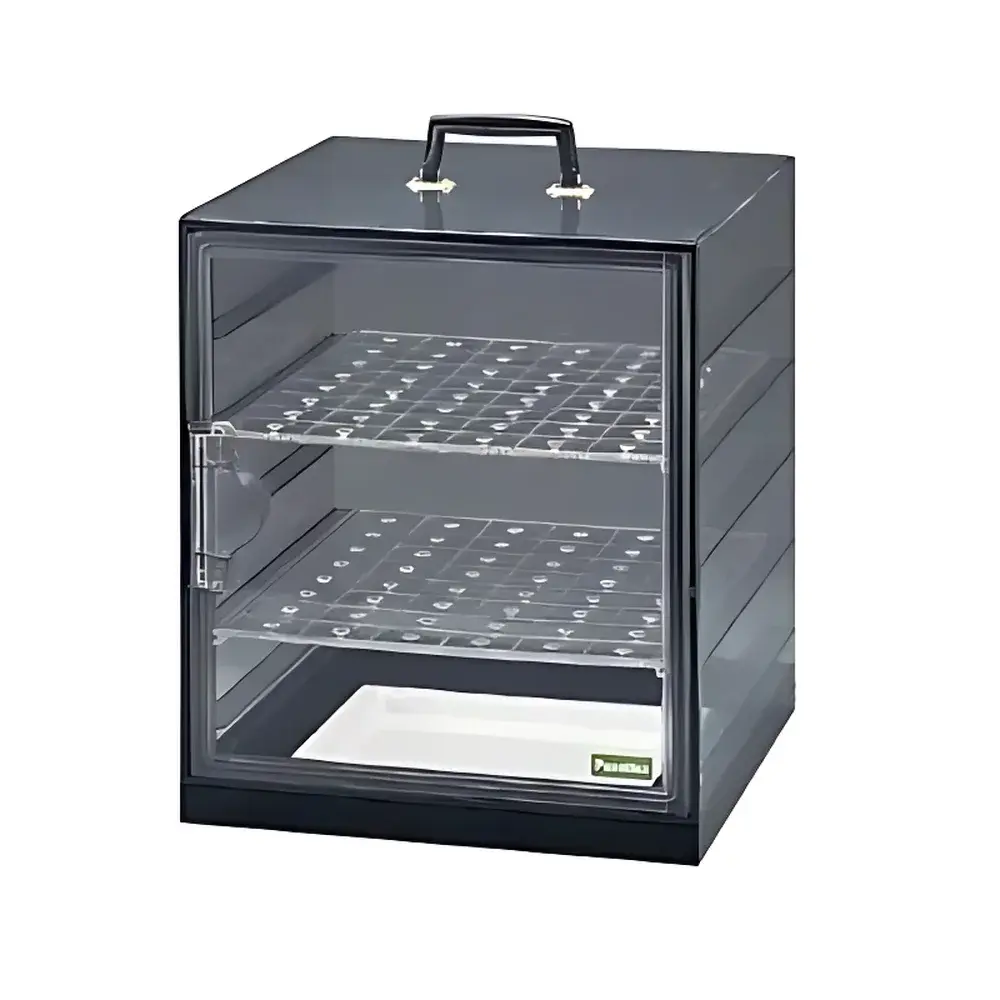
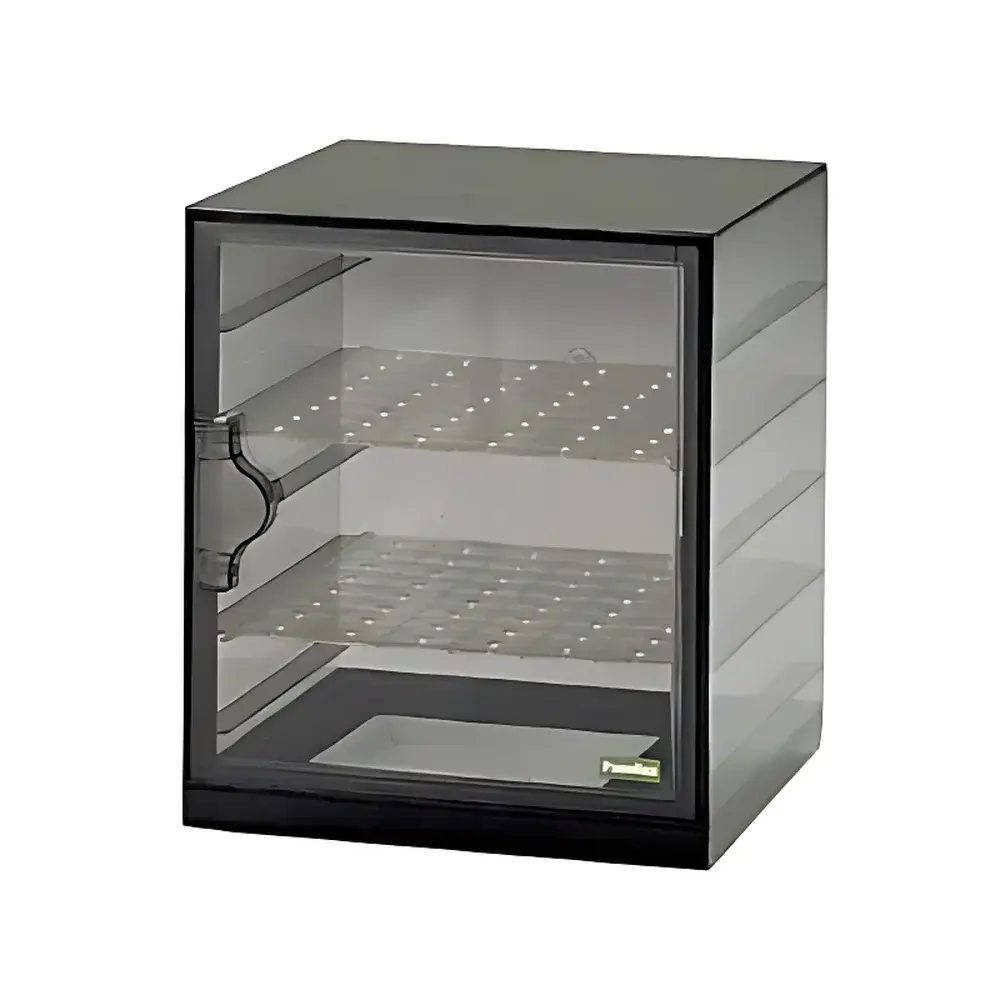
AS ONE IWH Desiccator Cabinet with Handle
| Brand | AS ONE |
|---|---|
| Origin | Japan |
| Manufacturer | AS ONE Co., Ltd. |
| Model | 1-961-01 |
| Instrument Type | Vacuum Desiccator Cabinet |
| External Dimensions | 350 × 350 × 400 mm |
| Internal Dimensions | 340 × 344.5 × 387 mm |
| Chamber Material | AS (Acrylonitrile-Styrene) Resin |
| Shelf Dimensions | 306 × 332 × 10 mm |
| Shelf Spacing | 65 mm (max. 5 shelves) |
| Shelf Load Capacity | 2 kg per shelf |
| Total Load Capacity | 5 kg |
| Net Weight | ~4.2 kg (including 2 shelves and 1 silica gel tray) |
| Accessories | 2 shelves, 1 silica gel tray |
Overview
The AS ONE IWH Desiccator Cabinet is a compact, manually operated low-humidity storage solution engineered for laboratories requiring reliable moisture control without vacuum or active dehumidification systems. Unlike electric desiccators or nitrogen-purged cabinets, the IWH relies on passive desiccant-based drying—primarily utilizing replaceable silica gel trays—to maintain a stable low-relative-humidity environment inside its sealed chamber. Its design follows fundamental principles of vapor-phase equilibrium suppression: by saturating the internal headspace with desiccant material, water activity is reduced to levels suitable for storing hygroscopic reagents, precision calibration standards, optical components, thin-film samples, and moisture-sensitive electronic assemblies. The cabinet is not intended for thermal drying or accelerated dehydration; rather, it serves as a static, ambient-temperature dry-storage platform compliant with general laboratory good storage practice (GSP) guidelines for humidity-sensitive materials.
Key Features
- Single-touch door actuation mechanism enables rapid, one-handed access—minimizing exposure time to ambient humidity during sample insertion or retrieval.
- Horizontal sliding flat-panel door allows lateral placement of elongated or plate-shaped items (e.g., wafers, slides, sensor substrates), optimizing spatial utilization within the constrained internal volume.
- Ergonomic integrated handle facilitates safe relocation across lab benches or between controlled environments without requiring auxiliary lifting tools.
- AS resin (acrylonitrile-styrene copolymer) construction provides chemical resistance to common solvents, dimensional stability under repeated humidity cycling, and non-outgassing behavior critical for cleanroom-adjacent applications.
- Modular shelving system supports up to five 306 × 332 mm shelves at 65 mm vertical intervals, enabling customizable layering for heterogeneous sample sets while maintaining consistent airflow distribution around desiccant trays.
Sample Compatibility & Compliance
The IWH cabinet accommodates standard laboratory consumables including glass vials (up to 50 mL), Petri dishes (90–100 mm), microscope slides, quartz cuvettes, and small PCBs. Its internal geometry—340 × 344.5 × 387 mm—ensures compatibility with ISO/IEC 17025-aligned storage protocols for reference materials requiring documented humidity history. While the unit itself carries no CE marking or UL certification (as it contains no electrical components), its passive operation eliminates electromagnetic interference risks and aligns with intrinsically safe storage requirements in analytical labs handling Class I flammable solids. It is routinely deployed in facilities adhering to ISO 14644-1 Class 7 cleanroom support zones and meets baseline environmental controls specified in ASTM E1447 (Standard Practice for Storage of Hygroscopic Reference Standards).
Software & Data Management
The AS ONE IWH is a fully manual, non-electronic device and does not incorporate embedded sensors, data loggers, or connectivity interfaces. Humidity monitoring must be performed externally using calibrated hygrometers (e.g., Vaisala HMP7 series) placed inside the chamber during qualification. Users are advised to implement paper-based or LIMS-integrated log sheets documenting desiccant replacement dates, visual inspection of silica gel color indicators (blue → pink transition), and periodic verification of seal integrity per SOP-DS-02 (Desiccator Cabinet Maintenance Protocol). For GLP/GMP-regulated environments, audit trails should include dated entries confirming compliance with internal humidity control thresholds (typically ≤30% RH for most pharmaceutical excipients and ≤15% RH for lithium battery cathode materials).
Applications
- Long-term storage of anhydrous salts (e.g., calcium chloride, magnesium sulfate) and desiccant-grade molecular sieves.
- Precursor storage for thin-film deposition processes where trace moisture induces nucleation defects in ALD/CVD precursors.
- Stabilization of NIST-traceable humidity calibration standards prior to gravimetric or spectroscopic validation.
- Interim holding of cleaned optical filters and laser optics to prevent water-film formation and subsequent coating degradation.
- Controlled ambient storage of hygroscopic polymers (e.g., polyvinyl alcohol, chitosan films) during mechanical testing preparation.
FAQ
Does the IWH cabinet include a built-in vacuum pump or pressure gauge?
No. The IWH is a passive desiccator cabinet and does not feature vacuum capability, pressure regulation, or any electrical components.
How often should the silica gel tray be regenerated or replaced?
Regeneration frequency depends on ambient humidity, opening frequency, and load mass. Under typical lab conditions (45–60% RH, 2–3 openings/day), visual inspection every 7–10 days is recommended; full regeneration (2–3 hours at 120°C) or replacement is required when >50% of the gel transitions from blue to pink.
Can this cabinet be used for storing lithium-ion battery materials?
Yes—provided internal RH is maintained below 10% via frequent desiccant maintenance. It is commonly used for cathode powder storage prior to slurry preparation in R&D labs following IEEE 1625 guidelines.
Is the AS resin interior compatible with acetone or isopropanol cleaning?
Yes. AS resin exhibits resistance to short-term exposure to IPA and acetone; however, prolonged immersion or ultrasonic cleaning is not recommended due to potential surface crazing.
What is the maximum operating temperature range for the IWH cabinet?
The cabinet is rated for ambient storage only (15–30°C). It is not designed for elevated temperature operation and must not be placed near heat sources or in direct sunlight.



