
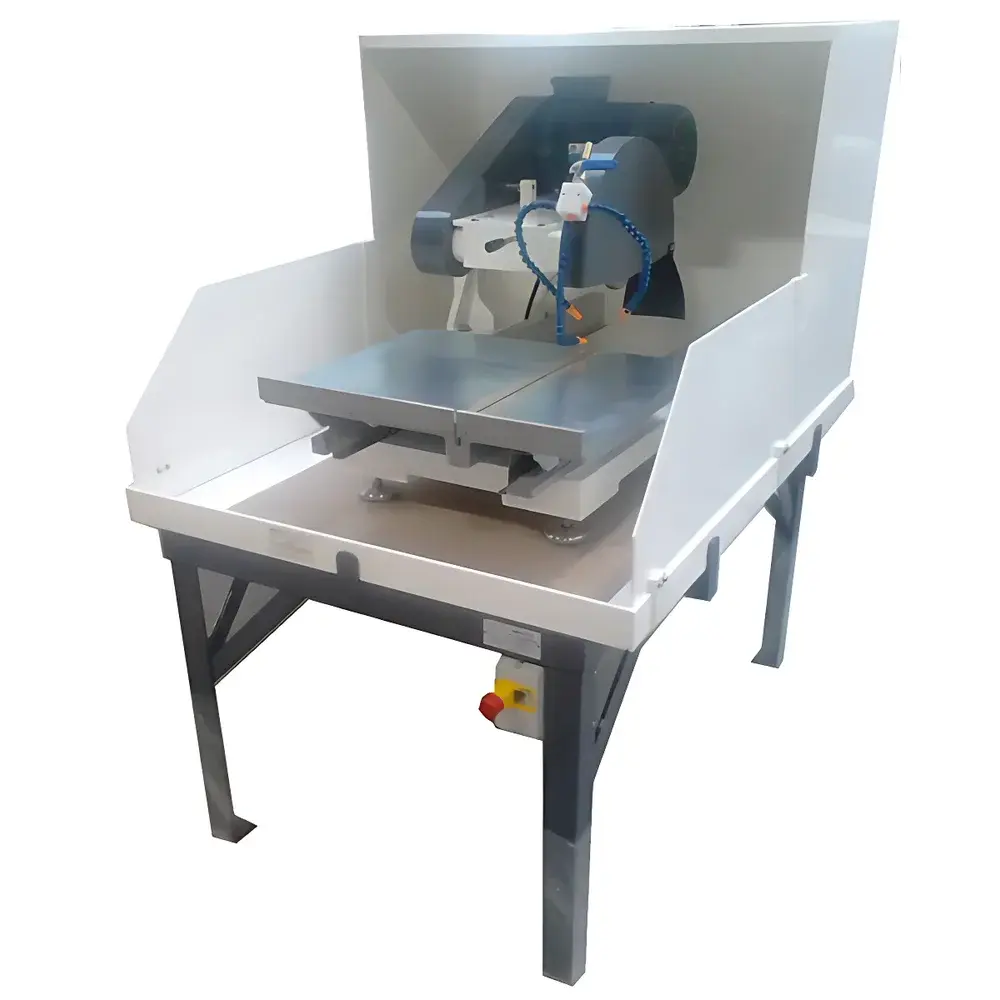
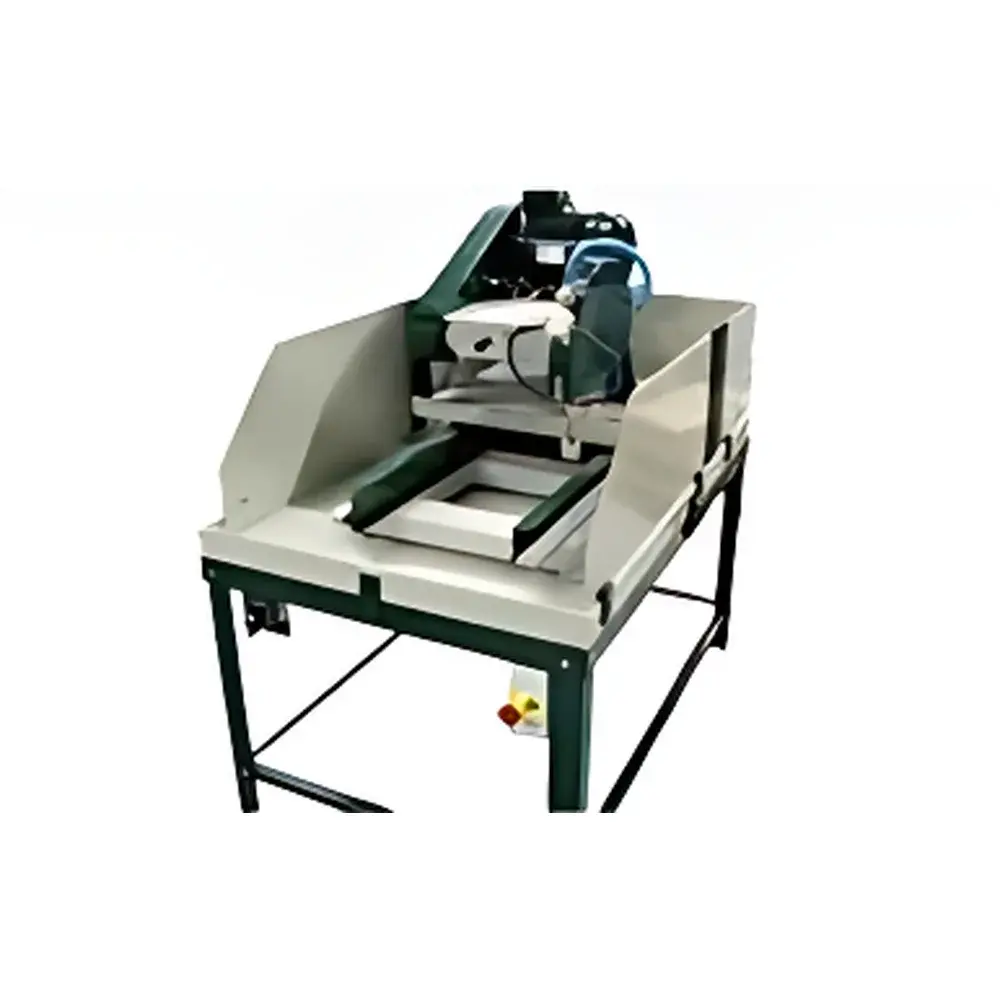
J0204 Industrial-Grade Precision Rock Cutting Machine
| Origin | France |
|---|---|
| Manufacturer Type | Authorized Distributor |
| Origin Category | Imported |
| Model | J0204 |
| Price Range | USD 27,000–68,000 (FOB) |
| Instrument Type | Precision Cutting Machine |
| Motor | 3 kW, 400 V / 50 Hz, IP55 |
| Diamond Blade Diameter | 400 mm (optional: 500 mm) |
| Spindle Speeds | 960 / 1440 / 2160 rpm (via stepped pulley system) |
| Maximum Core Length | 350 mm |
| Fixture Slot Dimensions | 30 × 45 mm |
| Working Surface | 620 mm (W) × 500 mm (L) |
| Table Height | 900 mm |
| Vertical Stroke | 680 mm |
| Dust Extraction Port | Optional 50–160 mm duct connection |
| Coolant System | Recirculating water pump with polypropylene coolant reservoir |
| Safety Features | Reinforced base frame, splash guard, anti-vibration mounts, circuit breaker with overload protection |
Overview
The J0204 Industrial-Grade Precision Rock Cutting Machine is a heavy-duty, laboratory-engineered solution for the reproducible sectioning of large, irregular geological specimens—including massive rock blocks, drill cores, and heterogeneous ore samples—into standardized test sections. Designed around Couette-type mechanical cutting principles and optimized for high-mass inertia stability, the system employs a rigid cast-iron frame, precision-ground linear guides, and a dynamically balanced spindle assembly to ensure minimal runout (<0.05 mm TIR) under sustained load. Its modular architecture supports both dry-cutting (with integrated dust extraction via adjustable ducting) and wet-cutting (using recirculated deionized water for thermal management and particulate suppression), enabling compliance with occupational health standards such as OSHA 1910.1050 (crystalline silica exposure) and EU Directive 2004/37/EC. The machine meets structural safety requirements per EN ISO 12100 and electrical safety per IEC 61000-6-2/6-4.
Key Features
- Triple-speed spindle drive (960 / 1440 / 2160 rpm) via interchangeable V-belt pulleys—enabling optimal blade velocity selection for varying hardness (e.g., quartzite vs. shale) while maintaining torque integrity
- Adjustable vertical stroke (680 mm) with fine-positioning micrometer scale (0.1 mm resolution) for repeatable depth-of-cut control
- Dual-mode sample handling: stainless-steel V-groove sliding rails with four bronze roller bearings provide low-friction lateral translation; optional vacuum-assisted clamping fixtures available for high-aspect-ratio specimens
- Integrated coolant management: submersible centrifugal pump circulates water through a corrosion-resistant polypropylene reservoir (capacity: 25 L), with temperature monitoring and automatic shutoff at >45°C
- Modular dust mitigation: rear-mounted 160 mm diameter exhaust port compatible with industrial cyclone separators or HEPA-filtered fume extraction systems
- Electrical safety architecture: IP55-rated motor enclosure, dual-pole circuit breaker with thermal-magnetic trip, emergency stop with mechanical latch, and grounded chassis with <1 Ω earth resistance
Sample Compatibility & Compliance
The J0204 accommodates specimens up to 350 mm in length and 200 mm in maximum cross-section. Its fixture system accepts both cylindrical core samples (standard NQ, HQ, PQ sizes) and irregularly shaped bulk rock fragments secured via custom aluminum alloy jigs (available as optional accessories). All wet-cutting operations comply with ASTM D3740 (Standard Practice for Evaluation of Laboratories Engaged in Testing and/or Inspection of Soil and Rock) for specimen preparation traceability. Dry-cutting configurations meet ISO 16000-7 (Indoor air — Part 7: Determination of volatile organic compounds) when coupled with certified filtration. The machine’s structural design conforms to GLP Annex 15 (Validation and Qualification) for equipment suitability assessment in regulated geotechnical and mining laboratories.
Software & Data Management
While the J0204 operates as a standalone electromechanical system without embedded firmware, it supports full auditability through external documentation protocols. Each cutting cycle can be logged manually or via optional USB-connected data logger (model DL-J0204-LOG), recording timestamp, selected speed, coolant flow rate (via inline turbine sensor), and operator ID. All logs are exportable in CSV format and compatible with LIMS platforms compliant with FDA 21 CFR Part 11 (electronic records and signatures) when paired with validated user authentication modules. Calibration certificates for blade runout, table flatness (±0.02 mm/m), and vertical travel linearity are supplied with initial commissioning and recommended annually per ISO/IEC 17025.
Applications
- Preparation of thin-section specimens (30 × 45 mm standard mount size) for petrographic microscopy and SEM-EDS analysis
- Sectioning of exploration drill cores for geochemical assay subsampling in accordance with AS/NZS 4317:2019 (Mineral exploration—Sampling and analysis)
- Manufacturing of standardized compression test specimens (e.g., ASTM D7012) from intact rock blocks
- Controlled fragmentation of metallurgical ores for liberation analysis and comminution modeling
- Archival sample splitting for certified reference material (CRM) production under ISO Guide 35
FAQ
What diamond blade specifications are supported?
Standard configuration includes a 400 mm diameter sintered diamond blade rated for granite-class hardness (Mohs 7–8); optional 500 mm blades are available with reinforced steel hubs and segmented rim geometry for improved chip clearance.
Is the machine suitable for cutting concrete or asphalt specimens?
Yes—when equipped with carbide-tipped or hybrid diamond-carbide blades, the J0204 achieves consistent sectioning of construction materials per ASTM C42/C42M (core sampling and testing of concrete).
Can the coolant system be adapted for use with biocidal additives?
The polypropylene reservoir and stainless-steel piping are chemically inert to common biocides (e.g., isothiazolinones); however, additive concentration must remain ≤0.5% v/v to prevent pump seal degradation.
What maintenance intervals are recommended?
Daily: visual inspection of coolant level and blade tension; weekly: lubrication of rail guides with lithium-based grease (NLGI #2); annually: full calibration verification and motor insulation resistance test (≥10 MΩ @ 500 V DC).



