
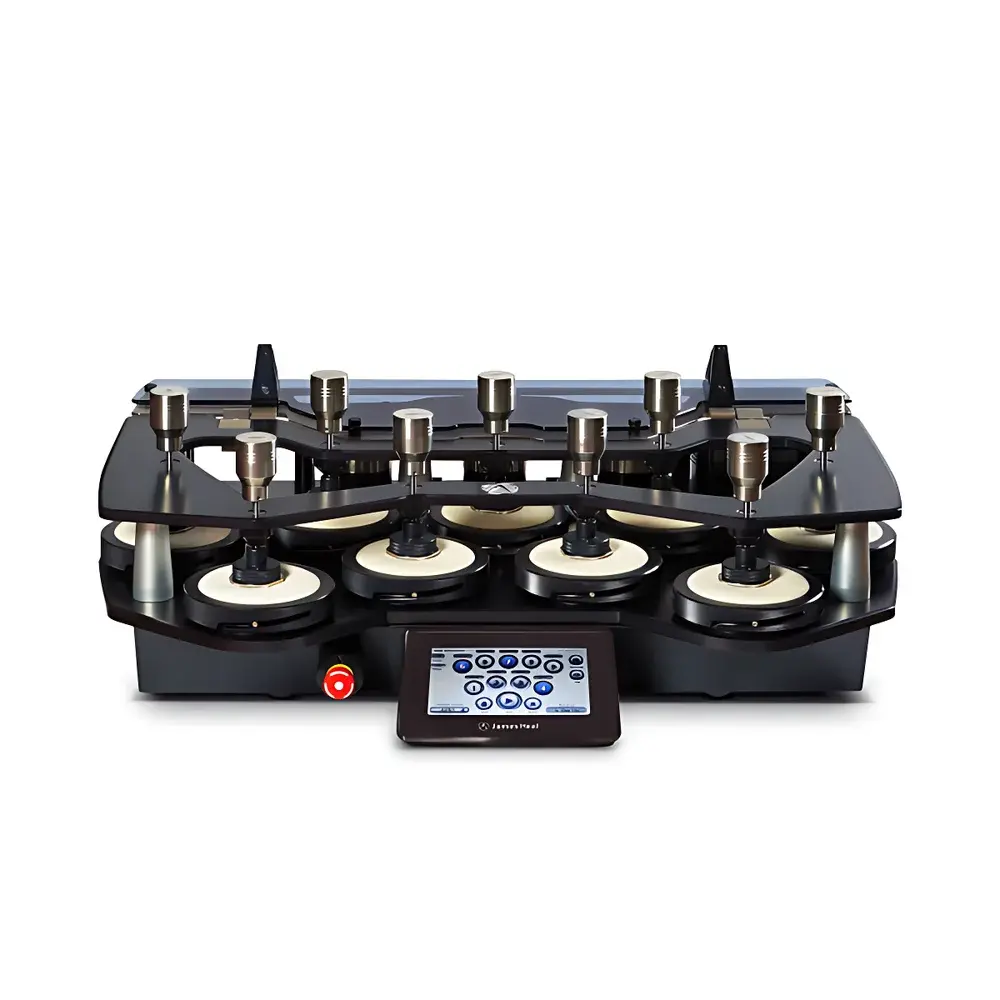
James Heal Martindale Abrasion Tester Model 1602W
| Origin | UK |
|---|---|
| Manufacturer Type | Authorized Distributor |
| Origin Category | Imported |
| Model | 1602W |
| Price Range | USD 13,500 – 67,500 |
| Instrument Type | Multi-Station Martindale Tribological Tester |
| Test Stations | 2 / 5 / 9 configurable |
| Display | 7-inch capacitive touchscreen interface |
| Counter | Independent station-based digital counter with real-time cycle tracking and estimated end-time prediction |
| Sample Holders | Interchangeable clamping fixtures for flat and contoured specimens |
| Compliance | Designed to meet ISO 12947-1/2/3, ASTM D4966, BS EN ISO 12947, GB/T 21196.1–21196.4 |
Overview
The James Heal Martindale Abrasion Tester Model 1602W is an engineered tribological testing system designed for standardized evaluation of abrasion resistance, pilling propensity, and surface durability in flexible sheet materials. Based on the well-established Martindale motion principle—where a circular specimen undergoes oscillatory rubbing against an abradant fabric under controlled load and defined Lissajous trajectory—the 1602W delivers high reproducibility across textile, leather, coated fabric, technical nonwovens, and upholstery applications. Its modular architecture supports 2-, 5-, or 9-station configurations, enabling parallel testing while maintaining individual station autonomy in cycle counting, load application, and endpoint monitoring. The instrument operates within strict mechanical tolerances aligned with international test standards, ensuring data integrity required for quality control laboratories, R&D departments, and third-party certification facilities.
Key Features
- 7-inch capacitive touchscreen HMI with intuitive navigation, real-time status visualization, and multilingual UI support (English, French, German, Spanish, Chinese)
- Independent digital counters per test station—each equipped with automatic cycle logging, elapsed time stamping, and dynamic end-time estimation based on current run rate
- Motor-driven eccentric mechanism delivering precise 24 ± 0.5 mm lateral displacement at 60 ± 1 cycles/min, compliant with ISO 12947-1 and ASTM D4966 specifications
- Standardized loading system with calibrated weights (9 kPa, 12 kPa) and optional auxiliary loads for elevated pressure testing (e.g., 20 kPa for automotive textiles)
- Tool-free sample mounting system featuring spring-loaded clamps and interchangeable holder inserts for flat fabrics, knitted socks, leather strips, and irregularly shaped specimens
- Rugged aluminum alloy frame with vibration-dampening base and IP20-rated electronics enclosure for stable operation in shared laboratory environments
- Integrated emergency stop button, overload protection circuitry, and mechanical limit switches for operator safety and equipment longevity
Sample Compatibility & Compliance
The 1602W accommodates specimens up to 140 mm in diameter (standard) or custom-cut geometries using adaptable fixture kits. It supports standard abradants including worsted wool (ISO 12947-2), sandpaper (ASTM D4966 Annex A1), and nylon mesh (for coated substrates). All configurations are validated against ISO 12947 parts 1–4 (determination of abrasion resistance and pilling behavior), ASTM D4966 (Martindale abrasion tester specification), BS EN ISO 12947 series, and GB/T 21196.1–21196.4 (Chinese national standards for textile wear testing). The system’s mechanical repeatability (< ±0.8% CV across 10 replicate runs) satisfies GLP-compliant documentation requirements when paired with James Heal’s optional audit-trail-enabled software package.
Software & Data Management
When integrated with James Heal’s optional TestLink Pro software (v4.2+), the 1602W enables automated test method recall, parameter locking, electronic signature capture, and 21 CFR Part 11–compliant audit trails—including user login history, method versioning, raw cycle/time logs, and exportable PDF/CSV reports. Data synchronization occurs via Ethernet or USB 2.0; no cloud dependency is required for local network deployment. All firmware updates are delivered through signed binary packages verified against SHA-256 checksums to ensure traceability and cybersecurity compliance in regulated environments.
Applications
- Quality assurance of apparel fabrics (woven/knitted cotton, polyester blends, denim, stretch fabrics)
- Pilling resistance assessment of sweaters, fleece, and brushed synthetics per ISO 12947-2
- Durability validation of automotive interior textiles, seat covers, and headliner materials
- Performance benchmarking of medical textiles (e.g., surgical gowns, drapes) under repeated flex-abrasion stress
- Leather and synthetic leather abrasion rating for footwear and furniture applications
- Research-grade correlation studies between Martindale cycles and real-world service life modeling
FAQ
What standards does the 1602W comply with?
The instrument meets ISO 12947-1/2/3/4, ASTM D4966, BS EN ISO 12947, and GB/T 21196.1–21196.4 for abrasion and pilling testing.
Can I upgrade from a 2-station to a 5-station configuration later?
Yes—modular chassis design allows field retrofitting with factory-certified kits, including updated firmware calibration and mechanical alignment verification.
Is the touchscreen interface compatible with glove use in cleanroom environments?
The capacitive screen supports stylus input and has adjustable touch sensitivity; however, standard nitrile or latex gloves may require stylus assistance for reliable actuation.
Does the system include abradant fabric and calibration tools?
Standard delivery includes one set of ISO-standard worsted wool abradant (50 sheets), calibration weight set (9 kPa & 12 kPa), and alignment jig; additional consumables are available as part number bundles.
What maintenance intervals are recommended?
Biannual inspection of eccentric drive bearings, quarterly cleaning of specimen holders and abradant trays, and annual torque verification of loading mechanisms per James Heal Maintenance Protocol MP-1602W Rev. 3.



