
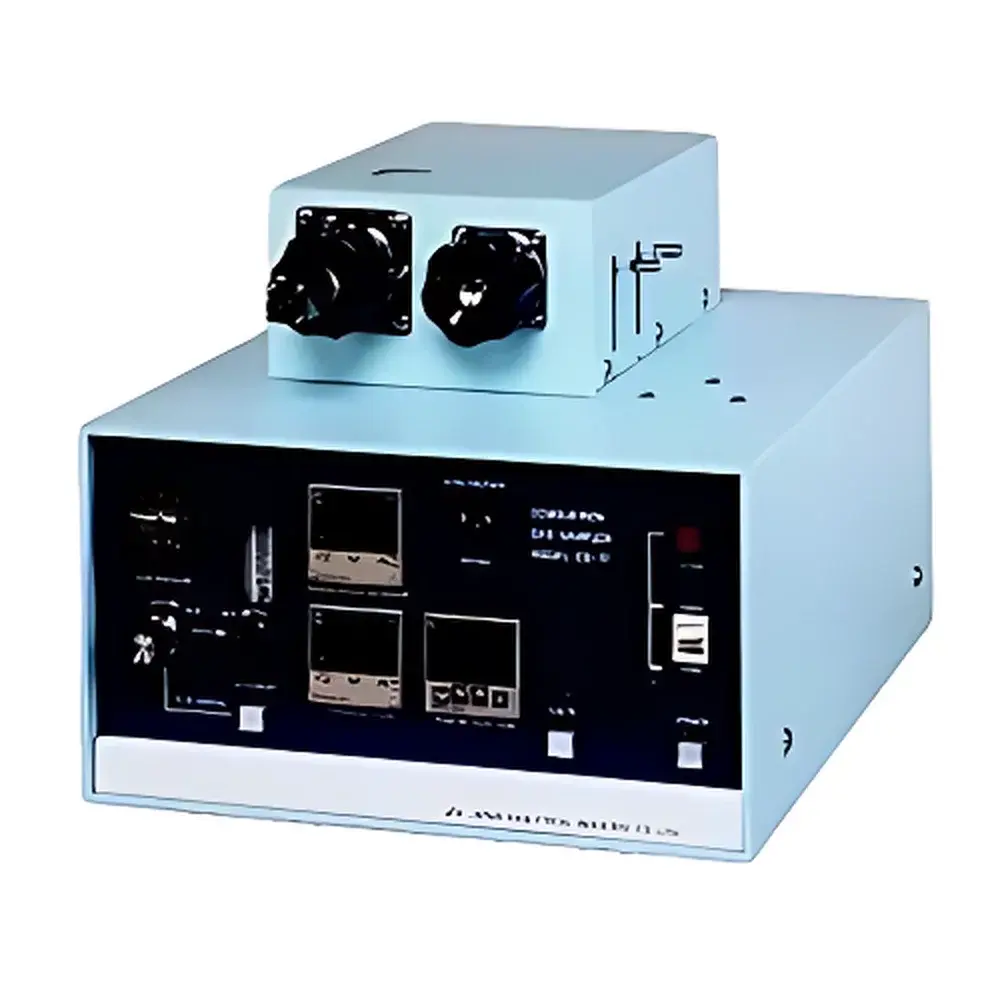
JASCO CG-77 Curie-Point Pyrolysis Combustion Gas Sampler
| Origin | Japan |
|---|---|
| Manufacturer Type | Authorized Distributor |
| Origin Category | Imported |
| Model | CG-77 |
| Quotation | Available Upon Request |
| Combustion Method | Thermal Decomposition–Oxidation |
| Combustion Tube Dimensions | 14 mm ID × 120 mm L |
| Heating Method | Curie-Point Induction Heating |
| RF Power Supply | 150 W Output |
| Ignition Coil Material | Nichrome Alloy |
| Operating Modes | Switchable Thermal Decomposition / Combustion via Front Panel Button |
| Combustion Chamber & Insulation Tube Temp Range | Ambient to 200 °C |
| Adsorption Tube Temp Range | Ambient to 200 °C (Optional CryoFocus Cryogenic Focusing Module Compatible) |
| Adsorption Tube Dimensions | 12 mm ID × 120 mm L |
| Auxiliary Gas Flow Rate | 0–500 mL/min, Pressure-Regulated |
| Dimensions (W×H×D) | 280 × 300 × 440 mm |
| Power Supply | 100 V AC, 4 A |
| Weight | 27.5 kg |
Overview
The JASCO CG-77 Curie-Point Pyrolysis Combustion Gas Sampler is a precision-engineered laboratory instrument designed for the controlled thermal decomposition and oxidative combustion of polymeric and organic materials under inert or atmospheric conditions. Unlike conventional JIS K 6910–based methods—which rely on fixed-temperature furnace pyrolysis and are limited in resolving high-molecular-weight volatile pyrolyzates—the CG-77 employs Curie-point induction heating to deliver rapid, reproducible, and spatially uniform thermal energy directly to the sample support foil (Pyrofoil®). This enables precise, time-resolved release of thermally labile combustion products—including aldehydes, aromatic hydrocarbons, halogenated compounds, and nitrogen-containing species—without thermal lag or wall-catalyzed degradation. The system integrates seamlessly with gas chromatography–mass spectrometry (GC–MS) or GC–FTIR platforms, supporting both direct online analysis and offline trapping via standardized adsorption tubes (e.g., PAT tubes) for subsequent thermal desorption into instruments such as the JASCO JTD-505Ⅱ Thermal Desorption Unit. Its modular combustion chamber design accommodates variable sample geometries and matrix types—from thin films and pellets to fiber bundles—ensuring compatibility across polymer science, fire safety testing, and regulatory compliance workflows.
Key Features
- Curie-point induction heating system delivering ±0.5 °C temperature reproducibility across repeated runs—critical for inter-laboratory method transfer and GLP-compliant data generation.
- Switchable operational modes (thermal decomposition only vs. decomposition–combustion) enabled via front-panel push-button interface, eliminating manual hardware reconfiguration.
- Adjustable auxiliary gas flow (0–500 mL/min) with integrated pressure regulation ensures stoichiometric oxygen delivery during combustion mode, minimizing incomplete oxidation artifacts.
- Modular combustion chamber architecture supports interchangeable tube configurations and optional cryogenic focusing (via CryoFocus accessory) for enhanced sensitivity toward low-boiling analytes (e.g., formaldehyde, acrolein).
- Robust RF power supply (150 W) and nickel-chromium ignition coil engineered for long-term stability under continuous thermal cycling (≥10,000 cycles rated).
- Full thermal control over both combustion zone (ambient to 200 °C) and adsorption tube holder (ambient to 200 °C), enabling programmed trap conditioning and desorption synchronization.
Sample Compatibility & Compliance
The CG-77 accepts solid polymer samples (up to 50 mg), elastomers, composites, and flame-retardant formulations without pre-digestion or solvent extraction. Its combustion tube (15 mL internal volume, 14 mm ID) and adsorption tube (12 mm ID, 120 mm L) conform to ISO 17025–recommended dimensional standards for trace gas capture. The system supports method development aligned with ASTM E1588 (Standard Guide for Fire Debris Analysis), ISO 13943 (Fire Safety Vocabulary), and JIS K 6910 (Plastics—Determination of Halogen Content by Oxygen Bomb Combustion). When operated with audit-trail-enabled software (e.g., JASCO ChromNAV v2.5+), it meets FDA 21 CFR Part 11 requirements for electronic records and signatures in regulated environments.
Software & Data Management
While the CG-77 operates as a standalone hardware platform, its timing signals (mode switching, heating start/stop, gas valve actuation) are TTL-compatible for synchronization with external GC autosamplers or data acquisition systems. When paired with JASCO’s ChromNAV software suite, users configure method parameters—including ramp rates, hold times, and trap desorption profiles—with full electronic logging, user access controls, and automated report generation. All instrument events are timestamped and stored with metadata (operator ID, sample ID, calibration status), satisfying GLP/GMP traceability mandates.
Applications
- Identification of brominated flame retardants (e.g., PBDEs, HBCDD) in e-waste plastics via halogen-specific detection after combustion–GC–ECD.
- Quantitative profiling of smoke toxicity markers (HCN, CO, NOx, benzene) from cable insulation materials per IEC 60695–7–50.
- Screening of thermal degradation pathways in bio-based polymers (PLA, PHA) under air vs. nitrogen atmospheres.
- Validation of halogen-free claims in printed circuit board laminates using microcoulometric detection post-combustion.
- Forensic fire debris analysis where molecular weight distribution of pyrolyzates informs ignition source differentiation.
FAQ
Can the CG-77 be used for quantitative halogen analysis?
Yes—when coupled with microcoulometric or ion chromatographic detection systems, the CG-77 delivers quantitative recovery of Cl, Br, and F within ±3% RSD (n=6) for certified reference materials (e.g., NIST SRM 2863).
Is the Curie-point heating compatible with non-ferromagnetic sample supports?
No—only JASCO-certified Pyrofoil® foils (F358–F764 series) are validated; their precise Curie temperatures (358–764 °C) ensure consistent thermal release profiles.
Does the system require external cooling for adsorption tube management?
Not inherently—the ambient-to-200 °C heating range suffices for most applications; however, the optional CryoFocus module provides active cooling to –40 °C for trapping C2–C4 carbonyls.
How is method validation documented for regulatory submissions?
JASCO provides IQ/OQ documentation templates compliant with ISO/IEC 17025, including temperature uniformity mapping, flow rate linearity verification, and adsorption efficiency testing protocols.
What maintenance intervals are recommended for the RF generator and ignition coil?
Routine inspection every 500 operating hours; RF power output calibration annually or after 2,000 cycles; ignition coil replacement recommended at 10,000 cycles or upon visible oxidation.



