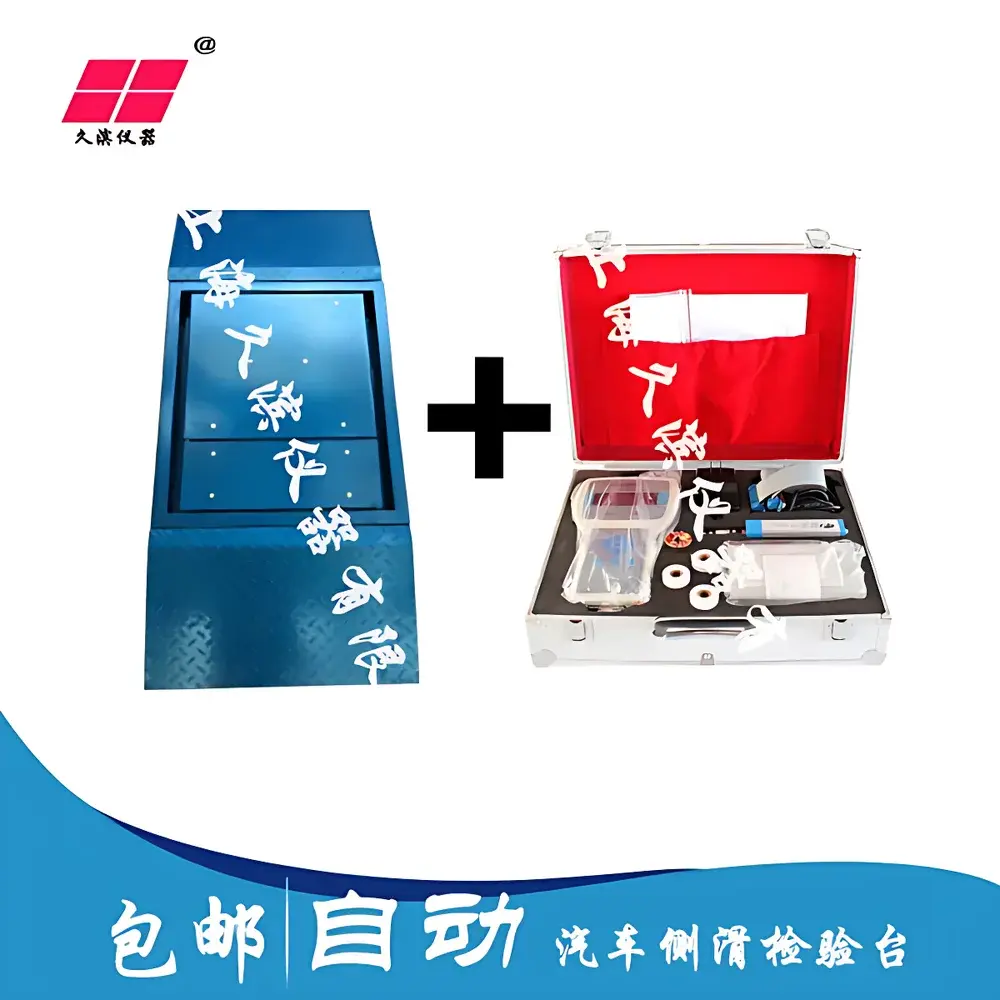
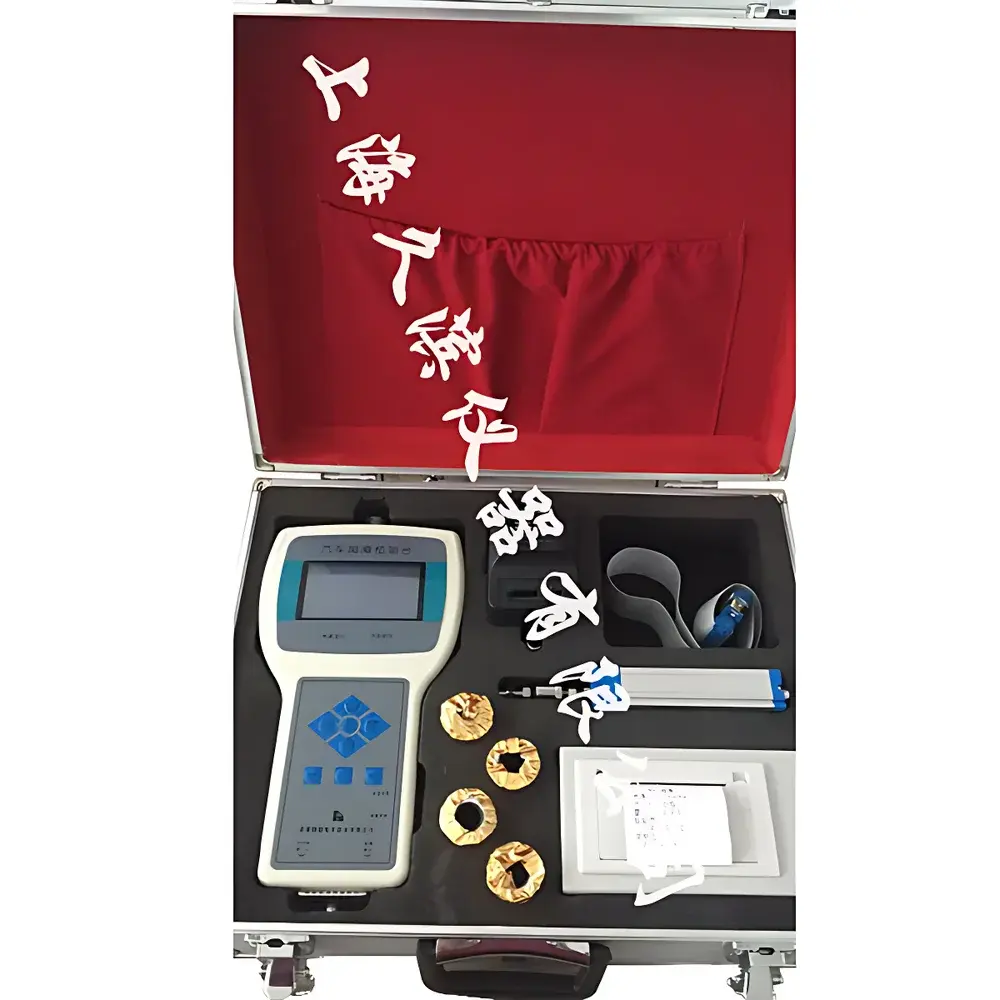
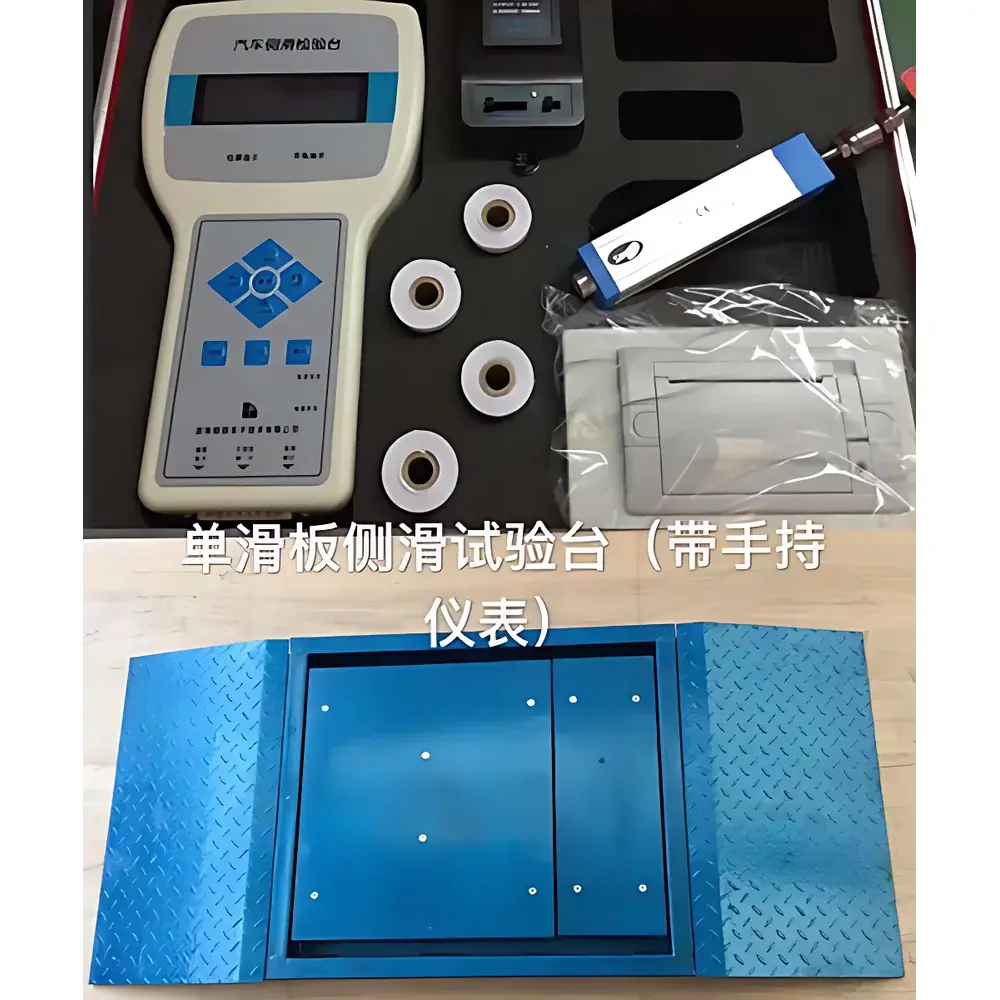
JB-10 Automotive Single-Plate Slip Tester by Jiubin Instruments
| Brand | Jiubin Instruments |
|---|---|
| Model | JB-10 |
| Type | Single-Plate Automotive Slip Tester |
| Rated Axle Load | 3 t / 10 t / 13 t |
| Measurement Range | ±10 m/km |
| Indication Error | ≤ ±0.2 m/km |
| Zero Offset Error | ±0.2 m/km |
| Slip Plate Dimensions (L×W) | 500 × 700 mm |
| Overall Frame Dimensions (L×W×H) | 800 × 900 × 100 mm |
| Approach Ramp Dimensions | 800 × 500 mm |
| Compliance Standard | JT/T 507–2004 “Automotive Slip Testers” |
Overview
The JB-10 Automotive Single-Plate Slip Tester is an electromechanical metrological instrument engineered for quantitative assessment of wheel alignment-induced lateral deviation during low-speed straight-line travel. It operates on the principle of Coulomb friction-coupled kinematic constraint: as a vehicle’s front axle traverses the freely sliding plate at ≤5 km/h, combined effects of camber angle and toe-in/out generate lateral tire scrub forces, inducing measurable transverse displacement of the plate relative to its base frame. This displacement—normalized to plate length—is reported as slip value in meters per kilometer (m/km), directly correlating with ISO 8855-defined alignment nonconformance thresholds. Designed for use in motor vehicle inspection stations, technical supervision bureaus, and automotive R&D test facilities, the JB-10 complies strictly with China’s national industry standard JT/T 507–2004, ensuring traceable measurement integrity under GLP-aligned operational protocols.
Key Features
- Single-plate architecture optimized for rapid throughput in high-volume inspection lanes, minimizing footprint while maintaining mechanical stability under dynamic loading.
- High-linearity potentiometric displacement sensor integrated with low-hysteresis linkage mechanism, delivering repeatable analog output across full ±10 m/km range with ≤±0.2 m/km indication error (per JT/T 507–2004 Clause 4.3.2).
- Modular load rating configuration (3 t / 10 t / 13 t) accommodates passenger vehicles, light-duty trucks, and medium-duty commercial chassis without structural retrofitting.
- DC12V low-voltage control architecture eliminates risk of electrical interference with vehicle ECUs and satisfies IEC 61000-6-2 immunity requirements for industrial environments.
- Mechanically lockable slip plate (via supplied locking pin) prevents unintended movement during non-testing periods, preserving zero-point calibration and extending sensor service life.
- Integrated approach ramp (800 × 500 mm) ensures smooth transition and consistent wheel contact geometry—critical for minimizing transient impact artifacts during entry.
Sample Compatibility & Compliance
The JB-10 is validated for testing all wheeled motor vehicles with axle loads within specified rating limits, including Category M1 (passenger cars), N1 (light goods vehicles), and select N2 configurations. It does not support dual-plate or dynamic-steering evaluation modes. All mechanical interfaces conform to JT/T 507–2004 dimensional tolerances (e.g., plate parallelism ≤0.1 mm/m, surface flatness ≤0.05 mm). Calibration verification procedures follow JJG 906–2015 (Verification Regulation for Automotive Slip Testers), requiring annual traceable recalibration against certified slip simulators. While JT/T 507–2004 is a Chinese transport industry standard, its measurement methodology aligns conceptually with ISO 11855-2 (Road vehicles — Wheel alignment parameters — Part 2: Test methods) for comparative data interpretation in cross-border technical audits.
Software & Data Management
The JB-10 outputs analog voltage signals (0–5 V DC) proportional to slip displacement, compatible with third-party DAQ systems supporting 12-bit or higher A/D resolution. No embedded firmware or proprietary software is included; signal conditioning—including anti-aliasing filtering, gain stabilization, and digital zero-tracking—is performed externally per user-defined inspection workflow. For regulatory reporting, raw voltage values must be converted using the certified sensitivity coefficient (e.g., 0.5 m/km/V) documented in the device’s calibration certificate. When integrated into automated inspection lines compliant with GB/T 27872–2011 (Technical Requirements for Motor Vehicle Safety Inspection Information Systems), the JB-10 supports audit-trail generation for slip measurements, satisfying basic data integrity requirements under CNAS-CL01:2018 (equivalent to ISO/IEC 17025).
Applications
- Routine safety inspection of front-axle geometry in statutory vehicle inspection centers (e.g., China’s GA 801–2019 compliance checks).
- Pre-delivery alignment verification for OEM assembly plants and authorized service networks.
- Periodic maintenance diagnostics in fleet management operations where camber/toe drift correlates with uneven tire wear or directional instability.
- Calibration reference for portable wheel alignment gauges during field service interventions.
- Educational demonstration of tire-road interaction mechanics in automotive engineering laboratories.
FAQ
What is the maximum permissible axle load for the JB-10?
The JB-10 is available in three rated capacities: 3 tonnes, 10 tonnes, and 13 tonnes. Select the variant matching your highest expected axle mass; operation beyond rated load voids calibration validity and risks mechanical deformation.
Does the JB-10 require external power for the slip plate mechanism?
No—the plate motion is purely passive and friction-driven; only the signal conditioning electronics require DC12V power.
Can the JB-10 measure camber or toe angles independently?
No. It measures net lateral slip resulting from the vector sum of camber thrust and toe-induced scrub; discrete angle quantification requires dedicated optical or laser-based alignment systems.
Is humidity or floor moisture a concern during operation?
Yes. Wet or contaminated surfaces between tire and plate introduce viscous drag anomalies. Per JT/T 507–2004 Section 5.2.3, test surfaces must be dry, clean, and free of oil or water film.
How often must the JB-10 be calibrated?
Annual calibration is mandatory per JJG 906–2015. Additionally, zero-point verification should be performed before each shift using the mechanical lock-and-release procedure described in the operator manual.
Related Products