
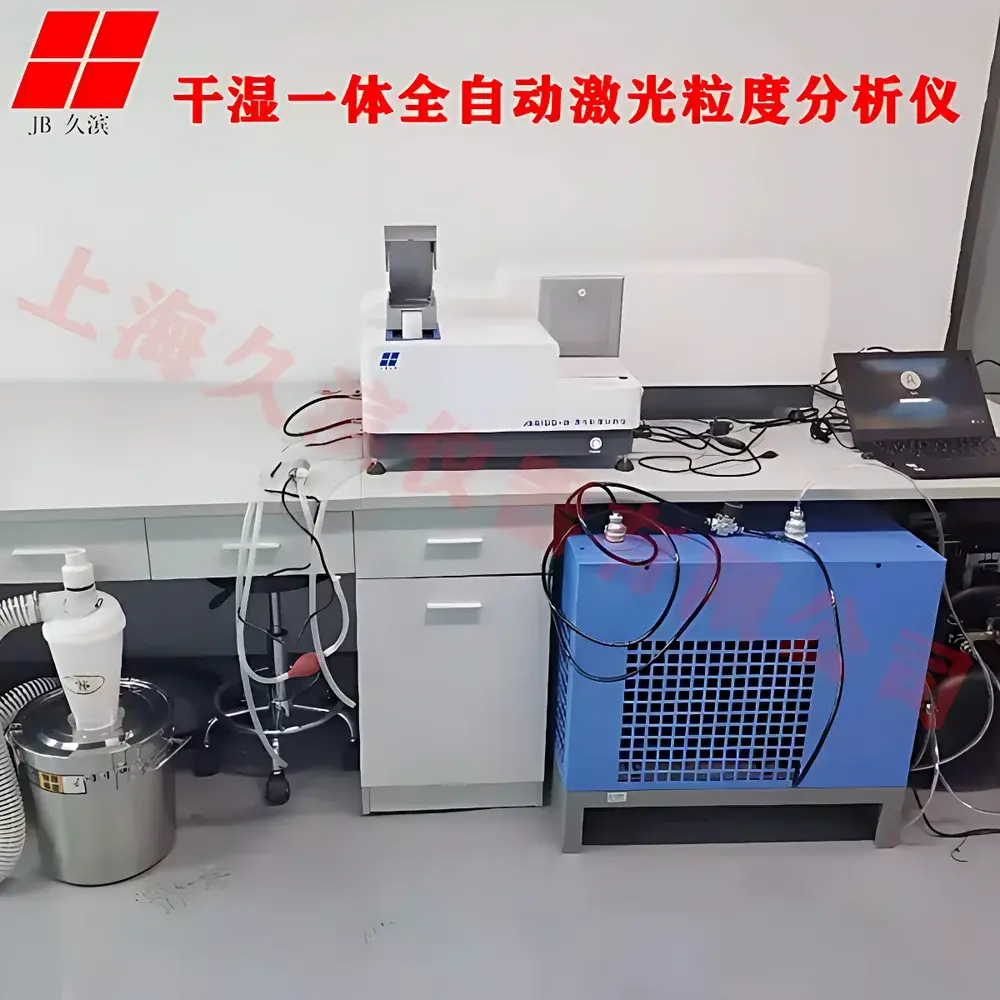
JB-6100-B Laser Particle Size Analyzer (Dry/Wet Dispersion)
| Brand | Jiubin Instruments |
|---|---|
| Origin | Shanghai, China |
| Model | JB-6100-B |
| Dispersion Method | Dry & Wet |
| Instrument Type | Laboratory Laser Diffraction Particle Size Analyzer |
| Measurement Range | 0.01 µm – 2000 µm |
| Repeatability | <1% (D50 of standard reference material) |
| Measurement Time | <10 s typical |
| Compliance | ISO 13320:2009, GB/T 19077–2016 |
| Detector Channels | 87-channel high-density crossed array with area compensation |
| Optical Model | Full-range Mie scattering theory with dynamic multiple-scattering correction |
| Laser Source | Sealed fiber-coupled semiconductor laser, λ = 650 nm, P > 10 mW |
| Data Acquisition | 16-bit, 200 kHz sampling rate |
| Feed System | Motorized stepless-speed feeder with software-controlled oil-free silent air compressor (integrated moisture and particulate filtration) |
| Operating Environment | 0–45 °C, 10–85% RH (non-condensing) |
| Power Supply | 110–240 V AC ±20 V, 50–60 Hz |
| Dimensions | 700 × 495 × 300 mm |
| Weight | 35 kg |
Overview
The JB-6100-B Laser Particle Size Analyzer is a dual-mode laboratory instrument engineered for high-precision particle size distribution (PSD) analysis of both dry powders and liquid suspensions. It operates on the physical principle of laser diffraction, applying full-range Mie scattering theory with dynamic correction for multiple scattering—critical for accurate measurement across broad concentration ranges (optical obscuration: 3–90%). Its optical architecture integrates a convergent-beam Fourier transform design, enhanced by a proprietary triple-lens system: a Fourier transform lens, a spectral filtering lens, and a standard Fourier lens. This configuration enables short focal length operation while maintaining wide angular detection coverage—maximizing resolution for submicron particles (<0.1 µm) and extending upper detection limits to 2000 µm without range segmentation or interpolation artifacts. The 87-channel high-density detector array employs geometrically optimized, area-compensated photodiode placement to ensure seamless, gap-free data acquisition across the entire scattering angle spectrum (0.01°–140°), eliminating stitching errors common in segmented optical systems.
Key Features
- Automated dry/wet dispersion module: Dry mode utilizes an oil-free, software-controlled silent air compressor with integrated moisture and particulate filtration; wet mode supports standard cuvette-based suspension analysis with ultrasonic deagglomeration.
- Intelligent laser management system: Fully automated sequence control—including background acquisition, sample dispersion, measurement, data saving, and post-measurement high-pressure purge—initiated with a single software command.
- Zero-residue dry feed path: Engineered non-stick pipeline geometry and negative-pressure feeding prevent particle deposition and cross-contamination between samples.
- Robust optical-mechanical architecture: Hermetically sealed laser cavity, anti-vibration floating chassis, and anti-dust optical housing ensure long-term stability and eliminate routine alignment requirements.
- High-speed data acquisition: 16-bit, 200 kHz real-time digitization captures transient scattering signals with sub-100 ms temporal resolution—enabling reliable measurement even for rapidly settling or agglomerating metal powders.
- Comprehensive error mitigation: Built-in safeguards include dry-run protection for ultrasonics, overflow detection for wet cells, and non-responsive logic for invalid operator inputs.
Sample Compatibility & Compliance
The JB-6100-B is validated for use with metallic powders (e.g., Al, Cu, W, Mo, Mg, Zn, rare-earth alloys), non-metallic inorganic materials (e.g., SiO₂, ZrO₂, Al₂O₃, TiO₂, CaCO₃, kaolin), battery cathode/anode materials (e.g., NMC, LFP, graphite), catalysts, pharmaceutical excipients, ceramic precursors, and industrial slurries. All measurements comply with ISO 13320:2009 (laser diffraction particle sizing) and GB/T 19077–2016 (Chinese national standard equivalent). The instrument supports GLP-compliant workflows through audit-trail-enabled software logging, user-access controls, and electronic signature-ready report generation—facilitating regulatory submissions under FDA 21 CFR Part 11 where required.
Software & Data Management
Jiubin’s proprietary ParticleSight™ software provides full automation, statistical analysis, and reporting flexibility. Users may export reports in Word, Excel, BMP, or plain-text formats. Analytical options include volume-weighted, number-weighted, and surface-area-weighted distributions; customizable percentile calculations (e.g., D10, D50, D90); comparative overlay of up to 12 datasets; and statistical metrics such as span, uniformity index, and geometric standard deviation. Distribution models supported include free distribution, Rosin-Rammler, and log-normal fitting. The interface supports English and Chinese language modes natively, with localization packages available upon request for additional languages. Data files are stored in vendor-neutral binary format with embedded metadata (timestamp, operator ID, instrument serial, calibration history).
Applications
This analyzer serves quality assurance laboratories in powder metallurgy, additive manufacturing (AM), battery material production, catalyst synthesis, and advanced ceramics. It quantifies critical attributes including median particle size (D50), fines content (100 µm), and distribution breadth—parameters directly correlated with sintering behavior, flowability, packing density, electrode coating uniformity, and catalytic surface area. In R&D settings, it enables rapid screening of milling parameters, surface modification efficacy, and dispersion stability in carrier fluids. Its ability to resolve multimodal distributions makes it particularly suitable for characterizing blended or hierarchical powders used in thermal spray coatings or composite feedstocks.
FAQ
Does the JB-6100-B support both volumetric and number-based distribution outputs?
Yes—the software calculates and displays volume, number, and surface-area distributions using Mie-derived scattering intensities and user-selectable refractive index values.
Is calibration traceable to NIST or ISO reference standards?
Instrument calibration is performed using certified polystyrene latex (PSL) and silica reference materials traceable to ISO 13320 Annex B protocols; full calibration certificates are provided with each unit.
Can the system operate under GMP/GLP-regulated environments?
Yes—software includes 21 CFR Part 11-compliant features: role-based access control, electronic signatures, immutable audit trails, and secure data archiving.
What maintenance is required for the dry dispersion module?
The air compressor filter cartridge should be replaced every 6 months under continuous use; the feed tube and dispersion nozzle require periodic inspection for wear but no scheduled lubrication or replacement.
How does the system handle highly reflective or absorbing metal powders?
The Mie model allows input of complex refractive index (n + ik); default values for common metals (Al, Cu, Fe) are preloaded, and custom values can be entered to minimize optical modeling error.
Related Products



