
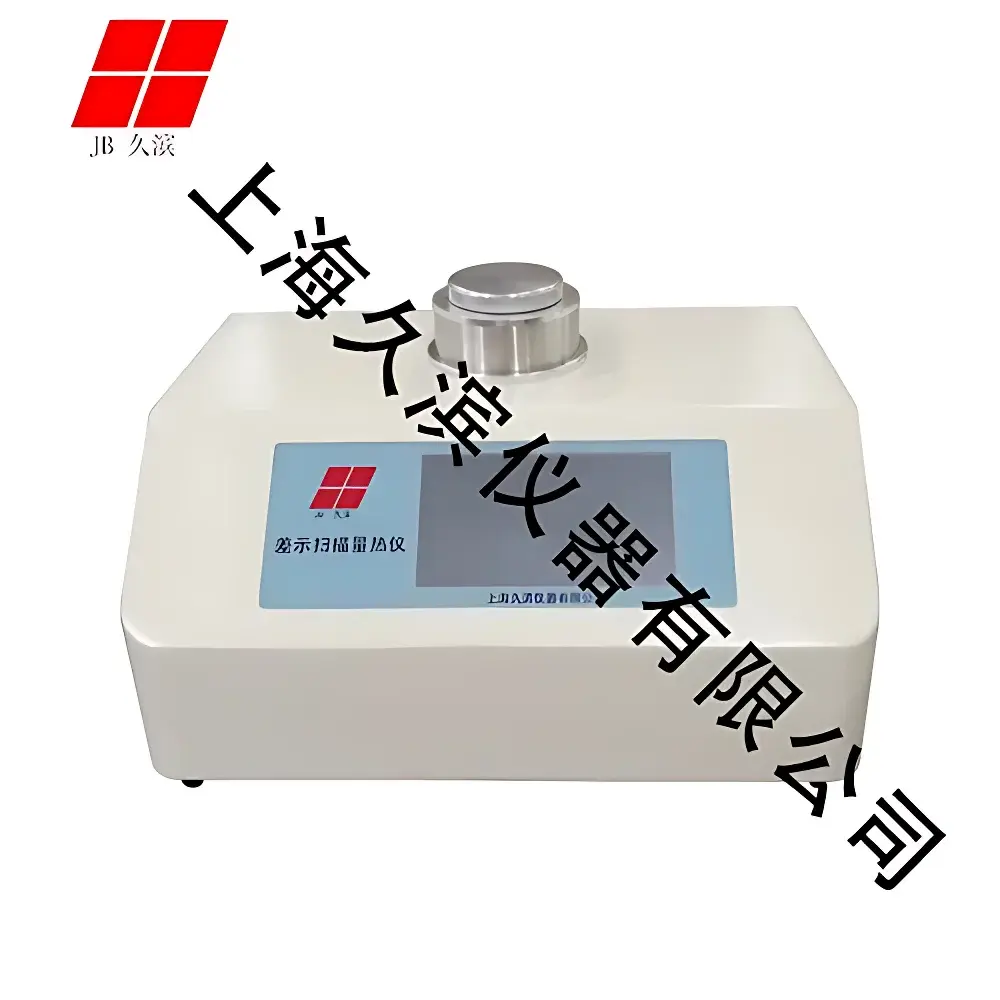
JB-DSC-500L Differential Scanning Calorimeter by Jiubin Instruments
| Brand | Jiubin Instruments |
|---|---|
| Origin | Shanghai, China |
| Model | JB-DSC-500L |
| Temperature Range | -150 to 500 °C |
| Temperature Accuracy | ±0.1 °C |
| Temperature Resolution | 0.01 °C |
| Heating/Cooling Rate | 0.1–50 K/min (heating), 0.1–10 K/min (cooling) |
| DSC Sensitivity | 0.1 µW |
| DSC Accuracy | ±1% |
| DSC Dynamic Range | ±200 mW |
| Atmosphere Control | Dual-gas mass flow controller with automatic switching |
| Calibration | Integrated standard reference materials with one-click temperature calibration |
Overview
The JB-DSC-500L Differential Scanning Calorimeter is a high-stability, laboratory-grade thermal analysis instrument engineered for precise quantification of heat flow differences between a sample and inert reference as a function of temperature or time. Based on the fundamental principle of power-compensated DSC, it measures endothermic and exothermic transitions—including glass transition (Tg), melting (Tm), crystallization (Tc), solid-solid phase changes, and oxidative induction time (OIT)—with high reproducibility and baseline stability. Designed specifically for polymer science, pharmaceutical development, and advanced materials R&D, the JB-DSC-500L delivers reliable Tg determination for plastic granules, thermoplastics, elastomers, and composite resins—critical parameters in material selection, processing optimization, and regulatory documentation under ISO 11357 and ASTM D3418.
Key Features
- Programmable multi-segment thermal protocols with full automation: ramp, hold, modulated, and step-scan modes—all controllable via intuitive touch interface or PC software.
- Dual platinum resistance temperature detectors (RTDs) for real-time, independent temperature monitoring at both furnace and sample positions—ensuring traceable accuracy and minimizing thermal lag effects.
- Integrated digital mass flow controller supporting two independent gas lines (e.g., N2, O2, Ar, or synthetic air) with programmable flow rates (0–200 mL/min) and automatic switching during sequential experiments.
- 7-inch high-resolution LED touchscreen (24-bit color) with localized UI navigation, offline operation capability, and synchronized data preview during acquisition.
- USB 2.0 interface compliant with Windows 2000 through Windows 11; software supports multi-resolution adaptive rendering across desktop, laptop, and tablet displays.
- One-click calibration routine using certified reference standards (indium, zinc, tin) for simultaneous verification of temperature accuracy, enthalpy response, and baseline linearity—fully traceable to NIST-traceable references.
- User-defined script environment with over 30 executable commands (e.g., “set_rate”, “hold_at_T”, “switch_gas”, “trigger_save”) enabling fully automated multi-step experiments without manual intervention.
Sample Compatibility & Compliance
The JB-DSC-500L accommodates standard aluminum, gold-plated aluminum, and hermetic stainless-steel crucibles (20–50 µL capacity), suitable for solid granules, pellets, films, powders, and viscous melts. It complies with key international testing standards including ISO 11357-1/2/3/6 (plastics—DSC methods), ASTM D3418 (melting and crystallization temperatures of polymers), ASTM E1356 (temperature calibration), and GB/T 19466 series (Chinese national DSC standards). Its hardware architecture and software audit trail functionality support GLP-compliant workflows, including user access control, electronic signature readiness, and raw-data integrity per FDA 21 CFR Part 11 requirements when operated with validated software configurations.
Software & Data Management
The bundled DSC Analysis Suite provides comprehensive post-acquisition tools: baseline correction (tangent, linear, polynomial), peak integration (onset, peak, endpoint), derivative analysis (dT/dt), multi-curve overlay, and comparative kinetics modeling (Ozawa-Flynn-Wall, Kissinger). All data files are stored in vendor-neutral .csv and proprietary .dsc formats with embedded metadata (operator ID, timestamp, instrument serial number, calibration status). Export options include PDF reports with customizable templates, Excel-compatible tables, and image exports (PNG, SVG) for publication-ready figures. Remote firmware and algorithm updates are delivered via secure HTTPS channel—no physical media required.
Applications
- Quantitative determination of glass transition temperature (Tg) in polyethylene (PE), polypropylene (PP), polycarbonate (PC), ABS, and engineering thermoplastics—essential for injection molding parameter validation.
- Crystallinity assessment of semi-crystalline polymers via enthalpy-of-fusion calculations against 100% crystalline references (e.g., ΔHf0 = 207 J/g for PE).
- Thermal stability evaluation of flame-retardant additives and nanocomposites using dynamic OIT measurements under oxygen atmosphere.
- Polymorph screening and solid-state characterization of active pharmaceutical ingredients (APIs) per ICH Q5A guidelines.
- Quality control of recycled plastic feedstock—detecting thermal degradation signatures, residual moisture, or cross-contamination via subtle shifts in Tg or cold-crystallization exotherms.
FAQ
What sample mass is recommended for accurate Tg measurement of plastic granules?
Typical mass range is 3–10 mg for standard aluminum pans; larger masses may improve signal-to-noise but risk thermal lag—especially in low-conductivity polymers.
Does the JB-DSC-500L support modulated DSC (MDSC®) mode?
No—this model implements conventional single-heater DSC architecture. MDSC requires dual-sensor, oscillatory heating capability not present in this configuration.
Can the instrument perform isothermal crystallization studies?
Yes—via programmable hold segments at user-defined sub-Tm temperatures, with real-time monitoring of crystallization onset and completion kinetics.
Is third-party software integration supported (e.g., MATLAB, Python)?
Raw data export in ASCII (.csv) format enables direct ingestion into scientific computing environments; API access is not provided, but scripting via COM interface is available under licensed developer agreement.
How often should temperature calibration be performed?
Recommended before each analytical campaign involving regulatory reporting; daily verification using indium (Tg = 156.6 °C) is advised for high-throughput QC labs operating under ISO/IEC 17025 accreditation.



