
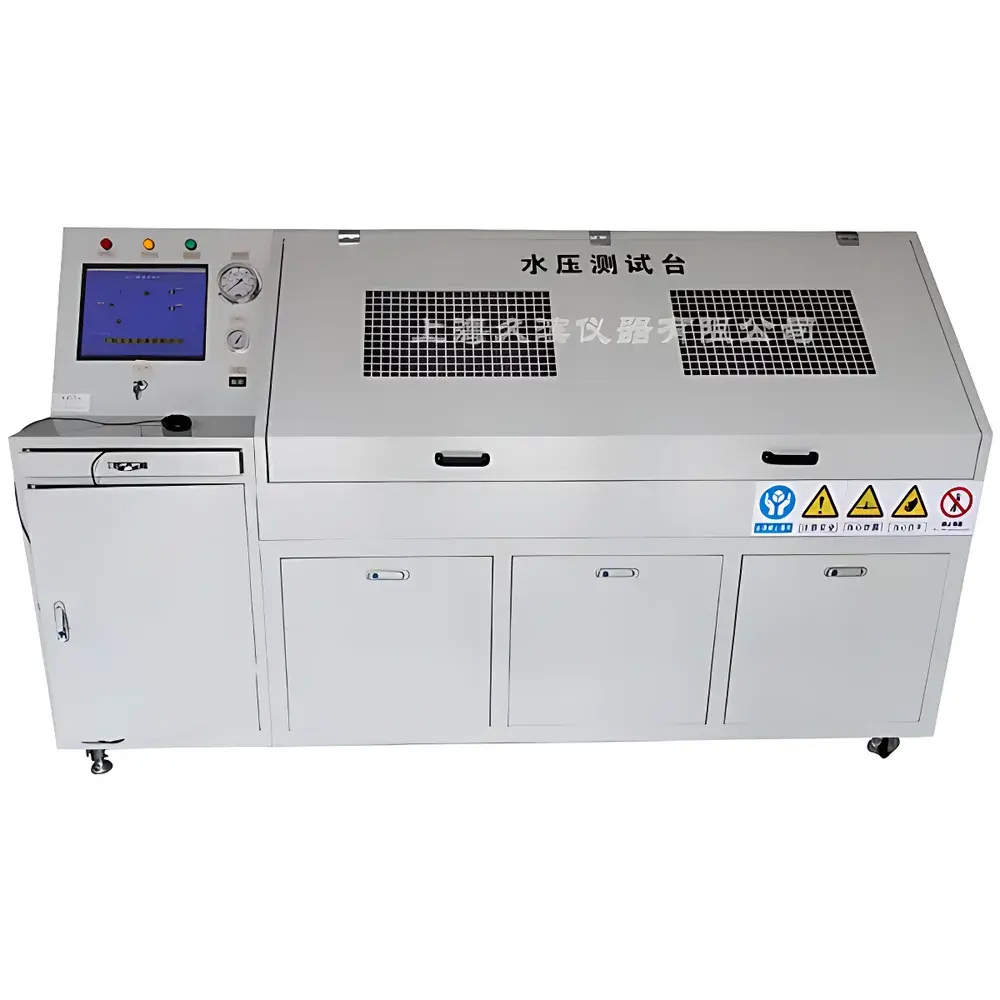
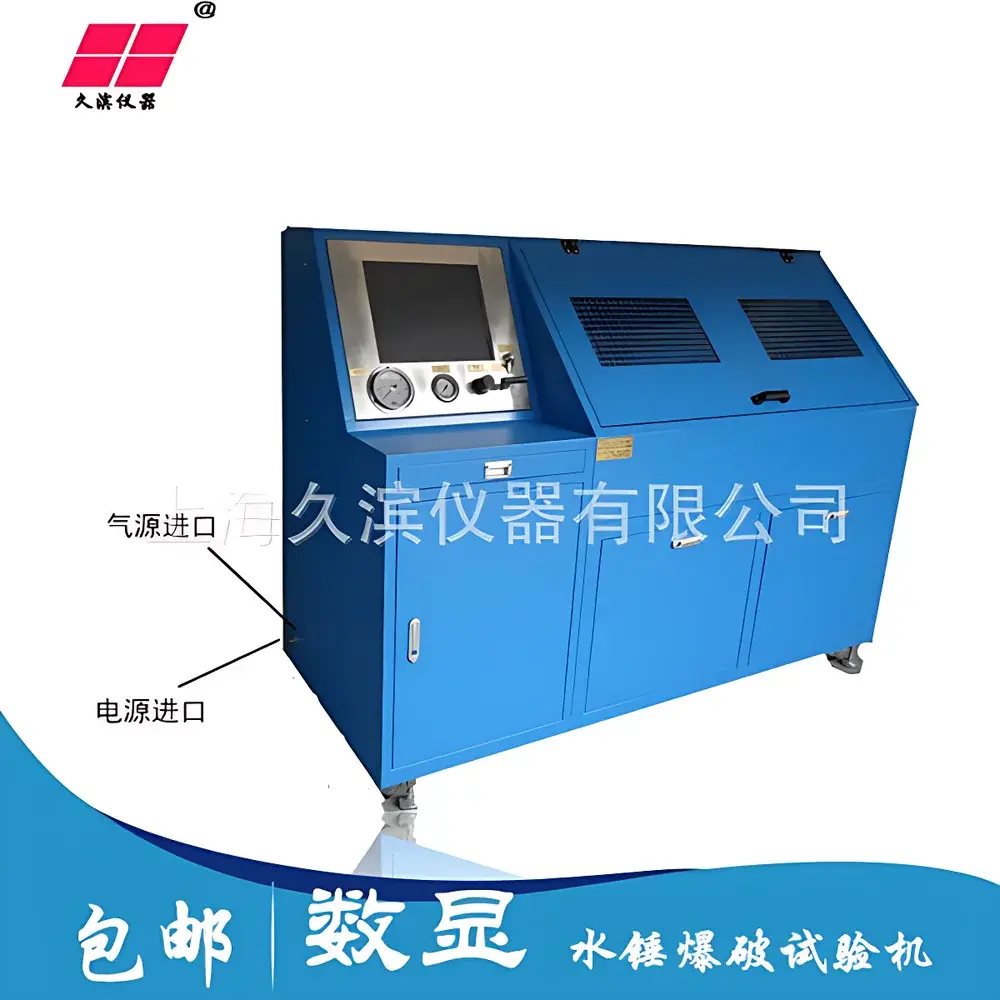
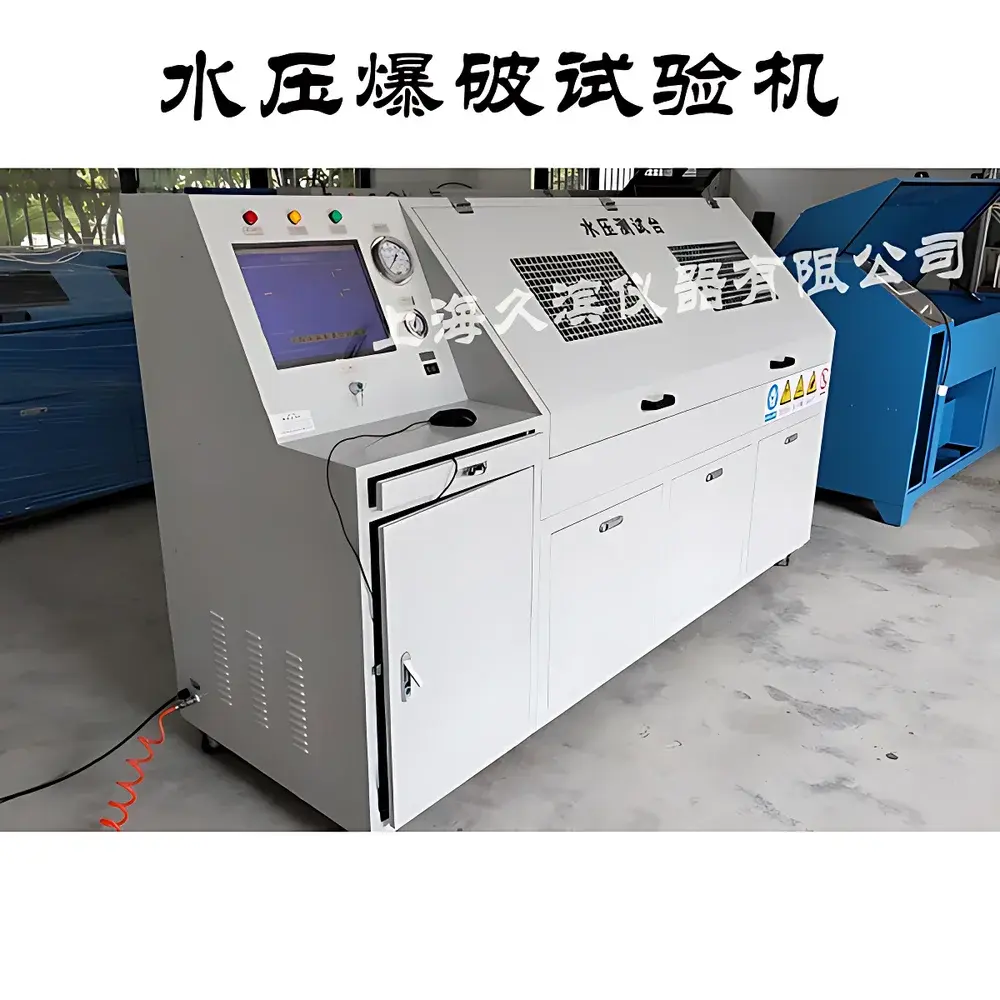
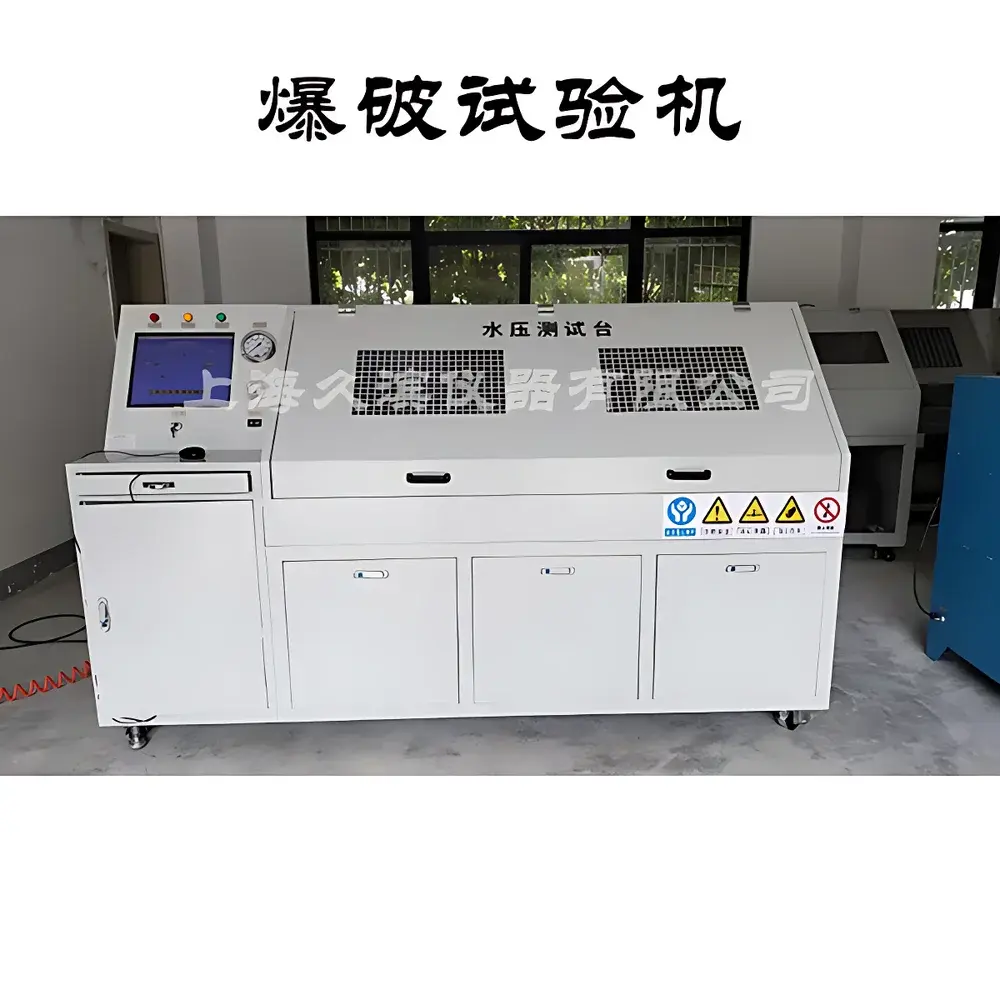
JB Instruments JB-150-BK-S Hydraulic Burst Test Bench
| Key | Brand: JB Instruments |
|---|---|
| Model | JB-150-BK-S |
| Origin | Shanghai, China |
| Drive Medium | Compressed Air (3–6.9 bar) |
| Test Medium | Municipal Tap Water |
| Max Test Pressure | 0–1500 bar (150 MPa) |
| Pressure Control Accuracy | ±10 bar (hold), ±0.5% FS (sensor) |
| Pressure Ramp Rate | 100–6000 bar/min (adjustable) |
| Power Supply | 220 V, 50 Hz, 0.15 kW |
| High-Pressure Outlet | 1 × G1/4 internal thread (600 series) |
| Cabinet Dimensions | 800 × 700 × 1500 mm |
| Test Chamber Dimensions | 2000 × 900 × 1200 mm (304 stainless steel, dual-zone with integrated water recovery tank) |
| Safety Features | Blast-resistant tempered glass lid, automatic pressure relief, real-time curve logging, audit-ready data export |
Overview
The JB Instruments JB-150-BK-S Hydraulic Burst Test Bench is a precision-engineered high-pressure testing system designed for deterministic evaluation of structural integrity under extreme hydrostatic stress. Based on the principle of pneumatic-hydraulic intensification, it utilizes compressed air (3–6.9 bar) to drive dual-stage intensifier pumps—enabling rapid low-pressure filling followed by controlled, high-fidelity pressurization up to 1500 bar (150 MPa). This architecture eliminates hydraulic oil contamination risks and ensures compatibility with potable water, pharmaceutical-grade fluids, and other aqueous test media required in regulated manufacturing environments. The system complies with fundamental mechanical testing principles defined in ISO 11425, ASTM D1598 (burst testing of plastic pipe), and ISO 6802 (hydraulic hose burst resistance), while supporting protocol development aligned with FDA 21 CFR Part 11 data integrity requirements via secure electronic records and audit trails.
Key Features
- Dual-pump intensification architecture: Low-pressure pump enables fast fill-up (≤10 L/min at <100 bar); high-pressure pump delivers precise ramping up to 1500 bar with programmable rates from 100 to 6000 bar/min.
- Integrated safety-critical subsystems: Blast-rated tempered glass enclosure (EN 12600 Class P2A), automatic overpressure shutdown, redundant pressure relief valves, and fail-safe venting logic.
- High-stability pressure control: Real-time closed-loop hold mode with ±10 bar compensation tolerance; pressure transducers calibrated to 0.5% full-scale accuracy (IEC 60770 compliant).
- Stainless-steel wetted path: All high-pressure components—including valves, fittings, tubing, and chamber interior—are fabricated from AISI 304 stainless steel, certified for sustained operation at ≥1.5× maximum working pressure (MAWP).
- Modular cabinet-chamber configuration: Separated control cabinet (800 × 700 × 1500 mm) and test chamber (2000 × 900 × 1200 mm) minimize electromagnetic interference and facilitate cleanroom integration.
- Self-contained fluid management: Integrated water recovery tank with stainless steel mesh partition, inline sintered metal filtration (≤5 µm particle retention), and automatic air purge sequence prior to pressurization.
Sample Compatibility & Compliance
The JB-150-BK-S accommodates a broad spectrum of pressure-containing components, including but not limited to: RO/Pure Water system housings and pressure vessels; automotive coolant, brake, and fuel delivery hoses; thermoplastic and multilayer composite piping (e.g., PE-RT, PEX-Al-PEX); HVAC expansion tanks; medical fluid delivery manifolds; and industrial heat exchanger headers. Sample mounting interfaces are user-supplied per ASME B16.5 flange standards or custom adapter kits (G1/4 internal thread port standard). The system supports static pressure hold, stepwise pressure cycling, and dynamic pulse testing protocols. Documentation output meets GLP/GMP traceability requirements—including timestamped pressure vs. time curves, event logs (start/hold/rupture/relief), and operator ID tagging—ensuring readiness for regulatory audits under ISO/IEC 17025 or FDA QSR.
Software & Data Management
Control and acquisition are managed through an embedded industrial PC running deterministic real-time OS with dedicated HMI software. All test sequences—including pre-fill, ramp rate, target pressure, dwell duration, burst detection threshold, and post-test depressurization profile—are configured via intuitive graphical interface. Pressure data is sampled at ≥100 Hz and logged with microsecond-level timestamp resolution. Export formats include CSV (for Excel/Python analysis), PDF (formatted test reports with digital signature support), and XML (compatible with LIMS and MES systems). Audit trail functionality records all parameter changes, user logins, report generations, and system alarms in immutable binary logs—fully compliant with 21 CFR Part 11 §11.10 and §11.30 requirements for electronic records and signatures.
Applications
- Validation of pressure vessel design margins per ASME BPVC Section VIII Div. 1
- Burst strength certification of polymer-based fluid conduits per ISO 11425 and ASTM D1599
- Accelerated life-cycle testing of automotive thermal management circuits
- Quality conformance screening for NSF/ANSI 58-certified water filtration components
- R&D evaluation of novel composite pipe materials under combined thermal-mechanical loading
- Fatigue resistance assessment via repetitive pressure pulsing (water hammer simulation)
FAQ
What test media are compatible with this system?
Municipal tap water is the standard medium; deionized water, glycol-water mixtures, and other non-corrosive aqueous solutions may be used subject to compatibility verification of seals and sensors.
Is the system suitable for continuous production-line testing?
Yes—it supports automated batch execution with barcode-triggered test profiles, pass/fail auto-judgment based on preset rupture thresholds, and direct integration into factory SCADA networks via Modbus TCP or OPC UA.
How is calibration traceability maintained?
Each unit ships with NIST-traceable calibration certificate for pressure transducers (valid for 12 months); field recalibration is supported using external deadweight testers conforming to ISO 3382.
Can the system perform multi-step pressure cycling (e.g., 50–1200–50 bar repeated)?
Yes—up to 99 programmable pressure steps per cycle, with independent dwell times, ramp rates, and termination conditions (including pressure decay monitoring for leak detection).
What maintenance intervals are recommended?
Filter element replacement every 200 operational hours; visual inspection of O-rings and tubing joints before each test session; annual verification of pump efficiency and relief valve setpoints by authorized service personnel.



