
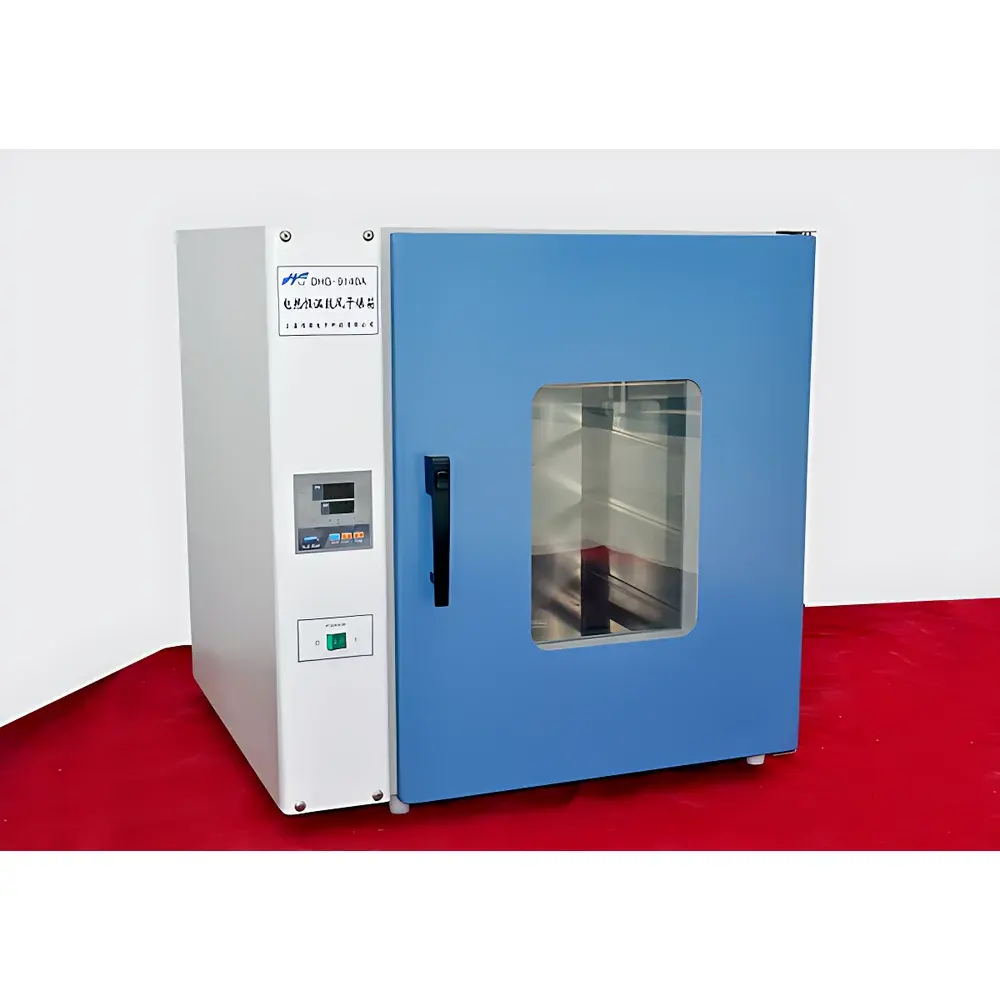
JBS DHG-9030A Precision Forced-Air Drying Oven
| Brand | JBS |
|---|---|
| Origin | Jiangsu, China |
| Manufacturer Type | Direct Manufacturer |
| Instrument Type | Precision Drying Oven |
| Temperature Range | RT+10°C to 300°C |
| Temperature Uniformity | ±0.5°C |
| External Dimensions | 420 × 420 × 620 mm |
| Internal Chamber Dimensions | 350 × 350 × 350 mm |
| Chamber Material | Mirror-Finish Stainless Steel (AISI 304) |
| Heating Method | Forced-Air Convection with Low-Noise Centrifugal Blower |
| Control System | Microprocessor-Based Digital PID Controller |
| Temperature Resolution | 0.1°C |
| Timer Range | 0–9999 minutes |
| Power Supply | 220 V AC, 50 Hz |
| Safety Features | Over-Temperature Cut-Off, Sensor Fault Detection, Leakage Current Protection |
Overview
The JBS DHG-9030A Precision Forced-Air Drying Oven is engineered for laboratory and industrial applications requiring stable, uniform thermal treatment of samples under controlled dry-heat conditions. Based on the principle of forced convection heating—where a low-noise centrifugal blower circulates heated air through an optimized internal duct system—the oven ensures rapid heat transfer and exceptional temperature homogeneity across the entire 350 × 350 × 350 mm stainless steel chamber. Unlike natural convection ovens, this design eliminates thermal stratification and significantly reduces drying or sterilization cycle times. The unit operates within a calibrated range from ambient +10°C to 300°C, with a typical temperature fluctuation of ±0.5°C and a control resolution of 0.1°C—meeting baseline performance expectations for ISO/IEC 17025-compliant calibration laboratories and GLP-regulated environments where thermal process consistency is critical.
Key Features
- Mirror-finish AISI 304 stainless steel interior chamber—resistant to corrosion, easy to clean, and compatible with repeated exposure to organic solvents and high-temperature sterilization cycles.
- Microprocessor-based digital PID temperature controller with dual-line LED display showing both setpoint and real-time chamber temperature—enabling precise manual adjustment and immediate verification of thermal stability.
- Integrated safety architecture including over-temperature cut-off (independent of main controller), ground-fault leakage protection, and real-time sensor fault diagnostics—ensuring operational integrity during unattended operation.
- Programmable timer (0–9999 minutes) supporting single-stage or multi-step thermal protocols; supports automatic shutdown and audible alert upon completion.
- Optimized airflow path with rear-mounted blower and perforated top/side baffle plates—achieving ≤±1.5°C temperature uniformity (measured per ASTM E2207-18 at nine-point grid) at 150°C steady state.
- Electrostatically coated cold-rolled steel exterior with double-glazed observation window—providing visual monitoring without thermal loss or condensation interference.
Sample Compatibility & Compliance
The DHG-9030A accommodates standard laboratory glassware (e.g., Petri dishes, weighing bottles, crucibles), metal sample holders, and polymer trays up to 300 mm in height. Its dry-heat environment is suitable for moisture content determination (per AOAC 934.01), residual solvent removal, pre-weighing desiccation of filter papers, wax embedding preparation, and depyrogenation of glassware at ≥250°C for 30 minutes (aligned with USP <1211> dry-heat sterilization guidance). While not certified as a Class II biological safety device, its construction and thermal validation protocol support compliance with ISO 14644-1 (cleanroom-compatible surface finish), ISO 9001 (process-controlled manufacturing), and basic GMP documentation requirements for equipment qualification (IQ/OQ/PQ).
Software & Data Management
This model operates as a standalone instrument without embedded data logging or network connectivity. However, its analog voltage output (0–5 V DC proportional to chamber temperature) is compatible with external chart recorders or SCADA systems for continuous traceability. For regulated environments, users may integrate the oven into a validated thermal mapping study using calibrated thermocouples (Type K or T) and compliant data acquisition software meeting FDA 21 CFR Part 11 requirements—including electronic signatures, audit trails, and secure storage of calibration certificates and temperature uniformity reports. JBS provides full technical documentation, including factory calibration records and electrical safety test reports (IEC 61010-1), upon request.
Applications
- Moisture analysis in pharmaceutical excipients, food powders, and ceramic precursors per gravimetric methods (ASTM D2216, ISO 11465).
- Drying of filter media post-gravimetric particulate matter collection (EPA Method 201A, ISO 12103-1).
- Curing of coatings, adhesives, and printed circuit board substrates under controlled thermal ramp profiles.
- Preconditioning of hygroscopic reference standards prior to analytical weighing (USP <1112>, Ph. Eur. 2.2.45).
- Depyrogenation of glass vials, syringes, and stainless steel tools in non-sterile manufacturing areas.
- Accelerated aging studies of polymers and packaging materials under defined thermal stress (ISO 188, ASTM D573).
FAQ
What is the maximum load capacity for uniform temperature distribution?
The chamber maintains ≤±1.5°C uniformity when loaded with up to 15 standard 100-mL beakers evenly distributed on two shelves.
Does the oven support ramp-soak programming?
No—this model features only fixed-setpoint control with timer-based termination; ramp-soak functionality requires optional external programmable controllers.
Is the stainless steel chamber electropolished?
No—it features a mechanically polished mirror finish (Ra ≤ 0.8 µm), sufficient for routine cleaning and residue-free operation but not equivalent to electropolished surfaces used in ultra-high-purity applications.
Can it be used for sterilization of medical devices?
It meets dry-heat sterilization time/temperature thresholds per ISO 15883-5, but formal validation (including biological indicator testing) must be performed by the end user per ISO 17665-1.
What is the recommended recalibration interval?
Annual calibration against NIST-traceable references is advised for GLP/GMP use; more frequent verification (e.g., quarterly) is recommended if used for regulatory submissions or quality-critical processes.



