
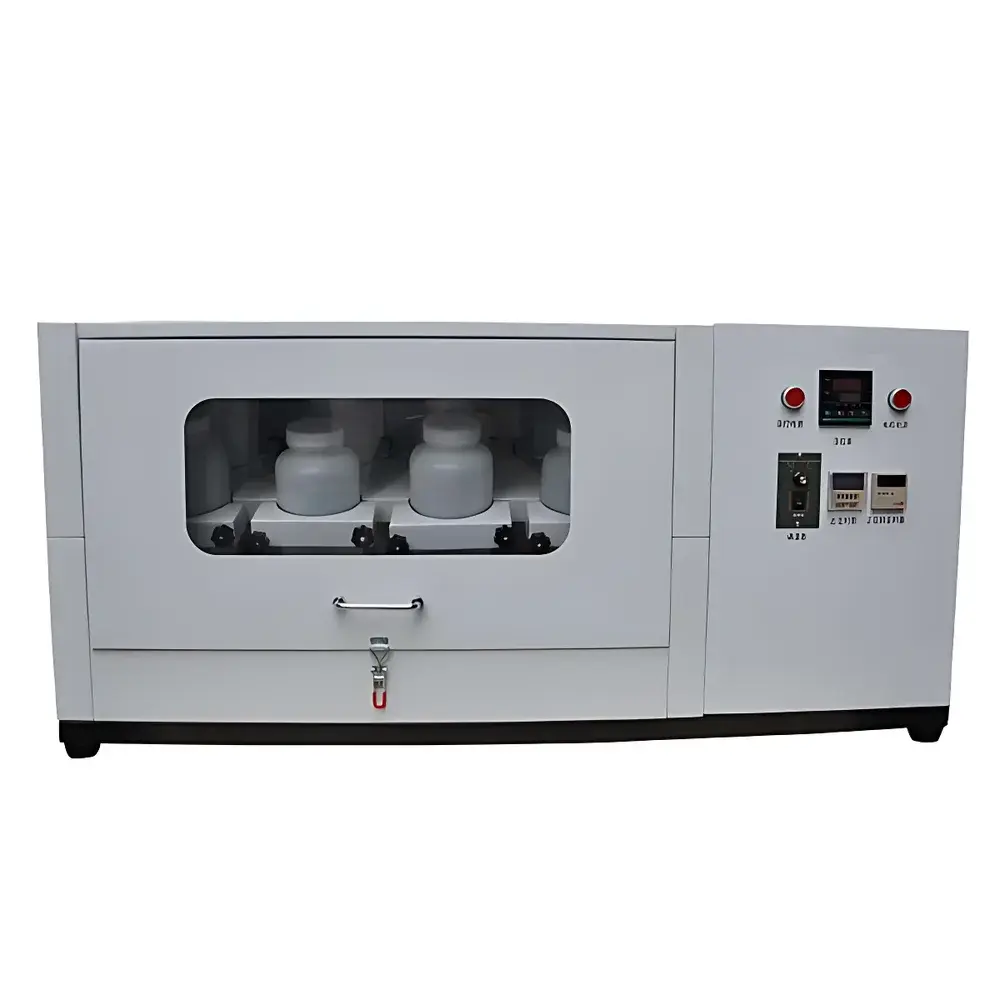
JBS GGC-W Temperature-Controlled Inversion Shaker
| Brand | JBS |
|---|---|
| Origin | Jiangsu, China |
| Manufacturer Type | Manufacturer |
| Product Category | Domestic |
| Model | GGC-W |
| Instrument Type | Inversion Shaker |
| Timer Range | 0–999 h |
| Oscillation Speed | 0–90 rpm |
| Temperature Control Range | Ambient to 65 °C |
| Platform Quantity | 1 |
| Sample Capacity Options | 4, 6, 8, 10, or 12 positions |
| Compatible Vessels | 2 L glass bottles, PE bottles, and EPA/standard leaching extraction containers |
| Construction Material | Stainless steel with anti-corrosive coating or mirror-finish stainless steel |
| Power Supply | 220 V, 50 Hz |
| Temperature Accuracy | ±0.5 °C |
| Safety Features | Full 360° inversion enclosure, lid-actuated power cutoff, and overload protection |
Overview
The JBS GGC-W Temperature-Controlled Inversion Shaker is an engineered solution for standardized solid waste leaching toxicity testing in regulatory and research laboratories. Designed specifically to comply with U.S. EPA Method 1311 (TCLP), ASTM D3987, and Chinese environmental standards HJ/T 299–2007 (Sulfuric-Nitric Acid Leaching Procedure) and HJ/T 300–2007 (Acetic Acid Buffer Extraction), this shaker implements precise rotational inversion—rather than orbital or reciprocating motion—to ensure uniform, reproducible contact between solid matrices and leaching agents under controlled thermal conditions. Its core operational principle relies on programmable bidirectional 360° inversion cycles, enabling defined forward-reverse intervals or continuous unidirectional rotation, critical for simulating realistic contaminant mobilization dynamics in heterogeneous waste samples. The integrated Peltier-assisted or resistive heating system maintains temperature stability across the full ambient-to-65 °C range, supporting both ambient and elevated-temperature leaching protocols required for assessing pH-dependent metal solubility and organic compound desorption.
Key Features
- Microprocessor-based digital control with LCD interface for intuitive parameter entry and real-time monitoring of speed, time, and temperature
- Programmable inversion logic: user-selectable forward duration, pause interval, reverse duration, and cycle repetition count
- Stable speed regulation from 0 to 90 rpm with ≤±1 rpm deviation over extended operation (≥72 h)
- High-load capacity platform engineered for uniform torque distribution—capable of accommodating up to twelve 2 L extraction vessels simultaneously without mechanical drift
- Thermal chamber with forced-air circulation and dual-sensor feedback loop ensures ±0.5 °C temperature accuracy and uniformity across all sample positions
- Full-enclosure safety architecture featuring automatic power cutoff upon lid opening and electronic current-limiting circuitry to prevent motor stall damage
- Corrosion-resistant construction using either electropolished 316 stainless steel or powder-coated 304 stainless steel, validated for compatibility with acidic, alkaline, and organic leaching media
Sample Compatibility & Compliance
The GGC-W accommodates standard EPA-compliant leaching vessels—including 2 L borosilicate glass bottles, HDPE/PE extraction containers, and custom-designed Teflon-lined reactors—without requiring adapters or auxiliary fixtures. Its platform geometry and clamping mechanism ensure secure retention during high-cycle inversion, minimizing vibration-induced vessel displacement or cap loosening. The instrument meets functional requirements for GLP-compliant leaching studies under ISO/IEC 17025-accredited laboratories. It supports audit-ready documentation when paired with validated software (see Software & Data Management). All thermal and mechanical performance specifications align with the operational constraints defined in HJ/T 299–2007 and HJ/T 300–2007, including minimum inversion frequency (30 rpm), maximum allowable temperature deviation (±0.5 °C), and mandatory 18-h minimum extraction duration capability.
Software & Data Management
While the GGC-W operates via standalone front-panel controls, it is compatible with optional PC-based data logging modules that record timestamped temperature, speed, and cycle status at user-defined intervals (1 s to 5 min resolution). Exported CSV files are structured for direct import into LIMS platforms or statistical analysis tools such as R or Python pandas. When used in regulated environments, the optional software module supports 21 CFR Part 11–compliant user authentication, electronic signatures, and immutable audit trails—including operator ID, parameter changes, and runtime anomalies. Calibration records, maintenance logs, and performance verification reports (e.g., temperature uniformity mapping per ICH Q5C guidelines) can be archived and retrieved per laboratory SOPs.
Applications
- Regulatory leaching tests for hazardous waste classification per RCRA, EU Waste Framework Directive, and China’s “Standard for Identification of Hazardous Wastes” (GB 5085.x)
- Research-scale evaluation of contaminant release kinetics from contaminated soils, fly ash, slag, and municipal solid waste incineration residues
- Method development and validation for alternative leaching protocols targeting emerging contaminants (e.g., PFAS, microplastics, nanomaterials)
- Quality control of stabilized/solidified waste forms, including cementitious and geopolymer encapsulants
- Extraction optimization studies in pharmaceutical environmental risk assessment (ERA) and agrochemical residue fate modeling
- Teaching laboratories conducting EPA-compliant TCLP training modules and undergraduate environmental chemistry experiments
FAQ
Does the GGC-W support continuous unidirectional rotation, or is inversion mandatory?
The unit supports three operational modes: continuous forward rotation, continuous reverse rotation, and programmable alternating inversion—each configurable via the front panel.
What is the maximum allowable load per position when using 2 L glass bottles?
Each position supports up to 3.5 kg gross weight (vessel + sample + leachate), verified under worst-case 90 rpm operation with thermal soak at 65 °C.
Is third-party calibration certification available?
Yes—NIST-traceable calibration certificates for temperature and rotational speed are available upon request, issued by ISO/IEC 17025-accredited service providers.
Can the shaker be integrated into a networked lab automation system?
RS-232 and optional Ethernet interfaces enable integration with SCADA or central lab management systems; Modbus RTU protocol support is provided in firmware v2.3+.
How often does the system require preventive maintenance?
Recommended maintenance includes biannual inspection of drive belt tension, thermal sensor calibration verification, and cleaning of air intake filters—documented in the included GLP-aligned maintenance log template.




