
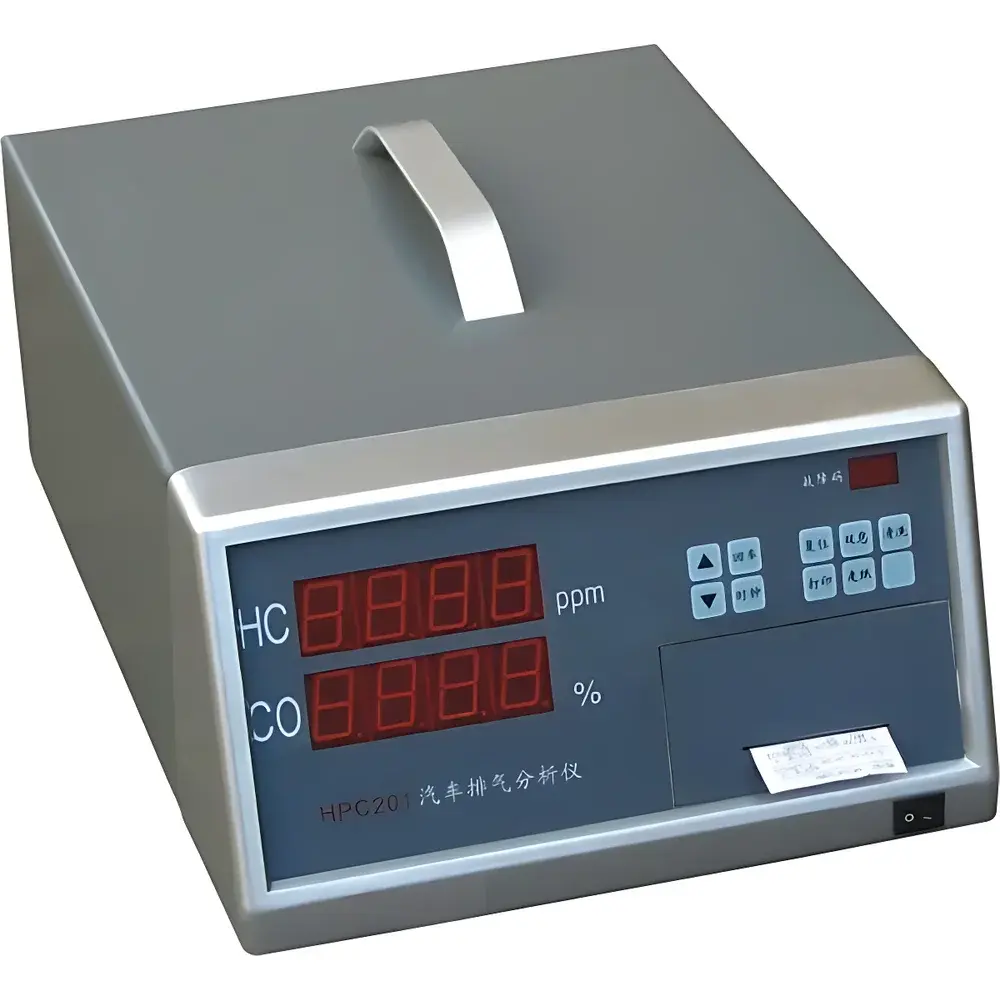
JBS HPC201 Automotive Exhaust Gas Analyzer
| Brand | JBS |
|---|---|
| Origin | Jiangsu, China |
| Manufacturer Type | OEM/ODM Producer |
| Product Category | Domestic |
| Model | HPC201 |
| Instrument Type | Online Fixed-Mount Analyzer |
| Measurement Principle | Non-Dispersive Infrared (NDIR) for CO |
| Maximum Permissible Error | ±5% of reading |
| Zero Drift | ±3% FS/8h |
| Span Drift | ±3% FS/8h |
| Repeatability | ≤±2% FS |
| Measurement Range | HC: 0–10,000 ppm (v/v) |
| CO | 0–10% (v/v) |
| Accuracy | HC: ±12 ppm or ±5% (whichever greater) |
| CO | ±0.06% or ±5% (whichever greater) |
| Resolution | HC: 1 ppm |
| CO | 0.01% |
| Response Time (t₉₅) | ≤10 s |
| Warm-up Time | 8 min (3 min emergency mode) |
| Operating Environment | –5°C to +50°C, RH ≤90% non-condensing |
| Power Supply | AC 100–240 V, 50/60 Hz or DC 12 V (with optional inverter) |
| Power Consumption | 40 VA |
| Dimensions | 420 × 310 × 170 mm (L×W×H) |
| Weight | ~9 kg |
| Display | High-brightness digital LED |
| Output Interfaces | Built-in thermal printer |
| Auto Functions | Auto-zero calibration |
| Measurement Modes | Free idle and dual-idle testing per GB 18285–2018 and ISO 3930 |
Overview
The JBS HPC201 Automotive Exhaust Gas Analyzer is a CE-compliant, fixed-installation emission monitoring system engineered for regulatory-grade measurement of hydrocarbon (HC) and carbon monoxide (CO) concentrations in vehicle exhaust streams. It operates on dual-sensor principles: non-dispersive infrared (NDIR) spectroscopy for CO quantification and flame ionization detection (FID) — or catalytic combustion, depending on configuration — for total hydrocarbon analysis. Designed to meet the performance requirements of national and international vehicle inspection standards—including China’s GB 18285–2018, ISO 3930:2000, and EU Directive 2007/46/EC—the HPC201 delivers trace-level sensitivity, rapid response kinetics, and long-term baseline stability under variable ambient conditions. Its architecture integrates real-time gas conditioning, pressure-compensated flow control, and temperature-stabilized optical cells to minimize environmental interference and ensure metrological integrity across repeated test cycles.
Key Features
- High-precision dual-gas detection with independent NDIR (CO) and FID/catalytic (HC) sensing modules, each optimized for linearity and low cross-sensitivity
- Automatic zero-point calibration with temperature-compensated reference cell, eliminating manual drift correction
- Real-time digital signal processing with embedded linearization algorithms compliant with ISO 11469 and ASTM D6645
- Integrated thermal printer supporting timestamped reports: gas species, concentration values (instantaneous, average, minimum), test duration, date, and operator ID
- Multi-interface connectivity: isolated RS232/RS485 serial ports for SCADA integration; 4–20 mA analog outputs for PLC interfacing; optional Ethernet gateway for cloud telemetry
- Intelligent fault diagnostics: localized error reporting (e.g., “Sensor A: NDIR cell contamination”, “Flow path: pressure drop >15 kPa”) via on-device display and serial log export
- Robust mechanical design rated IP20 for indoor installation in inspection bays; operating range validated from –5°C to +50°C at ≤90% RH non-condensing
Sample Compatibility & Compliance
The HPC201 is validated for direct sampling of cooled, filtered, and dried exhaust gas from gasoline-fueled light-duty vehicles during standardized idle-mode tests (free idle and dual-idle per GB 18285). It accommodates inlet gas temperatures up to 80°C with optional external cooling trap, and tolerates particulate loading <0.1 mg/m³ when paired with certified 5-µm inline filtration. Regulatory compliance includes full alignment with GB/T 18285–2018 Annex C (performance verification protocol), ISO 3930:2000 Clause 6 (accuracy and repeatability validation), and EN 14181 QAL1/QAL2 requirements for automated emission monitoring systems. All firmware and calibration records support audit-ready documentation per GLP and ISO/IEC 17025 traceability frameworks.
Software & Data Management
Firmware supports configurable data logging intervals (1–60 s), local storage of ≥10,000 test records with cyclic overwrite, and CSV export via USB or serial link. Optional PC-based JBS-EmitView software provides graphical trend analysis, pass/fail flagging against regional limits (e.g., China Tier 6, Euro 6d), and automated report generation compliant with GB 21968–2008 documentation format. Audit trail functionality logs all user actions (calibration, parameter changes, print events) with timestamps and operator IDs—meeting foundational requirements for FDA 21 CFR Part 11 electronic record integrity where deployed in accredited inspection centers.
Applications
- Mandatory periodic vehicle inspection (PVI) stations conducting statutory emissions certification
- Automotive R&D laboratories performing engine calibration and aftertreatment system validation
- Fleet maintenance facilities implementing preventive emissions diagnostics
- Environmental agencies deploying mobile or semi-permanent roadside monitoring units
- Training institutions delivering certified technician programs aligned with IATF 16949 competency frameworks
FAQ
What calibration gases are required for routine verification?
Certified 100 ppm HC (propane in air) and 2.0% CO (in N₂) standard gases traceable to NIM or NIST are recommended for daily span checks; zero air (<0.1 ppm HC, <1 ppm CO) must be oil-free and particle-filtered.
Does the HPC201 support remote firmware updates?
Yes—via secure HTTPS-based OTA update through optional Ethernet module; all updates undergo SHA-256 signature verification and rollback capability.
Can it interface with third-party inspection management platforms?
Fully compatible with common XML/JSON REST APIs and Modbus RTU/TCP protocols; JBS provides documented register maps and sample Python SDKs for integration.
Is the built-in printer compliant with fiscal data retention regulations?
Thermal printouts include immutable timestamps, unique test IDs, and checksum-verified concentration data—satisfying GB/T 18285–2018 record retention mandates for ≥3 years.
What maintenance schedule is recommended for field operation?
Optical windows cleaned weekly; filter elements replaced every 3 months or after 500 test cycles; full sensor recalibration performed annually by JBS-certified service engineers using traceable standards.







