
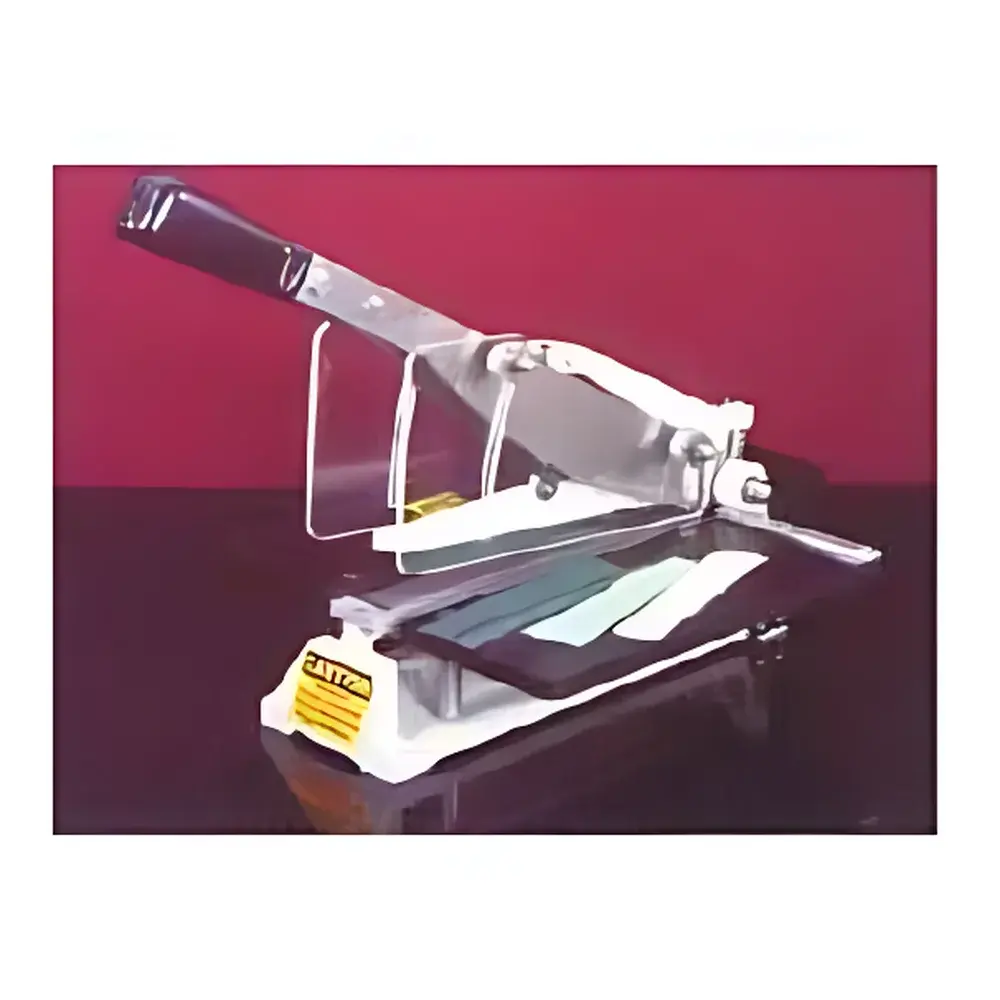
T/A JDC Precision Dual-Blade Sample Cutter
| Brand | T/A |
|---|---|
| Origin | USA |
| Manufacturer Type | Authorized Distributor |
| Origin Category | Imported |
| Model | JDC |
| Price Range | USD 7,000–14,000 |
| Maximum Sample Length | 10, 12, or 16 in (254, 305, 406 mm) |
| Adjustable Cut Width | 1/8–3 in (3–76 mm) |
| Cutting Tolerance | ±0.001 in (±0.0254 mm) |
| Net Weight | 28–100 lb (13–46 kg) |
Overview
The T/A JDC Precision Dual-Blade Sample Cutter is a manually operated, benchtop sample preparation instrument engineered for high-reproducibility planar cutting of thin, flexible sheet materials in quality control, R&D, and standardization laboratories. Designed in accordance with ASTM D882, ISO 1924, TAPPI T494, and other international tensile and physical testing standards, the JDC cutter delivers consistent, burr-free rectangular specimens with dimensional fidelity critical for mechanical property evaluation—including tensile strength, elongation, tear resistance, and burst testing. Its dual-blade architecture enables simultaneous top-and-bottom shearing action, eliminating lateral displacement and minimizing material deformation during cut initiation. Unlike rotary or guillotine-style cutters, the JDC employs a precision-ground linear slide mechanism coupled with hardened steel blade carriers, ensuring orthogonal alignment between blade edge and specimen plane across all operating widths and lengths.
Key Features
- Dual opposing carbon tool steel blades (Rockwell hardness ≥62 HRC), cryogenically treated for thermal stability and extended edge life under repeated cold/hot ambient exposure
- Interchangeable length stops (10 in / 254 mm, 12 in / 305 mm, 16 in / 406 mm) with vernier-adjusted locking pins for repeatable specimen length definition
- Micro-adjustable width gauge with engraved scale (0.125–3.000 in in 1/64-in increments) and fine-thread clamping screw for sub-mil width repeatability
- Integrated vacuum-assisted sample retention platform with recessed sealing groove—prevents curling, buckling, or slippage of low-stiffness substrates (e.g., tissue paper, nonwovens, metallized films)
- Modular base configuration: lightweight aluminum frame (28–42 lb) for portable use; optional cast iron pedestal mount (up to 100 lb total mass) for vibration-damped operation on shared lab benches
- CE-compliant optional polycarbonate safety shield with hinged access panel and interlocked blade retraction—meets ANSI B11.19 and OSHA 1910.212 requirements for point-of-operation guarding
Sample Compatibility & Compliance
The JDC cutter accommodates a broad spectrum of planar, non-rigid sheet materials up to 0.040 in (1.0 mm) thickness, including but not limited to: uncoated and coated papers (bond, kraft, newsprint), corrugated board liners, aluminum and copper foils (≥0.0005 in), polyethylene/polypropylene films, PET and cellulose acetate sheets, medical-grade nonwovens (spunbond/meltblown), and sanitary tissue products. All configurations comply with GLP documentation requirements for specimen preparation traceability—each unit ships with NIST-traceable calibration certificate verifying perpendicularity (<0.05° deviation), parallelism (≤0.002 in over 12 in), and dimensional repeatability (±0.001 in at 95% confidence per ISO 5725-2). Optional audit-ready logbook templates support FDA 21 CFR Part 11–aligned recordkeeping when paired with Thwing-Albert’s LabLink™ QC software.
Software & Data Management
While the JDC operates as a mechanical cutting system without embedded electronics, it integrates seamlessly into digital QA workflows via Thwing-Albert’s LabLink™ suite (v4.2+). This validated Windows-based application enables assignment of unique specimen IDs linked to batch numbers, operator credentials, environmental logs (temperature/humidity), and calibration status. Cut parameters (length, width, material type) are stored alongside corresponding tensile test results from compatible T/A instruments (e.g., STI-100, FC-100), enabling automated cross-correlation analysis for outlier detection. Audit trails include timestamped user actions, electronic signatures, and immutable export to CSV/PDF for internal review or regulatory submission.
Applications
- Preparation of standardized test specimens for ASTM D882 (tensile properties of plastic film/sheet), ISO 1924-2 (tensile testing of paper and board), and TAPPI T494 (tensile breaking strength of paper)
- Generation of uniform strips for Elmendorf tear testing (ASTM D1922), Mullen burst (TAPPI T403), and Taber abrasion substrates
- High-volume specimen production in packaging validation labs—especially for laminated pouches and barrier films requiring precise edge definition prior to peel testing
- Research-grade sample segmentation in polymer science, where thickness-dependent mechanical behavior must be isolated via controlled geometry
- Calibration verification of automated cutters using JDC-certified reference specimens in metrology labs
FAQ
Is the JDC cutter compatible with ISO/IEC 17025-accredited testing laboratories?
Yes—the JDC meets ISO/IEC 17025 clause 6.4.10 (equipment suitability) and supports documented uncertainty budgets for specimen geometry when used with certified calibration artifacts.
Can the JDC cut multi-layer composites such as foil-laminated paper?
Yes, provided total stack thickness remains ≤0.040 in (1.0 mm) and layers are bonded; optimal performance requires pre-conditioning to 23°C/50% RH per ISO 187.
What maintenance schedule is recommended for blade longevity?
Blades require honing every 5,000 cuts or quarterly (whichever occurs first); full replacement is advised after 20,000 cuts or visible micro-chipping under 10× magnification.
Does Thwing-Albert provide installation qualification (IQ) documentation?
Yes—factory-issued IQ/OQ protocols (per ASTM E2500) are available upon request and include mechanical verification, dimensional mapping, and operator training sign-off checklists.
Related Products



