
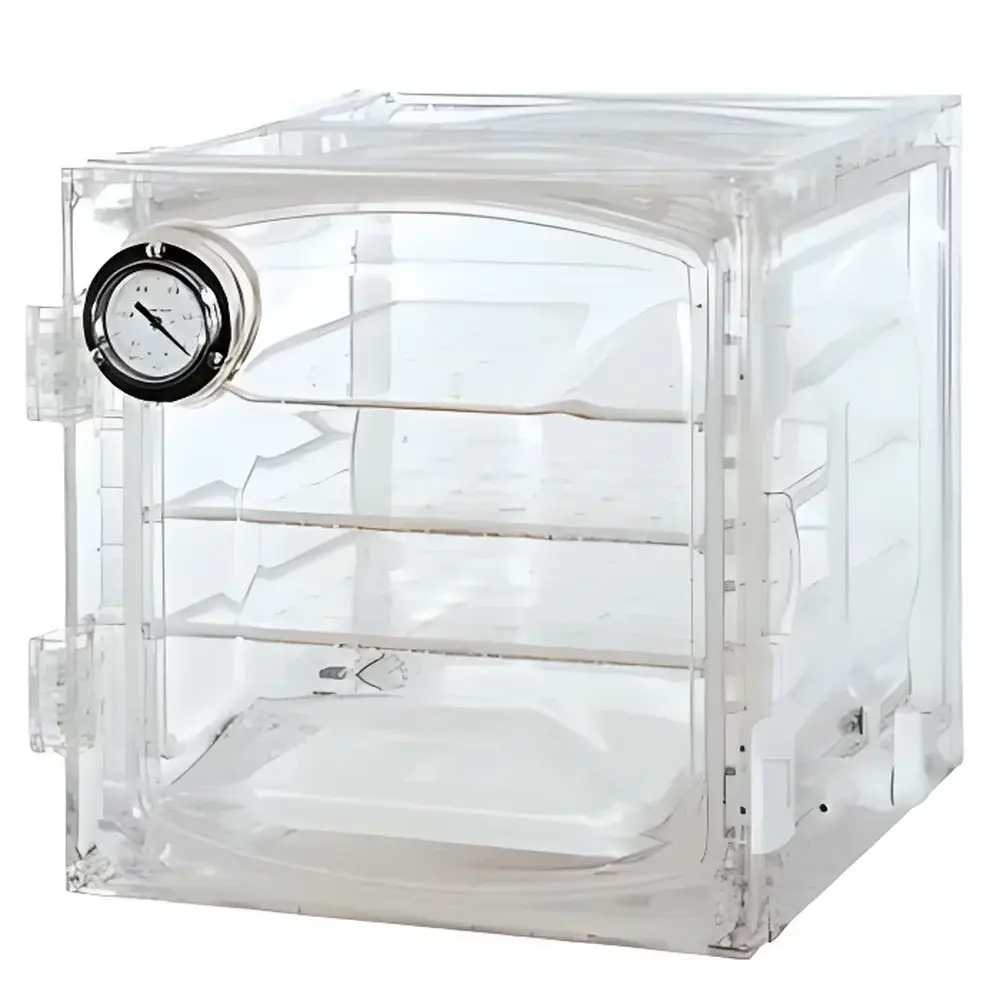
JEIO TECH VDC Series Vacuum Desiccator Cabinets (VDC-11/11U, VDC-21/21U, VDC-31/31U, VDC-41/41U)
| Brand | JEIO TECH |
|---|---|
| Origin | South Korea |
| Model Variants | VDC-11/11U, VDC-21/21U, VDC-31/31U, VDC-41/41U |
| Internal Volume | 11–45 L (0.4–1.6 cu ft) |
| Maximum Achievable Vacuum | 1.33×10⁻⁴ MPa (1 Torr) |
| Vacuum Gauge Range | 0 to –0.1 MPa |
| Sealing Material | High-purity silicone gasket |
| Chamber Material | Optical-grade polycarbonate (PC) |
| Shelving Capacity | 2–6 adjustable PC shelves (max load per shelf: 3–5 kg) |
| Port Configuration | Triple-valve manifold (exhaust, inlet, gas exchange) + optional 9.5 mm (0.37") barbed fittings (U-series only) |
Overview
The JEIO TECH VDC Series Vacuum Desiccator Cabinets are engineered for controlled, long-term storage of moisture-, oxygen-, and light-sensitive materials in research laboratories, pharmaceutical quality control environments, and electronics manufacturing cleanrooms. Unlike conventional desiccators relying solely on desiccant media, the VDC series integrates active vacuum generation with hermetic sealing to achieve and sustain ultra-low humidity conditions—down to <10 ppm residual water vapor under stable 1.33×10⁻⁴ MPa (1 Torr) vacuum. The system operates on a passive vacuum retention principle: after evacuation via external pump (not included), the high-integrity silicone gasket seal maintains vacuum integrity for up to 72 hours without power or continuous pumping. This eliminates oil contamination risks associated with mechanical vacuum pumps and reduces operational cost and environmental footprint. Constructed entirely from optical-grade, shatter-resistant polycarbonate (PC), the chamber provides full visual access while resisting corrosion from solvents, acids, and base vapors commonly encountered during sample conditioning.
Key Features
- Ultra-stable vacuum retention: Achieves ≤1.33×10⁻⁴ MPa (1 Torr) and holds vacuum for ≥72 hours post-pump-off—validated per ASTM D5422 for desiccator performance stability.
- Triple-function rotary valve manifold: Enables precise control over vacuum exhaust, atmospheric venting, and inert gas purging (e.g., N₂ or Ar) without breaking chamber integrity.
- Optical-grade polycarbonate construction: Provides >90% visible light transmission while blocking UV-B/C radiation—critical for photolabile compounds, reference standards, and calibration materials.
- Modular shelving system: Standard configurations include 2–3 reinforced PC shelves; expandable to 4–6 shelves depending on model (VDC-11U to VDC-41U), each rated for 3–5 kg static load.
- Integrated vacuum gauge: Front-mounted analog pressure indicator calibrated to ISO 27874 traceable standards, enabling real-time verification without external instrumentation.
- Stackable chassis design: Footprint-optimized geometry allows vertical stacking in space-constrained labs—no structural reinforcement required beyond standard lab bench loading limits (≤150 kg/m²).
- U-series enhanced connectivity: Models ending in “U” feature four pre-drilled 9.5 mm barbed ports for seamless integration with centralized vacuum manifolds, gas delivery lines, or automated monitoring systems.
Sample Compatibility & Compliance
The VDC cabinets accommodate a broad range of solid and powdered samples—including hygroscopic APIs, lithium battery cathode precursors, metal-organic frameworks (MOFs), enzyme powders, and certified reference materials (CRMs). All internal surfaces are non-reactive to Class I–III solvents per ISO 15190 Annex B. Polycarbonate chambers comply with USP <661.1> for pharmaceutical packaging material compatibility and pass EN 14126 biological barrier testing. RoHS 2011/65/EU compliance is certified for VDC-U variants; non-U models meet KCC and KC Mark requirements for electrical safety in Korean laboratory installations. No internal heaters, fans, or electronic controllers are present—ensuring intrinsic safety in Class I, Division 2 hazardous locations when used with approved external vacuum sources.
Software & Data Management
As a purely mechanical vacuum containment system, the VDC series requires no firmware, drivers, or proprietary software. Vacuum status is monitored visually via the analog gauge—eliminating data logging dependencies and ensuring uninterrupted operation during IT infrastructure outages. For labs requiring audit-ready records, the gauge reading may be manually logged into ELN platforms compliant with 21 CFR Part 11 (e.g., LabArchives, Benchling) using timestamped entries. Optional third-party digital pressure transducers (e.g., MKS Baratron® 627B) can be integrated via U-series ports for automated data capture into SCADA or LIMS systems—supporting GLP/GMP traceability through calibrated, temperature-compensated output (0–5 VDC or 4–20 mA).
Applications
- Pharmaceutical QC: Storage of hygroscopic active pharmaceutical ingredients (APIs) prior to Karl Fischer titration or XRPD analysis—preventing deliquescence-induced measurement drift.
- Materials science: Conditioning of MOFs, perovskites, and solid electrolytes under inert vacuum prior to BET surface area or TGA characterization.
- Electronics R&D: Handling of moisture-sensitive SMD components (e.g., GaN HEMTs, MEMS sensors) in accordance with J-STD-033D dry pack requirements.
- Reference lab operations: Long-term stabilization of NIST-traceable humidity standards and gravimetric calibration weights per ISO/IEC 17025 clause 7.6.3.
- Academic research: Safe containment of air-sensitive organometallic catalysts and radical intermediates during synthesis workflow pauses.
FAQ
What external vacuum pump is recommended for optimal performance?
A two-stage oil-free diaphragm pump with ultimate vacuum ≤5×10⁻⁵ MPa (e.g., KNF NMP 830 or Vacuubrand PC 101) is recommended to ensure rapid evacuation and compatibility with solvent vapors.
Can the VDC cabinet be used for vacuum drying?
No—these units are designed exclusively for storage under static vacuum. They lack heating elements, temperature control, or condensate traps required for active drying protocols.
Is the polycarbonate chamber resistant to acetone or chloroform?
Yes—optical-grade PC exhibits excellent resistance to short-term exposure (<30 min) to acetone, methanol, and isopropanol; prolonged contact with chloroform or THF is not advised per ASTM D543.
How often should the silicone gasket be replaced?
Under normal use (≤5 cycles/week), gasket replacement is recommended every 24 months; accelerated aging occurs above 40°C ambient or in ozone-rich environments.
Are custom shelf configurations available?
JEIO TECH offers OEM-compatible perforated PC trays and stainless-steel mesh inserts upon request—subject to minimum order quantities and dimensional validation against internal airflow constraints.



