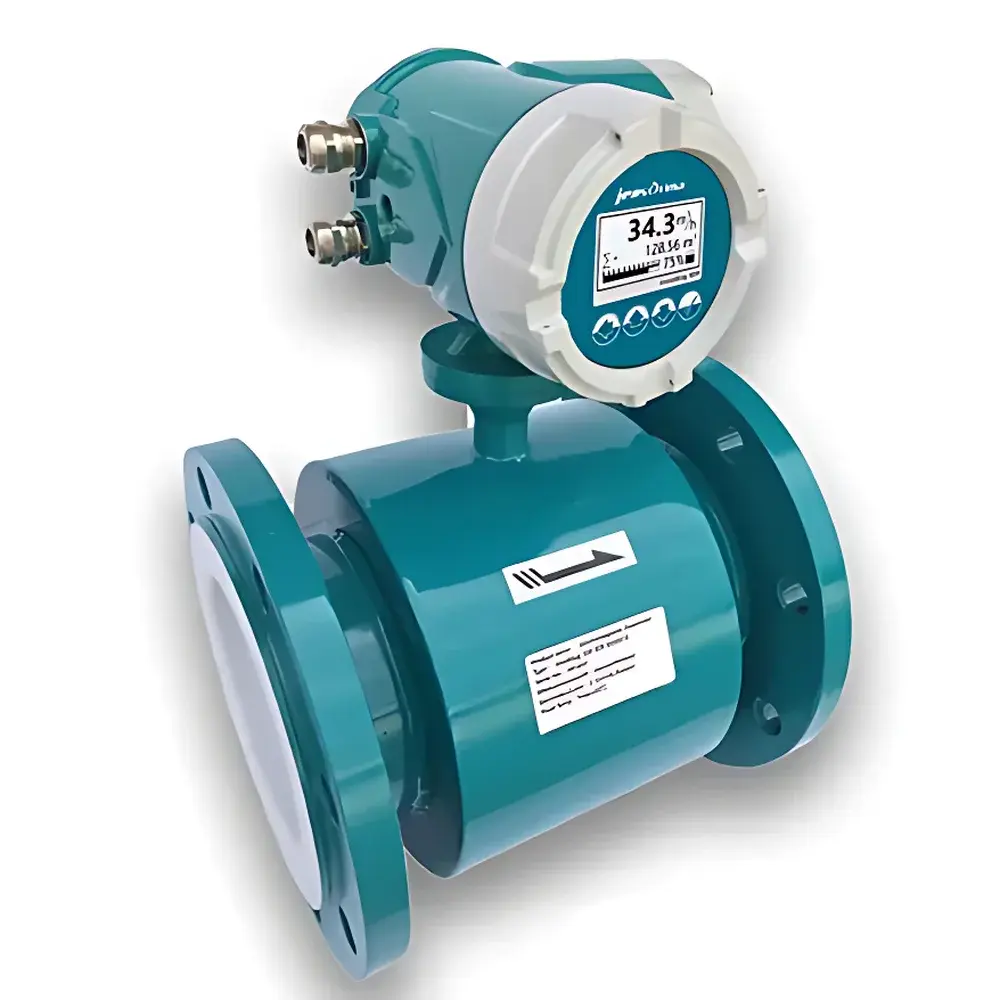
JENSPRIMA innoMag 300 Electromagnetic Flowmeter
| Brand | JENSPRIMA |
|---|---|
| Origin | Shanghai, China |
| Model | innoMag 300-1 |
| Body Type | Integral or Remote (S/L) |
| Pipe Size Range | DN10–DN2000 |
| Flow Range | 0.2–30,000 m³/h |
| Accuracy | ±0.5% of reading |
| Repeatability | ±0.1% of reading |
| Minimum Conductivity | ≥5 µS/cm |
| Electrode Materials | 316L SS, Hastelloy C, Tantalum, Titanium, Platinum |
| Lining Materials | PTFE (DN10–DN1000), Hard Rubber (DN50–DN2000) |
| Process Temperature | PTFE: –40 to +150°C |
| Rubber | –10 to +80°C |
| Ambient Temperature | –20 to +70°C |
| Output Signals | 4–20 mA (max. 750 Ω), Pulse/Frequency, Alarm Relay |
| Communication Protocols | MODBUS RTU (standard), HART (optional) |
| Power Supply | 85–260 VAC or 24 VDC |
Overview
The JENSPRIMA innoMag 300 is a high-performance electromagnetic flowmeter engineered for precise, maintenance-free volumetric flow measurement of conductive liquids in industrial process control applications. Operating on Faraday’s Law of electromagnetic induction, the innoMag 300 generates a magnetic field perpendicular to the flow direction; as conductive fluid passes through this field, a voltage proportional to the average flow velocity is induced across two electrodes mounted in the pipe wall. This principle ensures measurement independence from fluid pressure, temperature, density, viscosity, and turbulence—making it especially suitable for challenging media including wastewater, slurry, pulp, acids, alkalis, and abrasive or corrosive solutions. Designed for continuous online operation, the innoMag 300 supports bidirectional flow detection with high signal stability and long-term zero-point integrity, fulfilling critical requirements in water utilities, metallurgy, chemical processing, mining, and pharmaceutical manufacturing environments.
Key Features
- True electromagnetic measurement principle compliant with ISO 4064-2 and IEC 60534-2-1 standards for liquid flow instrumentation
- Integral (S-type) and remote-mounted (L-type) configurations for flexible installation in confined or hazardous areas
- Wide bore range from DN10 to DN2000, accommodating low-flow laboratory lines to large-diameter municipal pipelines
- No moving parts and zero pressure drop—eliminating mechanical wear, energy loss, and upstream/downstream straight-pipe requirements
- Robust sensor architecture with IP67/IP68-rated housing (aluminum body) and optional explosion-proof certification (ATEX/IECEx pending configuration)
- Electrode options include 316L stainless steel (general purpose), Hastelloy C (chloride resistance), tantalum (HF and strong acid service), titanium (seawater and oxidizing media), and platinum (ultra-high purity applications)
- Lining selection optimized for chemical compatibility: PTFE for broad chemical inertness and thermal stability up to 150°C; hard rubber for abrasion resistance in slurry and mineral processing
Sample Compatibility & Compliance
The innoMag 300 measures only liquids with minimum electrical conductivity of 5 µS/cm—sufficient for tap water, seawater, most acids/bases, slurries, and industrial effluents. It is not suitable for hydrocarbons, deionized water, or non-conductive solvents. All wetted materials comply with FDA 21 CFR 177.1550 (PTFE) and EN 15662 (rubber linings). The device meets electromagnetic compatibility (EMC) per IEC 61326-1 and functional safety guidelines aligned with IEC 61508 SIL 2 for use in safety-related control loops when configured with redundant outputs and certified firmware. Calibration traceability follows ISO/IEC 17025 via accredited third-party laboratories.
Software & Data Management
The innoMag 300 integrates seamlessly into modern DCS, SCADA, and MES platforms via its standard MODBUS RTU (RS485) interface. Optional HART 7 protocol enables full device diagnostics, parameter configuration, and loop verification without interrupting process operation. Local setup is performed via four tactile membrane buttons and a backlit LCD display with multilingual menu support (English, German, French, Spanish). All configuration changes—including damping time, totalizer reset, flow direction lock, and alarm thresholds—are logged with timestamp and user ID, supporting audit readiness under GLP/GMP and ISO 9001 quality systems. Firmware updates are performed via secure USB or serial interface with checksum validation.
Applications
- Municipal and industrial water/wastewater treatment: influent, effluent, chemical dosing, and reclaimed water metering
- Steel and non-ferrous metallurgy: cooling water circuits, pickling line acid flow, and slurry transport in ore processing
- Chemical and petrochemical plants: batch transfer, reactor feed control, and caustic/chlorine solution monitoring
- Mineral processing and cement production: abrasive slurry flow in grinding circuits and tailings pipelines
- Food & beverage and biopharma: CIP/SIP-compatible flow verification where hygienic design is supplemented by appropriate electrode/lining selection
FAQ
What is the minimum conductivity required for reliable measurement?
The innoMag 300 requires a minimum liquid conductivity of 5 µS/cm. Below this threshold, signal-to-noise ratio deteriorates, leading to unstable output.
Can the innoMag 300 measure bidirectional flow?
Yes—the device provides true bidirectional flow indication with polarity-sensitive output scaling and independent forward/reverse totalizers.
Is grounding mandatory for electromagnetic flowmeters?
Yes. Proper grounding via grounding rings or grounding electrodes is essential to minimize noise and ensure measurement accuracy, particularly in plastic-lined or non-conductive piping systems.
Does the innoMag 300 support intrinsically safe operation in hazardous areas?
When equipped with optional HART or pulse outputs and powered by 24 VDC, the innoMag 300 can be integrated into IS loops using approved associated apparatus (e.g., Zener barriers or galvanic isolators) compliant with IEC 60079-11.
How often does the innoMag 300 require recalibration?
Under stable operating conditions and with verified electrode/lining integrity, recalibration is recommended every 24–36 months per ISO 9001 and ANSI/ISA-5.1 guidelines—though field verification using master meter comparison or dry calibration may extend intervals.
Related Products