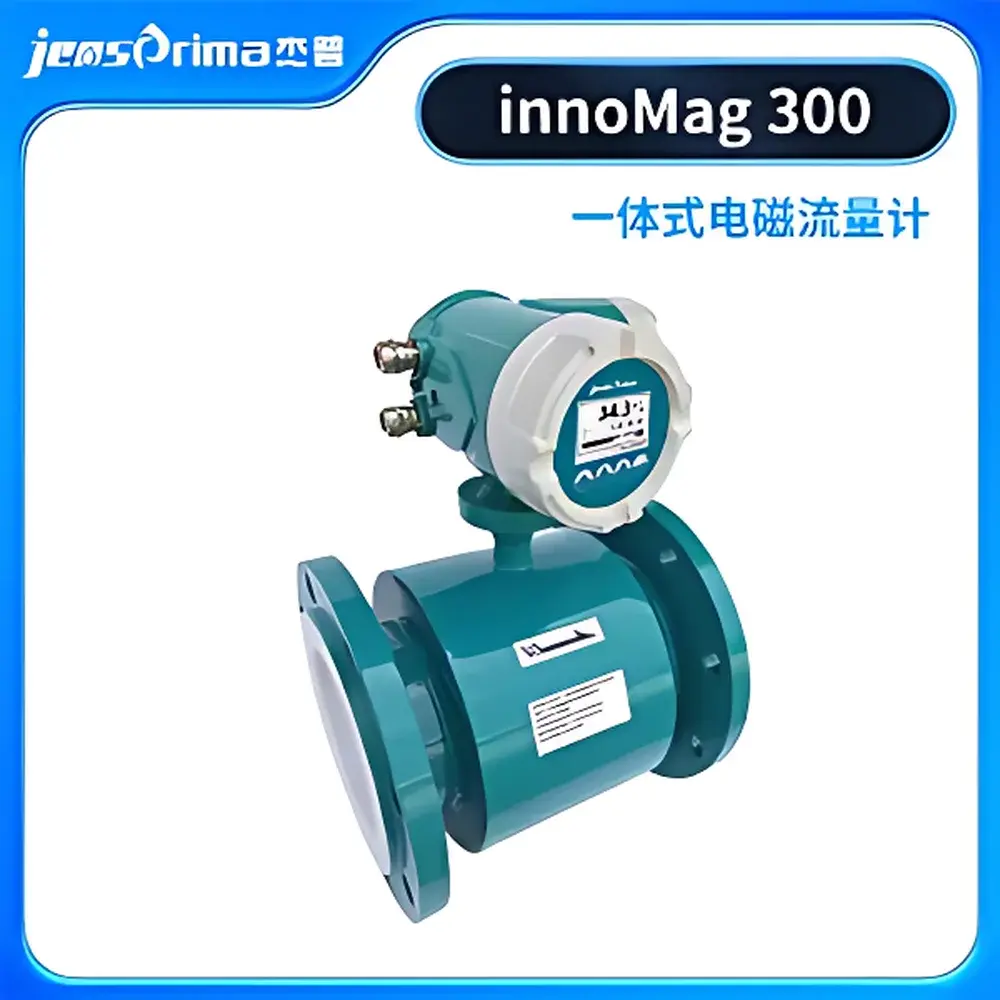
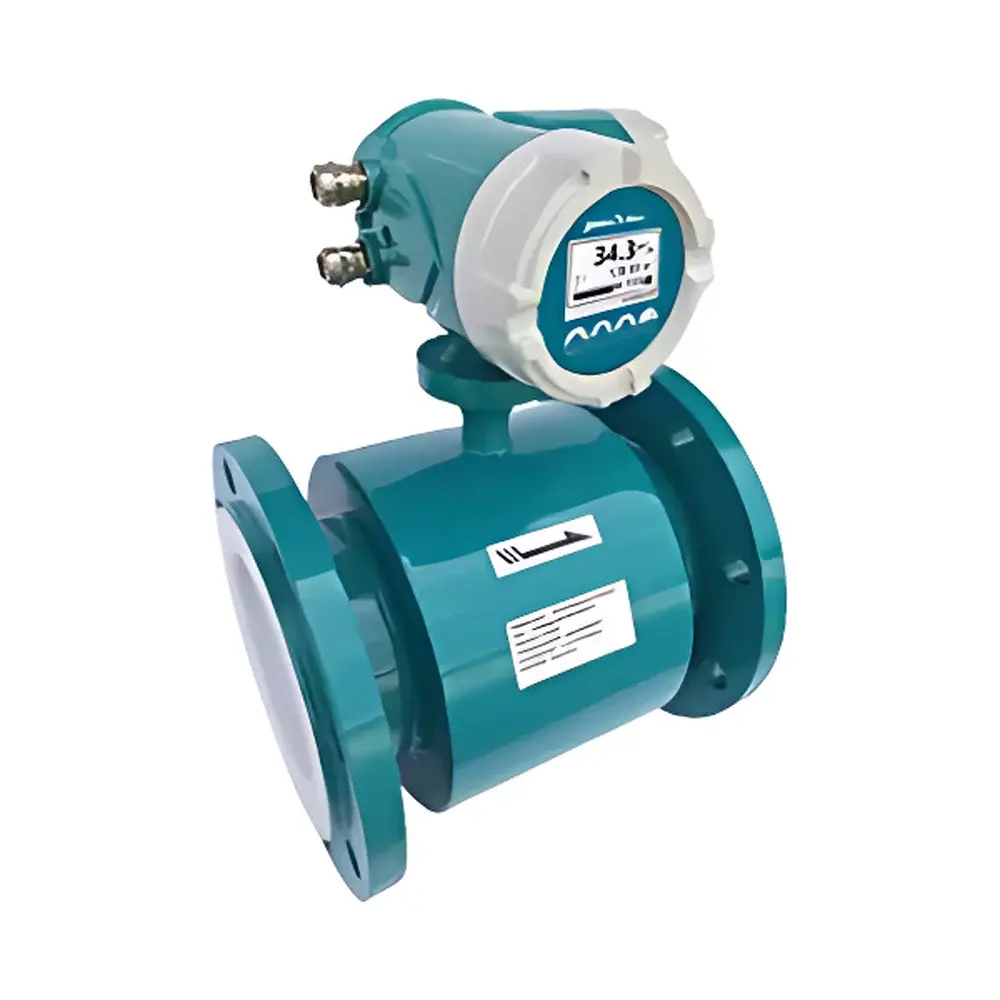
JENSPRIMA innoMag300 Electromagnetic Flowmeter
| Brand | JENSPRIMA |
|---|---|
| Origin | Shanghai, China |
| Model | innoMag 300 |
| Measurement Range | 0.2–30,000 m³/h |
| Accuracy | ±0.5% of reading |
| Repeatability | ±0.1% of reading |
| Minimum Conductivity | ≥5 µS/cm |
| Electrode Materials | 316 Stainless Steel, Hastelloy C, Tantalum, Titanium |
| Lining Materials | PTFE (DN10–DN1000), Rubber (DN50–DN2000) |
| Temperature Limits | PTFE Lining –40 to +150 °C |
| Ambient Temperature | –20 to +70 °C |
| Output Signals | 4–20 mA (max. 750 Ω), Pulse, Alarm |
| Communication Protocols | MODBUS RTU (standard), HART (optional) |
| Power Supply | 85–260 VAC or 24 VDC |
| Display | Backlit LCD |
| Installation Types | Integral (S-type), Remote (L-type) |
| Pressure Loss | Negligible (no obstruction in flow path) |
| Bidirectional Flow Measurement | Yes |
| Pipe Size Range | DN10–DN2000 |
Overview
The JENSPRIMA innoMag300 Electromagnetic Flowmeter is a high-performance, industrial-grade online flow measurement instrument engineered for precision, reliability, and long-term stability in demanding process environments. Based on Faraday’s Law of electromagnetic induction, the innoMag300 measures volumetric flow rate of conductive liquids by detecting the voltage induced across a magnetic field perpendicular to fluid motion. Its non-intrusive, full-bore design eliminates pressure drop and mechanical wear—making it ideal for continuous monitoring in water supply, wastewater treatment, chemical processing, pulp & paper, metallurgy, and food-grade applications. With a minimum conductivity threshold of 5 µS/cm, the device supports measurement of aggressive media including acids, alkalis, saline solutions, slurries, and potable water—without sensitivity to temperature, pressure, density, or flow profile variations.
Key Features
- True bidirectional flow measurement: Capable of detecting and quantifying forward and reverse flow with identical accuracy and resolution—essential for batch processes, recirculation loops, and custody transfer verification.
- Zero-pressure-loss architecture: Full-bore sensor design ensures no flow obstruction, eliminating energy loss and minimizing maintenance requirements across pumping systems.
- Modular electrode and lining configuration: Field-selectable electrode materials (316 stainless steel, Hastelloy C, tantalum, titanium) and liner options (PTFE for high-temperature/chemical resistance; natural or synthetic rubber for abrasion-prone slurries) enable application-specific optimization.
- High metrological integrity: Certified accuracy of ±0.5% of reading and repeatability of ±0.1% support compliance with ISO 4064, EN 14154, and industry-specific QA/QC protocols.
- Robust environmental resilience: IP67-rated integral electronics (S-type) or IP68 remote converter (L-type); operating ambient range –20 to +70 °C; extended thermal tolerance via PTFE lining (–40 to +150 °C).
- Integrated diagnostics and self-monitoring: Real-time electrode contamination detection, empty-pipe recognition, and grounding fault alerts reduce unplanned downtime and support predictive maintenance strategies.
Sample Compatibility & Compliance
The innoMag300 is validated for use with liquids exhibiting electrical conductivity ≥5 µS/cm—including municipal wastewater, caustic soda, sulfuric acid, seawater, mineral slurries, and pasteurized dairy streams. It complies with electromagnetic compatibility standards IEC 61326-1 (industrial environment) and meets essential safety requirements per IEC 61010-1. For regulated industries, its 4–20 mA analog output and MODBUS RTU interface are compatible with DCS/SCADA systems configured for SIL 2 functional safety architectures (per IEC 61508). Optional HART integration enables device-level configuration and health diagnostics within asset management frameworks aligned with ISA-95 and NAMUR NE107 guidelines.
Software & Data Management
The innoMag300 supports standardized industrial communication without proprietary software dependencies. Its embedded MODBUS RTU protocol allows seamless integration into PLC-based control networks (e.g., Siemens S7, Rockwell ControlLogix) for real-time flow data acquisition, totalization, and alarm event logging. When deployed with compliant SCADA historians or MES platforms, audit trails—including parameter changes, calibration events, and firmware updates—can be maintained in accordance with FDA 21 CFR Part 11 requirements when paired with appropriate system-level access controls and electronic signature validation. Local configuration is performed via intuitive menu navigation on the backlit LCD display, with optional PC-based setup using standard serial-to-USB adapters and MODBUS-compatible configuration tools.
Applications
- Drinking water distribution networks and booster station monitoring
- Primary, secondary, and tertiary wastewater treatment plant inflow/outflow metering
- Chemical dosing control in coagulation/flocculation basins
- Slurry flow measurement in mining dewatering and tailings management
- Process water recycling loops in steel mills and paper machines
- Sanitary flow verification in CIP (Clean-in-Place) systems for beverage and pharmaceutical manufacturing
FAQ
What is the minimum fluid conductivity required for reliable operation?
The innoMag300 requires a minimum conductivity of 5 µS/cm. This threshold ensures sufficient signal-to-noise ratio for stable measurement across all pipe sizes and flow velocities.
Can the flowmeter operate in partially filled pipes?
No. Electromagnetic flowmeters require fully filled, conductive fluid in the measuring tube. Installation must ensure continuous liquid coverage—typically achieved via proper upstream/downstream piping design and avoidance of high points or air pockets.
Is the device suitable for custody transfer applications?
While the innoMag300 meets general industrial accuracy standards (±0.5%), custody transfer typically mandates higher metrological assurance (e.g., ±0.2% or better) and third-party certification (e.g., MID approval). Consult local regulatory authorities and consider supplementary calibration traceability to national standards if used in fiscal metering contexts.
How is grounding implemented to ensure measurement stability?
Proper grounding is critical. The innoMag300 includes dedicated grounding terminals and recommends installation with grounded flanges or grounding rings—especially when non-conductive liners (e.g., PTFE) are used—to minimize noise coupling and ensure reference potential stability.
Does the flowmeter support intrinsically safe operation in hazardous areas?
The standard innoMag300 is rated for general-purpose industrial environments. For Zone 1/21 or Division 1 applications, explosion-proof enclosures or associated safety barriers must be applied externally—consult certified system integrators for ATEX/IECEx-compliant configurations.