
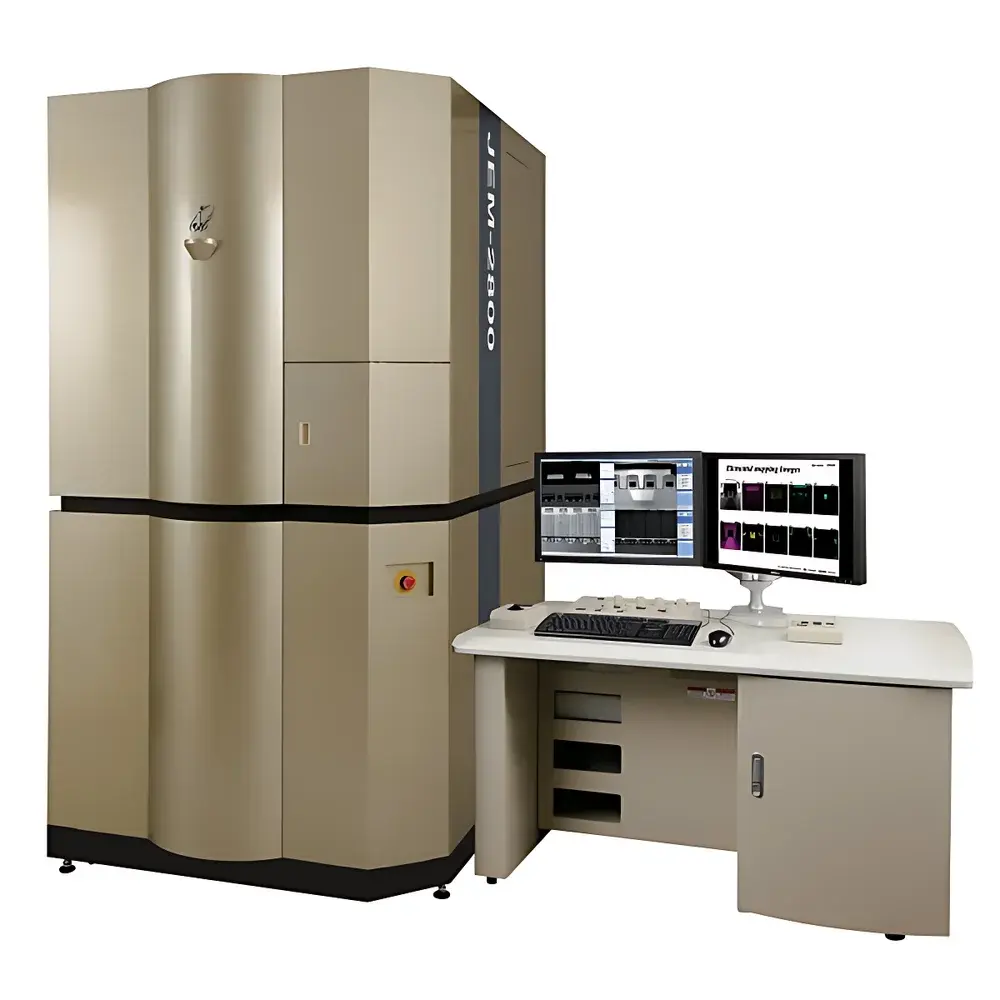
JEOL JEM-2800 High-Throughput Field-Emission Transmission Electron Microscope
| Brand | JEOL |
|---|---|
| Origin | Japan |
| Model | JEM-2800 |
| Point Resolution | 0.21 nm |
| Lattice Resolution | 0.10 nm |
| STEM Resolution | 0.16 nm |
| Secondary Electron Resolution | 0.5 nm |
| EDS Configuration | Dual Ultra-High-Sensitivity Silicon Drift Detectors (SDD) |
| Lorentz Mode | Standard Equipment |
Overview
The JEOL JEM-2800 is a high-throughput field-emission transmission electron microscope engineered for advanced materials characterization in industrial R&D and academic core facilities. Built upon JEOL’s proven Cold Field-Emission Gun (CFEG) platform, the JEM-2800 integrates a high-brightness electron source with an optimized optical column architecture to deliver simultaneous high spatial resolution and rapid analytical throughput. Its measurement principle relies on coherent electron beam transmission through ultrathin specimens (<100 nm), enabling atomic-scale imaging via phase contrast (HRTEM), Z-contrast imaging in scanning transmission mode (STEM), and quantitative microanalysis via energy-dispersive X-ray spectroscopy (EDS). Designed for operational robustness in non-dedicated microscopy laboratories, the system features an electromagnetically shielded column enclosure and vibration-damped mechanical base—reducing sensitivity to ambient electromagnetic noise and floor-borne disturbances common in shared instrumentation suites.
Key Features
- Field-emission electron source delivering stable probe current ≥1 nA at 200 kV, supporting high signal-to-noise ratio imaging and fast EDS mapping.
- Dual ultra-high-sensitivity silicon drift detectors (SDDs) mounted symmetrically around the specimen stage, enabling simultaneous acquisition of high-count-rate spectra with <125 eV Mn-Kα energy resolution at 100,000 cps.
- Standard Lorentz mode with dedicated lens excitation control and Faraday cage shielding, permitting magnetic domain imaging in soft magnetic materials without beam-induced artifacts.
- Automated alignment and calibration routines—including stigmator tuning, beam tilt compensation, and diffraction pattern centering—executed via JEOL’s TEM Navigator software suite.
- Modular column design accommodating optional add-ons: Gatan Imaging Filter (GIF), cryo-transfer holder, and in-situ heating/cooling stages compliant with ISO 14644-1 Class 5 cleanroom integration requirements.
Sample Compatibility & Compliance
The JEM-2800 supports standard 3 mm TEM grids (copper, nickel, gold, or silicon nitride membranes) and accommodates specialized holders for in-situ experiments, including atmospheric-pressure gas cells and liquid-phase electrochemical cells. Specimen exchange is facilitated by a fully automated airlock system meeting IEC 61000-4-8 immunity standards for magnetic field disturbances. All operational parameters—including high-voltage stability (±0.005%), lens current regulation (±0.01%), and vacuum integrity (column pressure ≤1×10⁻⁷ Pa)—are continuously logged and traceable per GLP/GMP audit requirements. The system complies with ISO/IEC 17025:2017 for testing laboratory competence and supports 21 CFR Part 11-compliant electronic signatures when paired with JEOL’s validated data acquisition module.
Software & Data Management
Control and analysis are unified under JEOL’s TEM Navigator v4.x platform—a Windows-based application certified for FDA-regulated environments. It provides role-based user access control, full audit trail logging (user actions, parameter changes, image metadata), and encrypted raw data storage in open TIFF/EMD formats. Real-time EDS quantification employs standardless ZAF correction algorithms traceable to NIST SRM reference materials. Image processing workflows integrate with third-party tools (DigitalMicrograph, HyperSpy) via standardized EMDB-compatible metadata tags. Automated report generation includes instrument calibration certificates, daily performance verification logs, and conformance statements aligned with ASTM E1568–22 (Standard Guide for Transmission Electron Microscopy).
Applications
The JEM-2800 serves as a primary characterization tool across semiconductor process development (e.g., gate oxide thickness metrology, dopant segregation analysis), battery materials research (solid-electrolyte interphase imaging, cathode particle cracking dynamics), and catalysis science (single-atom catalyst dispersion mapping, operando nanoparticle sintering studies). Its dual-EDS configuration enables rapid elemental correlation between STEM-HAADF imaging and nanoscale compositional gradients—critical for failure analysis in aerospace alloys and additive-manufactured metallic components. In life sciences, the Lorentz mode supports visualization of magnetic nanoparticle distribution in targeted drug delivery vectors under low-dose conditions.
FAQ
Is the JEM-2800 compatible with automated tilt-series acquisition for electron tomography?
Yes—the system supports motorized double-tilt holders and integrated tomography scripting via TEM Navigator, with angular range up to ±70° and incremental step resolution of 0.2°.
What vacuum level is maintained during Lorentz mode operation?
Lorentz mode operates at the same ultra-high vacuum conditions as standard TEM mode: ≤1×10⁻⁷ Pa in the column, ensured by a combination of ion pumps and non-evaporable getter (NEG) panels.
Can the dual-EDS configuration be upgraded to include wavelength-dispersive spectroscopy (WDS)?
No—WDS integration is not supported due to geometric constraints within the JEM-2800 pole-piece design; however, the dual SDD setup achieves comparable light-element sensitivity (B, C, N, O) with superior count-rate capability.
Does the system meet CE marking requirements for installation in EU laboratories?
Yes—the JEM-2800 carries full CE marking under the EU Machinery Directive 2006/42/EC and Electromagnetic Compatibility Directive 2014/30/EU, with technical documentation available upon request.
What is the recommended maintenance interval for the field-emission gun?
JEOL recommends flash cleaning every 6 months under typical usage (≤40 hrs/week), with full tip replacement advised after 18–24 months or upon observed degradation in emission stability (>5% current fluctuation over 1 hr).






