
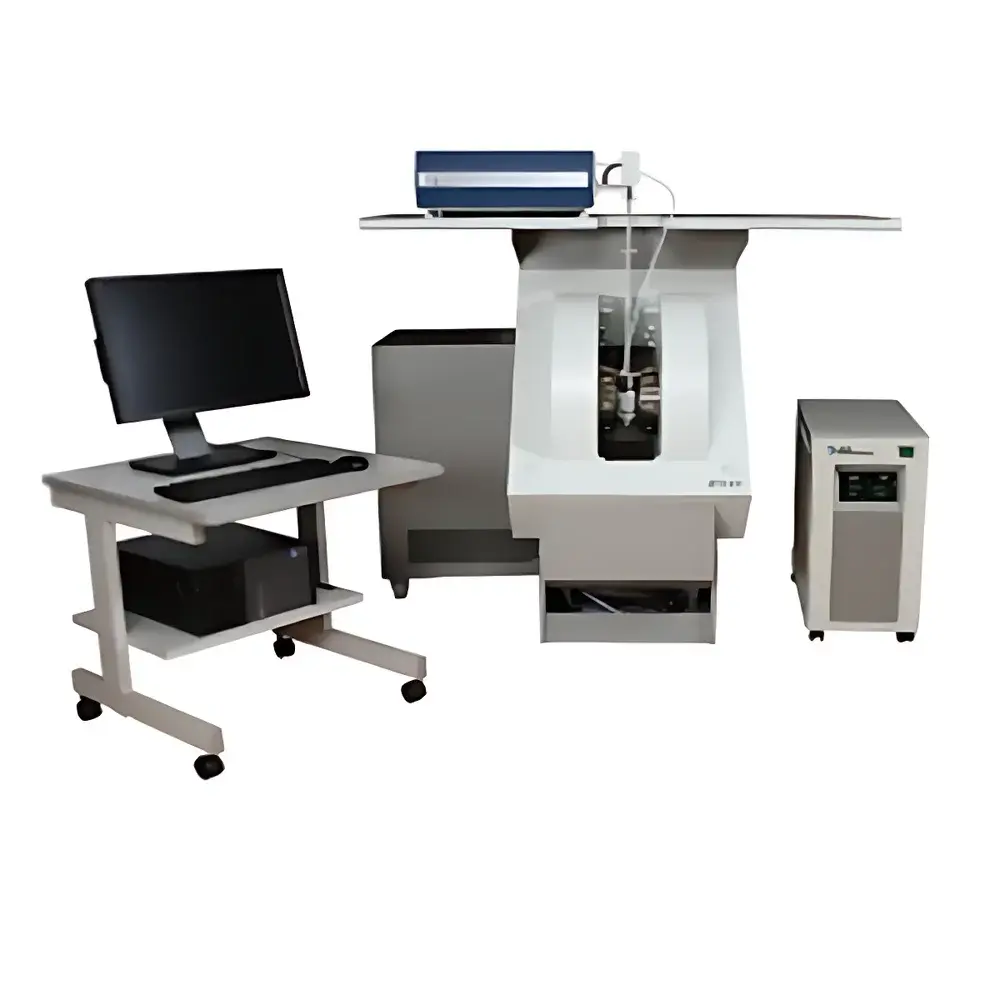
JEOL JES-X310 / JES-X320 Continuous-Wave Electron Spin Resonance Spectrometer
| Brand | JEOL |
|---|---|
| Origin | Japan |
| Instrument Type | Continuous-Wave (CW) ESR |
| Models | JES-X310, JES-X320 |
| Control System | Fully Computer-Controlled |
| Magnetic Field Control | Advanced Digital Gradient-Stabilized Electromagnet System |
| Operating Mode | X-band (9–10 GHz) |
| Detection Method | Phase-Sensitive Lock-in Detection with Field Modulation |
| Cryogenic Compatibility | Optional Liquid Nitrogen and Helium Cryostat Integration |
| Safety Compliance | IEC 61010-1, CE Marked |
Overview
The JEOL JES-X310 and JES-X320 are high-performance, fully computer-controlled continuous-wave electron spin resonance (CW-ESR) spectrometers engineered for quantitative detection and characterization of paramagnetic species in solid, liquid, and frozen solution states. Based on the fundamental principles of magnetic resonance—where unpaired electrons absorb microwave radiation under a precisely controlled static magnetic field—the JES-X3 series operates in the standard X-band frequency range (~9.5 GHz), delivering high signal-to-noise ratio and excellent spectral resolution through optimized cavity design (TE011 rectangular resonator), low-noise microwave bridge architecture, and real-time digital field stabilization. Unlike pulsed ESR systems, the CW configuration provides superior sensitivity for stable radicals, transition metal complexes, and defect centers, making it particularly suitable for routine quality control, kinetic studies, radiation dosimetry, and long-term stability monitoring in pharmaceutical, materials science, and environmental research laboratories.
Key Features
- Fully integrated Windows-based control software (JEOL ESR Studio) enabling automated parameter optimization, real-time spectrum acquisition, and multi-scan averaging with baseline correction and derivative display.
- Digital magnetic field control system featuring closed-loop gradient compensation, field homogeneity better than ±0.01 mT over 10 mm DSV, and programmable field sweep linearity ≤0.1% across full range (0–10,000 G).
- High-stability X-band microwave bridge with automatic frequency tuning, adjustable modulation amplitude (0.01–20 G), and phase-sensitive lock-in detection at 100 kHz modulation frequency.
- Modular sample handling support: standard quartz flat cells (3 mm OD), capillary tubes, and compatibility with JEOL’s optional variable-temperature units (VTU-400: 100–400 K; LHe cryostat: 4–300 K) and in-situ irradiation accessories.
- Rugged electromagnet architecture with water-cooled poles, low-drift power supply (<5 ppm/h), and built-in field calibration using Mn2+ reference standard.
- Comprehensive hardware diagnostics, automated cavity tuning, and self-calibration routines compliant with ISO/IEC 17025 traceability requirements for laboratory accreditation.
Sample Compatibility & Compliance
The JES-X3 series accommodates a broad range of sample formats—including powders, thin films, biological tissues, aqueous solutions, and polymer matrices—without requiring conductive coatings or vacuum sealing. Sample volume requirements are minimal (typically 10–50 µL for liquids or ~1–5 mg for solids), minimizing material consumption during method development. All configurations meet IEC 61010-1 safety standards for laboratory electrical equipment and carry CE marking for use within the European Economic Area. For regulated environments, the system supports audit-trail-enabled data logging and user-access controls aligned with FDA 21 CFR Part 11 requirements when deployed with JEOL’s optional GLP/GMP-compliant software module.
Software & Data Management
JEOL ESR Studio v4.x provides a unified interface for instrument control, spectral simulation (via integrated spin Hamiltonian solver), quantitative analysis (double integration for spin concentration), g-factor calculation, and hyperfine coupling constant extraction. Raw data is stored in vendor-neutral ASCII format (with metadata headers), ensuring interoperability with third-party tools such as MATLAB, OriginLab, and Python-based scientific libraries (e.g., SciPy, NumPy). The software includes batch processing capabilities for time-series experiments and supports export to ASTM E1348-compliant spectral exchange format (.spc). Data integrity is reinforced through timestamped operator logs, electronic signatures, and encrypted database backups.
Applications
- Identification and quantification of free radicals in pharmaceutical formulations exposed to light, heat, or oxidation stress.
- Characterization of paramagnetic impurities (e.g., Fe3+, Cu2+, Mn2+) in semiconductor-grade silicon wafers and battery cathode materials.
- Monitoring radiation-induced defects in food packaging polymers and medical device sterilization validation.
- Investigation of catalytic active sites in heterogeneous catalysts (e.g., V4+, Mo5+) under in-situ gas-flow conditions.
- Spin trapping studies of transient reactive oxygen species (ROS) in cell lysates and enzymatic reaction mixtures.
- Geological dating via trapped electron signal analysis in quartz and feldspar minerals (ESR geochronology).
FAQ
What is the typical minimum detectable spin concentration for the JES-X3 series?**
Detection limits depend on sample type and measurement conditions; for aqueous TEMPOL solutions at room temperature, the limit is approximately 10−9 mol/g with 1-minute acquisition time.
Is the system compatible with external magnetic field modulation or arbitrary waveform generators?**
Yes—via optional BNC-triggered analog input/output ports, enabling synchronized field sweeps with external stimuli (e.g., photoexcitation pulses, electrochemical bias).
Can the JES-X3 be upgraded to support rapid-scan or time-resolved ESR modes?**
No—this is a dedicated continuous-wave platform; pulsed or rapid-scan functionality requires separate instrumentation (e.g., JEOL JES-FA200 or JES-RE1X).
Does JEOL provide application support for method development in regulated industries?**
Yes—JEOL’s global applications team offers protocol validation assistance, IQ/OQ documentation templates, and on-site training aligned with USP <857>, EP 2.2.27, and ISO 13121 guidelines.
What maintenance intervals are recommended for optimal long-term performance?**
Annual calibration of magnetic field and microwave frequency is recommended; cavity cleaning and magnet pole inspection every 24 months; full system health check every 36 months per JEOL Service Bulletin SB-ESR-2023-01.





