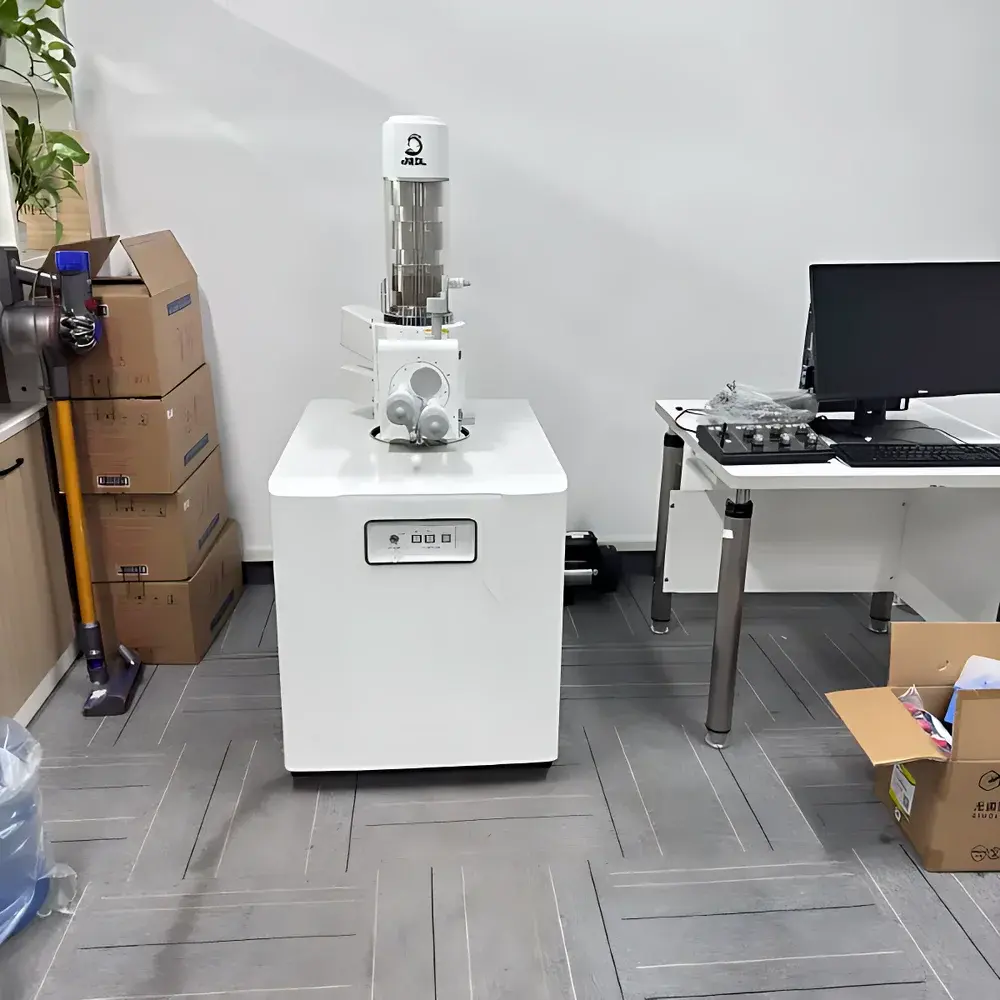
JEOL JSM-IT100 Used Scanning Electron Microscope (SEM) with EDS Capability
| Brand | JEOL |
|---|---|
| Origin | Japan |
| Model | JSM-IT100 |
| Vacuum Modes | High Vacuum & Low Vacuum (10–300 Pa) |
| Resolution | 3 nm @ 30 kV (HV), 4 nm @ 30 kV (LV) |
| Acceleration Voltage | 0.5–30 kV (optional extension to 30 kV) |
| Magnification | ×5 to ×300,000 |
| Stage Travel | X 80 mm, Y 40 mm, Z 5–48 mm, Tilt −10° to +90°, Rotation 360° |
| Max Sample Diameter | 150 mm |
| EDS Functions | Point analysis, elemental mapping, line scan, real-time filtering |
| Detector Options | Dry SD (10/30/60/100 mm² active area) |
| Software | InTouchScope™ GUI with integrated SEM/EDS workflow |
| Power Requirement | 100 V AC, no cooling water required |
| Footprint | ~30% smaller than prior JEOL benchtop SEMs |
| Operational Age | 2 years |
| Compliance | Designed per JEOL’s internal quality system aligned with ISO 9001 |
Overview
The JEOL JSM-IT100 is a compact, user-centric scanning electron microscope engineered for high reproducibility and operational accessibility in academic, industrial QC, and R&D laboratories. Based on JEOL’s five-decade heritage in electron optics, the JSM-IT100 implements thermionic tungsten-filament emission within a fully automated column architecture. Its dual-mode vacuum system supports both high-vacuum imaging (down to 3 nm resolution at 30 kV) and low-vacuum operation (10–300 Pa), enabling direct observation of non-conductive, hydrated, or outgassing specimens without sputter coating. The instrument employs a conical objective lens design with fixed aperture and XY-adjustable alignment, coupled with digital astigmatism memory (10 preset conditions) and fully automated beam alignment, focus, stigmation, contrast, and brightness routines — all accessible via a unified touch-enabled GUI.
Key Features
- Intuitive InTouchScope™ interface with 12.1″ capacitive touchscreen and optional mouse/panel control — designed for rapid operator onboarding and consistent protocol execution.
- Integrated low-vacuum capability (standard on LV/LA variants) permits uncoated analysis of polymers, biological tissues, ceramics, and composites.
- Modular column architecture supports field-upgradable acceleration voltage extension to 30 kV and optional dry silicon-drift EDS detectors (10–100 mm²).
- Motorized 5-axis sample stage (X/Y/Z/tilt/rotation) with navigation-assisted positioning — enabling optical-microscope-like field-of-view localization when paired with optional stage mapping software.
- Minimal infrastructure requirements: operates from a single 100 V AC outlet; zero water cooling or external chiller needed; footprint reduced by ~30% versus legacy JEOL benchtop platforms.
- Automated vacuum sequence with one turbomolecular pump (TMP) and one rotary vane pump (RP); full auto-pump-down and venting with pressure monitoring and interlock safeguards.
Sample Compatibility & Compliance
The JSM-IT100 accommodates samples up to 150 mm in diameter and 48 mm in height, with tilt range from −10° to +90° and continuous 360° rotation — supporting cross-sectional imaging, fracture surface analysis, and multi-angle tomographic reconstruction preparation. Its low-vacuum mode eliminates charging artifacts on insulators such as glass, paint layers, or untreated biofilms. For regulated environments, the system supports traceable operation through optional audit-trail logging (aligned with FDA 21 CFR Part 11 principles), and its standardized parameter sets facilitate method transfer across laboratories. While not certified to ISO/IEC 17025 per se, the platform meets foundational metrological requirements for SEM-based particle sizing (per ASTM E1245), inclusion analysis (per ASTM E1122), and failure analysis workflows compliant with IPC-J-STD-001 and MIL-STD-883.
Software & Data Management
InTouchScope™ provides a unified workspace for simultaneous SEM imaging and EDS acquisition — eliminating context switching between disparate applications. All image formats (BMP, TIFF, JPEG) embed metadata including kV, working distance, magnification, dwell time, and detector configuration. EDS quantification uses JEOL’s proprietary ZAF matrix correction algorithms; elemental maps are generated with pixel-by-pixel deconvolution and spectral background subtraction. The software supports batch report generation with customizable templates, export to CSV/PDF, and direct integration with LIMS via ODBC-compliant database connectors. Optional 3D Sight™ module enables topographic reconstruction from stereo pair acquisition and quantitative roughness profiling (Sa, Sq, Sz per ISO 25178).
Applications
This refurbished JSM-IT100 serves diverse analytical needs: nanomaterial morphology assessment (e.g., carbon nanotubes, MOFs, quantum dots); metallurgical phase identification and inclusion characterization in alloys; semiconductor defect review (bridges, voids, residue); forensic fiber and gunshot residue analysis; pharmaceutical tablet coating uniformity evaluation; and geological grain boundary mapping. Its low-vacuum stability makes it suitable for in situ dynamic experiments — such as humidity-controlled polymer swelling or thermal-stage-enabled recrystallization — when equipped with compatible environmental accessories. Academic users benefit from its pedagogical clarity: real-time beam parameter visualization and guided sample exchange protocols reduce training overhead significantly.
FAQ
Is this unit factory-refurbished or dealer-certified?
This JSM-IT100 has undergone comprehensive functional validation by an authorized JEOL service partner, including column alignment verification, vacuum integrity testing, EDS energy calibration (Mn Kα at 5.895 keV ± 0.5%), and stage repeatability assessment (±0.5 µm over full travel). Full service history and calibration certificates are provided.
Can it be integrated into a networked lab environment?
Yes — the system includes Gigabit Ethernet connectivity and supports remote desktop access via secure VNC. Image and spectrum data can be routed to shared NAS storage or cloud repositories using configurable FTP/SFTP protocols.
What consumables and maintenance intervals should be anticipated?
Tungsten filament lifetime averages 100–150 operating hours under standard conditions; replacement requires <15 minutes and no column venting. TMP oil change is recommended every 12 months or 3,000 hours; rotary pump oil every 6 months. JEOL offers extended service contracts covering preventive maintenance and priority response.
Does it support third-party EDS software?
Native acquisition is limited to JEOL’s EDS suite; however, spectrum files (.eds, .raw) are exportable in standard JCAMP-DX format for post-processing in commercial packages including Thermo Fisher Avantage, Oxford AZtec, or Bruker Esprit.
Is installation support included?
Standard delivery includes site survey guidance, leveling instructions, and remote commissioning assistance. On-site installation and operational qualification (IQ/OQ) services are available as billable options.
Related Products