
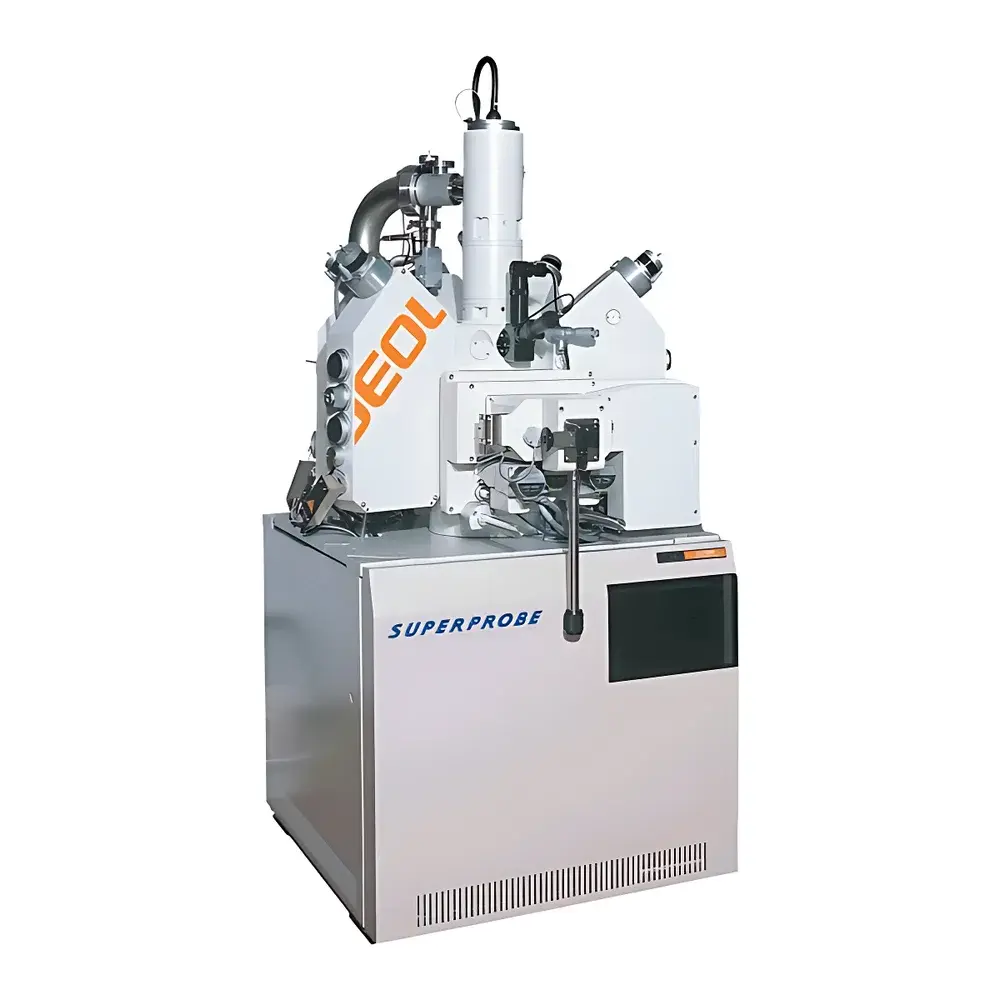
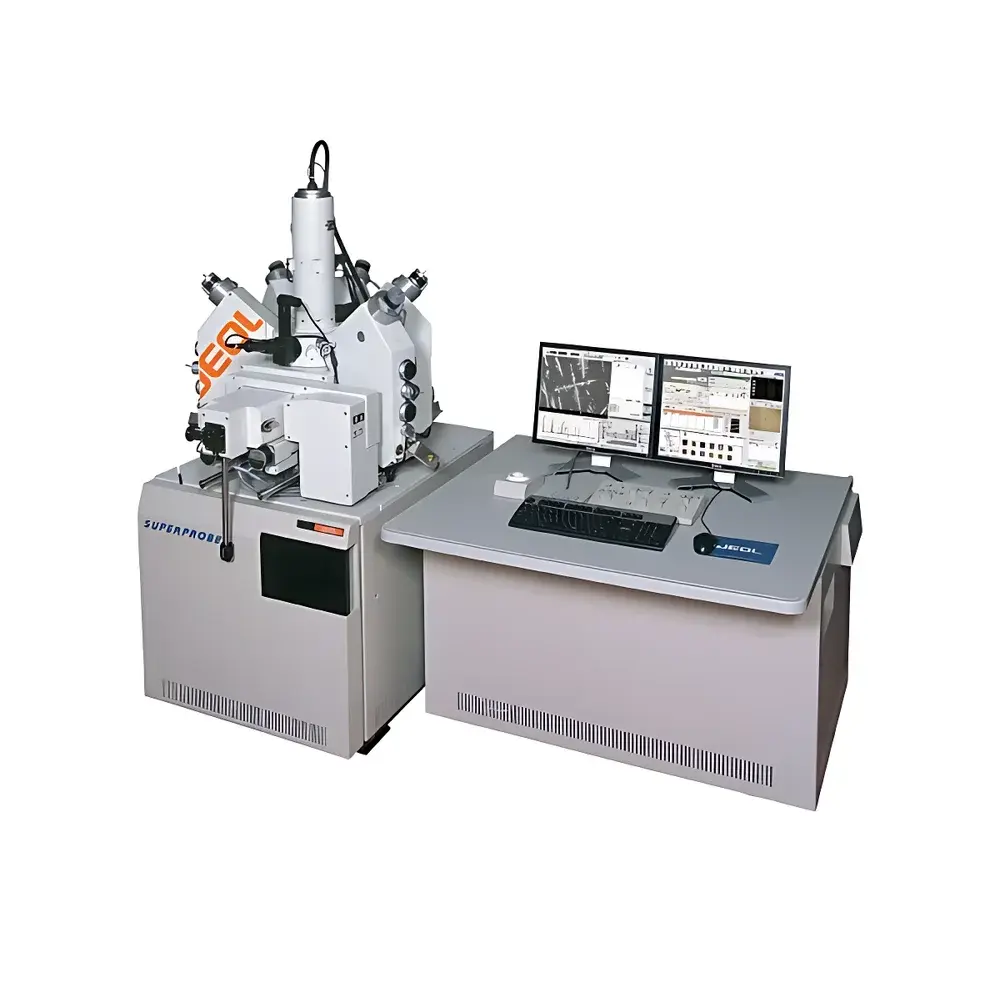
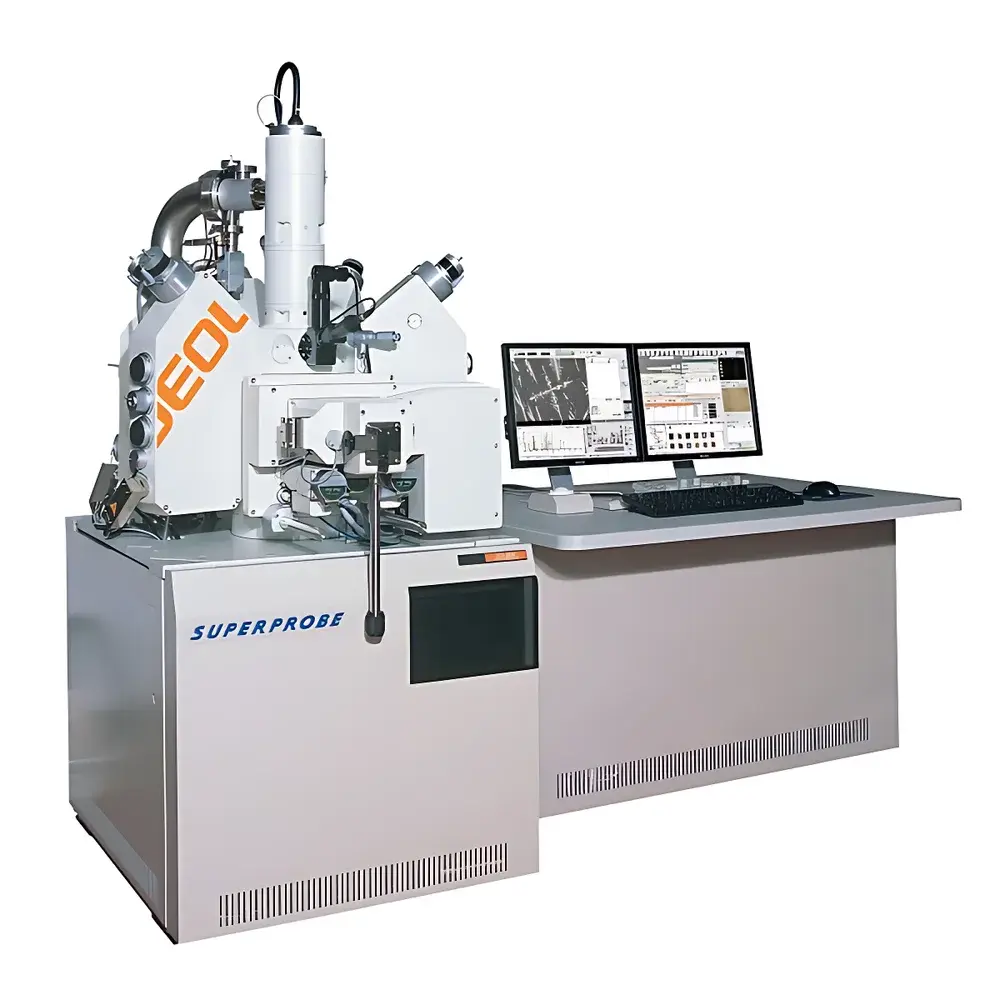
JEOL JXA-8230 Electron Probe Microanalyzer
| Brand | JEOL |
|---|---|
| Origin | Japan |
| Model | JXA-8230 |
| Accelerating Voltage | 0.2–30 kV (0.1 kV step) |
| Beam Current Range | 1×10⁻¹² – 1×10⁻⁵ A |
| Beam Current Stability | ±5% / h, ±0.3% / 12 h |
| Secondary Electron Resolution | 6 nm (W filament, WD = 11 mm, 30 kV) |
| Magnification | ×40 – ×300,000 |
| Max. Sample Size | 100 mm × 100 mm × 50 mm (H) |
| WDS Elemental Range | Be*¹–U (Be requires optional crystal) |
| EDS Elemental Range | B–U |
| WDS Wavelength Range | 0.087–9.3 nm |
| EDS Energy Range | 0–20 keV |
| WDS Spectrometers | 1–5 channels (configurable) |
| EDS Detector | 1 SDD (optional fanless digital pulse processor) |
| Display | Dual LCDs (1280×1024), dedicated for EPMA analysis and SEM/EDS operation |
Overview
The JEOL JXA-8230 Electron Probe Microanalyzer (EPMA) is a high-performance, wavelength-dispersive X-ray microanalysis system engineered for quantitative elemental mapping and compositional characterization at sub-micrometer spatial resolution. Based on the fundamental principle of electron-induced X-ray emission—where a focused electron beam excites characteristic X-rays from solid specimens—the JXA-8230 integrates both Wavelength Dispersive Spectroscopy (WDS) and Energy Dispersive Spectroscopy (EDS) in a single platform. Its dual-spectrometer architecture enables simultaneous high-sensitivity, high-energy-resolution WDS quantification (detection limits down to ~10 ppm for many elements) alongside rapid EDS surveying and qualitative screening. Designed for rigorous materials science, geoscience, metallurgy, and semiconductor R&D applications, the instrument delivers traceable, matrix-corrected quantitative results compliant with ISO 14701, ASTM E1508, and IUPAC guidelines for microbeam analysis.
Key Features
- Modular WDS configuration supporting 1–5 spectrometers, each equipped with selectable synthetic multilayer or natural crystal analyzers—including optional crystals for light-element detection (e.g., Be, B, C, N, O)
- Dual-mode operation: seamless switching between high-precision WDS point analysis, line scans, and element maps; and fast EDS acquisition using a silicon drift detector (SDD) with digital pulse processing
- Advanced electron optical column featuring thermionic tungsten or optional LaB₆ source, enabling stable beam currents from 10⁻¹² A to 10⁻⁵ A with long-term current stability (±0.3% over 12 h)
- Integrated PC-based user interface with “User Recipes” functionality—allowing full preservation and recall of analytical conditions including beam parameters, stage coordinates, spectrometer settings, and quantification protocols
- Automated EPMA startup sequence: one-click initiation of preconfigured EDS qualitative/quantitative workflows or WDS multi-element analyses without manual setup
- Fanless SDD option minimizes mechanical vibration and thermal drift, enhancing spectral stability during extended acquisitions
Sample Compatibility & Compliance
The JXA-8230 accommodates standard polished thin sections (up to 100 mm × 100 mm × 50 mm H), bulk metallic alloys, ceramics, geological specimens, and coated conductive samples. Non-conductive materials require carbon or Au/Pt sputter coating per ASTM E1508 recommendations. All quantitative routines incorporate ZAF or φ(ρz) matrix correction algorithms, with certified reference materials (CRMs) traceable to NIST SRMs and JCM standards. The system supports GLP-compliant data recording—including operator ID, timestamped acquisition logs, and full audit trails—and meets requirements for FDA 21 CFR Part 11 when deployed with JEOL’s optional secure software package.
Software & Data Management
JEOL’s proprietary ANALYSIS STATION software provides a unified environment for real-time spectrum visualization, peak deconvolution, background modeling, and stoichiometric quantification. Raw WDS and EDS spectra are stored in standardized .jxa and .eds formats, fully compatible with third-party tools such as DTSA-II and Probe for EPMA. Batch processing, report generation (PDF/Excel), and spectral library matching (including mineral and alloy databases) are natively supported. Data integrity is reinforced via automatic checksum verification, version-controlled method files, and encrypted project archives.
Applications
- Quantitative phase composition analysis in multiphase alloys, intermetallics, and weld zones
- In situ geochemical profiling of zoned minerals (e.g., garnet, plagioclase, pyroxenes) for petrogenetic modeling
- Trace-element partitioning studies in nuclear fuel matrices and ceramic electrolytes
- Failure analysis of electronic packaging interfaces and solder joint intermetallic compounds
- Light-element (B, C, N, O, F) distribution mapping in advanced steels and nitride semiconductors using optimized WDS crystals
FAQ
What is the minimum detectable concentration for WDS analysis on the JXA-8230?
Typical detection limits range from 10–50 ppm for most elements under optimal conditions (e.g., 30 kV, 100 nA beam, 100 s counting time), depending on atomic number, matrix absorption, and spectrometer configuration.
Can the JXA-8230 perform automated particle analysis?
Yes—via integrated stage control and image-based particle recognition in ANALYSIS STATION, enabling morphology-filtered, compositionally classified particle enumeration and statistics.
Is the system compliant with ISO/IEC 17025 for accredited testing laboratories?
When operated with documented SOPs, calibrated CRMs, and validated quantification models, the JXA-8230 satisfies technical requirements for ISO/IEC 17025 accreditation; full compliance depends on laboratory-specific quality management implementation.
What vacuum level is maintained in the sample chamber during analysis?
The specimen chamber operates at ≤1×10⁻⁴ Pa, while the electron column maintains ≤1×10⁻⁶ Pa, ensuring minimal beam scattering and stable probe formation.
Does JEOL provide application support for method development?
Yes—JEOL offers remote and on-site application assistance, including custom quantification protocol development, CRM selection guidance, and interlaboratory validation support.




