
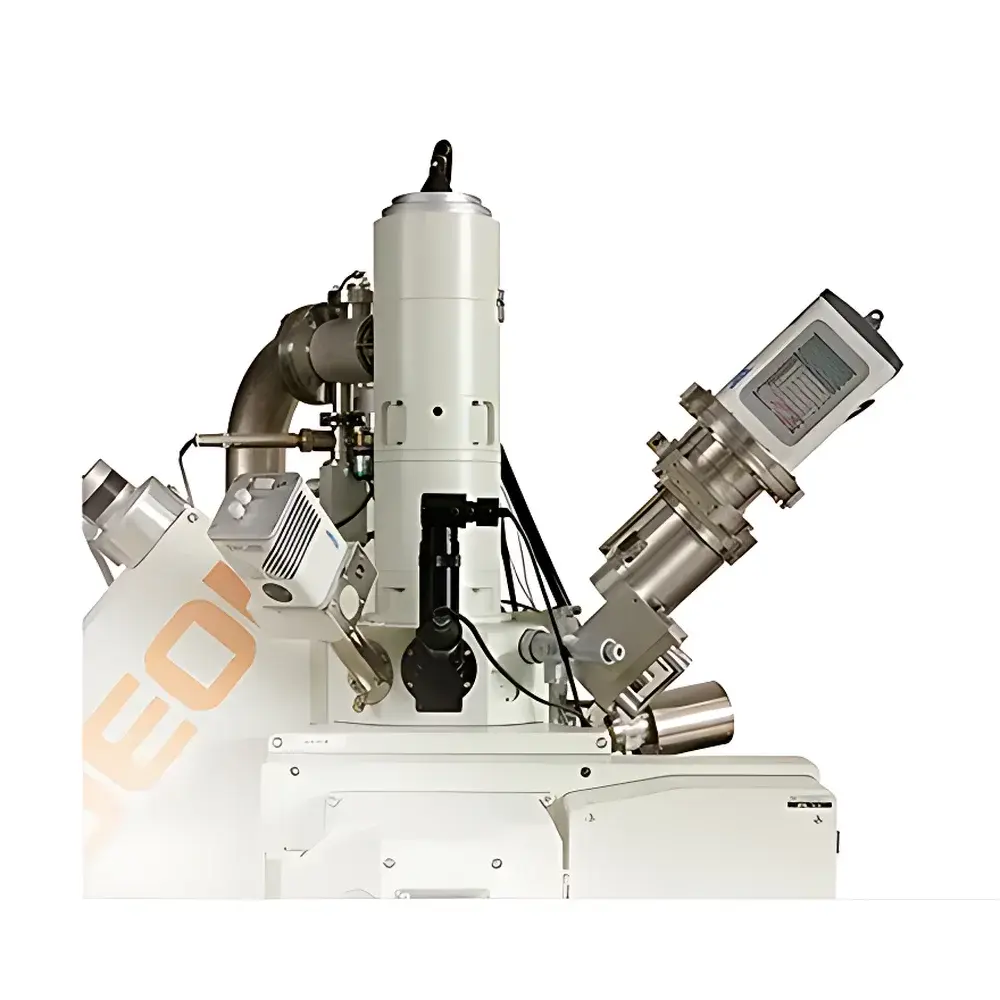
JEOL SXES Soft X-Ray Emission Spectrometer
| Brand | JEOL |
|---|---|
| Origin | Japan |
| Model | SXES |
| Energy Resolution | 0.3 eV (at Al-L edge, 73 eV) |
| Detection Energy Range | 50–170 eV (JS50XL grating) / 70–210 eV (JS50XL grating) |
| Mounting Interface | EPMA WDS Port #2 (front right) or FE-SEM WDS port (front left-rear) |
| Dimensions (W×D×H) | 168 mm × 348 mm × 683 mm (including CCD distance from interface) |
| Weight | 25 kg |
| Compatible Instruments | EPMA — JXA-8530F, JXA-8230, JXA-8500F, JXA-8200 |
Overview
The JEOL SXES Soft X-Ray Emission Spectrometer is a high-resolution wavelength-dispersive spectroscopic instrument designed for quantitative chemical state analysis of light elements (Z = 3–11) in solid-state materials. Unlike energy-dispersive spectrometers (EDS) that rely on semiconductor detector response and suffer from inherent peak broadening, the SXES employs grazing-incidence diffraction optics—specifically, a newly developed laminar-type variable-line-spacing grating (JS50XL)—coupled with a back-illuminated, deep-depletion CCD detector optimized for soft X-ray photon detection (50–210 eV). This optical architecture enables true parallel acquisition of emission spectra with sub-eV energy resolution, grounded in first-principles Bragg dispersion physics rather than electronic noise-limited pulse-height analysis. The system is engineered to integrate directly into existing electron probe microanalyzers (EPMA) and field-emission scanning electron microscopes (FE-SEM) via standardized WDS mechanical and vacuum interfaces, delivering element-specific valence-band density-of-states information critical for studying oxidation states, bonding configurations, and electronic structure in oxides, nitrides, carbides, and battery electrode materials.
Key Features
- Ultra-high energy resolution of ≤0.3 eV measured at the Al-L2,3 emission edge (73 eV), surpassing conventional WDS systems and enabling separation of spin-orbit doublets and fine chemical shifts in Li-K, B-K, C-K, N-K, O-K, and F-K spectra.
- Parallel spectral acquisition across full detection range (50–170 eV or 70–210 eV, depending on grating alignment), eliminating sequential scanning delays and improving counting statistics per unit beam time.
- Optimized optical path with minimized aberrations and high throughput: JS50XL grating features precisely fabricated groove density gradients and ion-beam polished substrates to maintain diffraction efficiency >15% across the soft X-ray band.
- Integrated vacuum-compatible mechanical design: compact footprint (168 mm × 348 mm × 683 mm) and 25 kg mass facilitate installation on standard EPMA WDS Port #2 (front-right) or FE-SEM WDS ports (front left-rear), with bakeable flange connections meeting UHV compatibility requirements (≤1×10⁻⁷ Pa).
- Thermoelectrically cooled CCD sensor (−60 °C operating temperature) with low readout noise (<5 e− RMS) and high quantum efficiency (>40% at 100 eV), ensuring stable signal-to-noise performance during long-duration acquisitions.
Sample Compatibility & Compliance
The SXES is compatible with conductive and semi-conductive bulk specimens, polished thin sections, and coated thin films routinely analyzed in EPMA and FE-SEM workflows. It requires no additional sample preparation beyond standard carbon or Au/Pd coating for charge dissipation. As an add-on module for JEOL analytical platforms, the SXES complies with IEC 61000-6-3 (EMC emissions) and IEC 61010-1 (safety requirements for electrical equipment for measurement). Data acquisition protocols support GLP-compliant metadata tagging—including operator ID, instrument configuration log, vacuum status, beam current, and dwell time—and are compatible with audit-trail-enabled reporting frameworks aligned with FDA 21 CFR Part 11 when deployed within validated laboratory information management systems (LIMS).
Software & Data Management
Control and spectral processing are performed using JEOL’s dedicated SXES Analysis Suite, which runs under Windows 10/11 64-bit environments. The software provides real-time spectrum preview, automatic peak identification using reference libraries (NIST SRD 143, IAEA X-ray Line Database), background subtraction via Shirley or Tougaard algorithms, and quantitative deconvolution of overlapping transitions (e.g., O-Kα vs. Ti-Lα in TiO2). All raw and processed spectra are stored in HDF5 format with embedded calibration parameters, supporting traceable reprocessing and inter-instrument comparison. Export options include ASCII, CSV, and CDF for integration with third-party analysis tools such as Igor Pro, MATLAB, or Python-based spectral fitting packages (e.g., lmfit, PyMca).
Applications
- Chemical state mapping of Li in cathode materials (LiCoO2, NMC, LiFePO4) via Li-K emission line shape analysis.
- Distinguishing sp2 vs. sp3 hybridization in carbon-based nanomaterials using C-K fine structure.
- Quantifying oxygen vacancy concentration in perovskite oxides through O-K spectral asymmetry and pre-edge intensity ratios.
- Identifying nitrogen coordination environments (pyridinic, pyrrolic, graphitic) in doped graphene catalysts.
- Valence band profiling of transition metal dichalcogenides (MoS2, WS2) for 2D electronics research.
FAQ
What is the minimum detectable energy shift resolvable by the SXES?
The SXES resolves energy shifts ≥0.3 eV at the Al-L edge; practical chemical shift detection limit is ~0.5 eV for light elements under optimal count-rate conditions (≥10,000 cps integrated over 100 eV window).
Can the SXES be used simultaneously with WDS or EDS detectors?
Yes—mechanical and vacuum interlocks ensure concurrent operation with JEOL’s WDS spectrometers; EDS may operate in parallel but requires beam current optimization to avoid detector saturation.
Is cryo-transfer capability supported for air-sensitive samples?
No—the SXES is not equipped with a cryo-stage or transfer lock; analysis must be conducted under standard high-vacuum conditions (≤1×10⁻⁴ Pa) with pre-characterized, stable samples.
Does the system support automated spectral acquisition sequences?
Yes—via JEOL’s StageLink scripting interface, users can define multi-point, multi-region, or raster-based acquisition routines synchronized with stage movement and beam blanking.
What maintenance is required for the diffraction grating and CCD?
The JS50XL grating is sealed within an ultra-high-vacuum chamber and requires no user servicing; the CCD is maintenance-free with thermoelectric cooling—only periodic vacuum pump oil replacement and chamber leak checks are recommended per JEOL PM schedule.




