
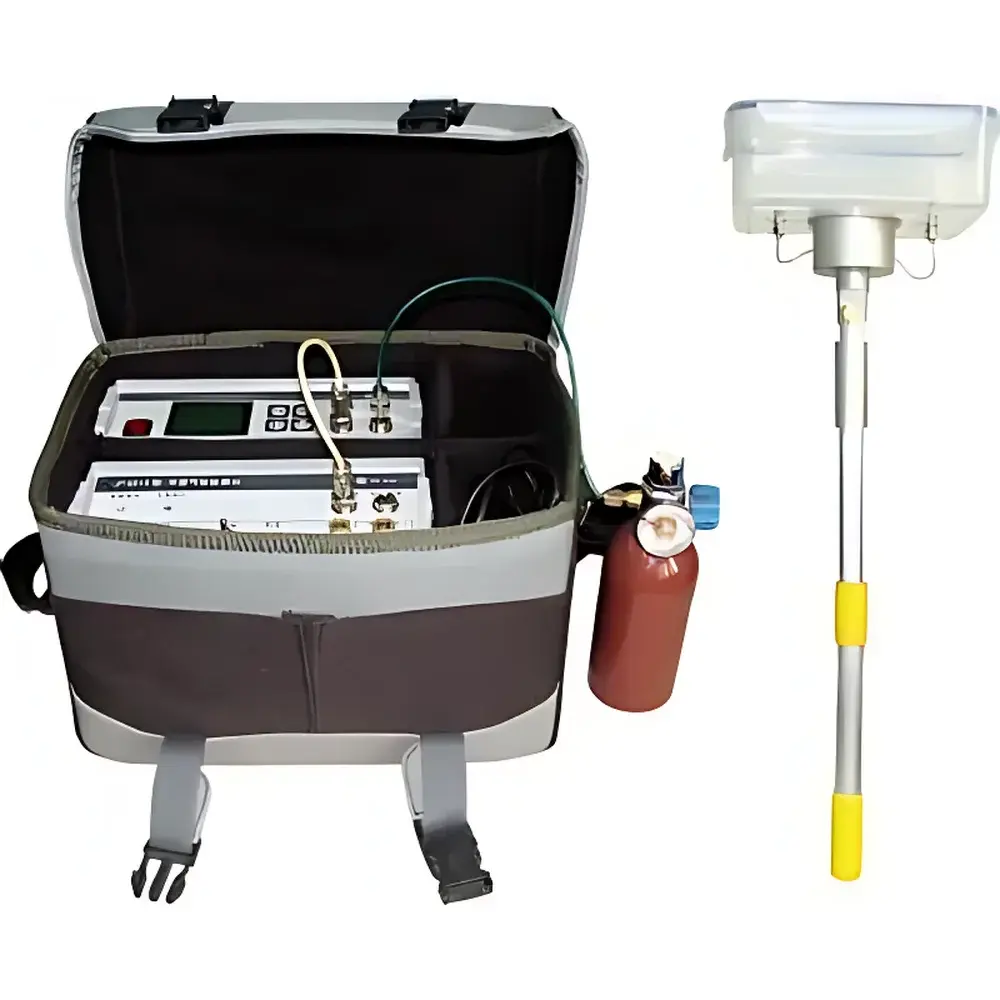
JF-2215 Portable Gas Detector Calibration System by Junfang Analytical
| Brand | Junfang Analytical |
|---|---|
| Model | JF-2215 |
| Origin | Beijing, China |
| Gas Compatibility | CH₄, CO, C₃H₈, H₂ (expandable to C₄H₁₀, C₂H₅OH) |
| Concentration Accuracy | ±2% FS |
| Repeatability | 1% |
| Stability (5 min) | ≤4% drift under sealed conditions |
| Predefined Concentration Steps | 7 per gas (user-configurable) |
| Gas Type | Non-corrosive gases only |
| Price Range | USD 2,800 – 7,000 |
Overview
The JF-2215 Portable Gas Detector Calibration System is an engineered solution for field verification and functional validation of fixed and portable combustible gas detectors. Designed in accordance with international calibration best practices—including ISO 6145-1 (gas mixtures by dynamic dilution) and IEC 60079-29-1 (performance requirements for gas detectors)—the system employs precision mass flow control and dual-stage dilution architecture to generate certified reference gas concentrations on-site. Unlike static span-gas cylinders, the JF-2215 dynamically blends zero air with certified standard gas (e.g., 100% CH₄ or 500 ppm CO in N₂) to deliver traceable, repeatable test concentrations across user-defined ranges. Its core function is not analytical measurement but metrological assurance: confirming detector response linearity, alarm threshold accuracy, and recovery time under real-world installation conditions—critical for compliance with OSHA 1910.120, NFPA 72, and local fire safety regulations.
Key Features
- On-site calibration capability eliminates dependency on laboratory-grade gas cylinders and reduces downtime during routine maintenance or post-installation commissioning.
- Dual independent mass flow controllers (MFCs) enable high-fidelity dilution ratios from 1:100 to 1:10,000, supporting both low-concentration toxic gas checks (e.g., 25 ppm CO) and high-range combustible tests (e.g., 25% LEL CH₄).
- Seven factory-preset concentration levels per gas type—fully editable via front-panel interface—streamline standardized bump testing protocols without software dependency.
- Integrated leak-tight manifold design ensures ≤4% concentration drift over 5 minutes when isolated, meeting ASTM E2654-19 criteria for short-term stability in field calibrators.
- Modular gas module architecture allows field-upgradeable support for additional analytes including butane (C₄H₁₀), ethanol vapor (C₂H₅OH), and other non-corrosive species upon configuration validation.
- Robust aluminum alloy chassis with IP54-rated enclosure enables operation in industrial environments ranging from −10 °C to +50 °C and relative humidity up to 90% non-condensing.
Sample Compatibility & Compliance
The JF-2215 is validated exclusively for use with non-corrosive, non-reactive gases—including methane (CH₄), carbon monoxide (CO), propane (C₃H₈), and hydrogen (H₂)—and does not support halogenated, acidic, or condensable vapors (e.g., Cl₂, H₂S, NH₃, or VOCs with dew points >25 °C). All internal wetted materials conform to ASTM F2253-03 for elastomer compatibility with hydrocarbon gases. The system complies with CE marking requirements under Directive 2014/30/EU (EMC) and 2014/35/EU (LVD), and its calibration traceability chain adheres to ISO/IEC 17025:2017 through documented linkage to NIM (National Institute of Metrology, China) certified reference materials. It supports audit-ready documentation for GLP/GMP-regulated facilities when used in conjunction with external logging devices.
Software & Data Management
While the JF-2215 operates autonomously via its embedded microcontroller and LCD interface, optional USB-C connectivity enables export of calibration event logs (timestamp, gas ID, target concentration, actual MFC output, operator ID) in CSV format. These logs are compatible with enterprise CMMS platforms such as IBM Maximo and SAP PM for preventive maintenance scheduling. Firmware updates maintain alignment with evolving regional standards—including upcoming revisions to EN 45544-2 (electrochemical gas detectors) and UL 2075 (gas detection equipment). No proprietary software installation is required; data transfer occurs via standard mass storage mode. Audit trail functionality meets FDA 21 CFR Part 11 requirements when paired with validated third-party electronic signature modules.
Applications
- Routine bump testing of catalytic bead and infrared combustible gas sensors prior to confined space entry (per OSHA 1910.146).
- Commissioning verification of newly installed fixed-point detectors in petrochemical process areas, LNG terminals, and biogas upgrading facilities.
- Periodic performance validation for municipal wastewater treatment plants monitoring CH₄ off-gas or CO in blower rooms.
- Calibration support for accredited third-party service providers performing ISO/IEC 17025-compliant gas detector certification.
- Educational use in occupational safety training programs demonstrating detector response dynamics and failure mode recognition.
FAQ
Can the JF-2215 calibrate hydrogen sulfide (H₂S) detectors?
No. The system is restricted to non-corrosive gases; H₂S is excluded due to material compatibility and sensor poisoning risks.
Is NIST-traceable gas required for operation?
Yes. Users must supply certified standard gas cylinders (e.g., 1,000 ppm CO in N₂, ±1% uncertainty) traceable to NIST or equivalent national metrology institutes.
Does it support automatic pass/fail reporting against alarm thresholds?
Not natively. Pass/fail assessment requires manual comparison of detector output against JF-2215’s target value; integration with external DAQ systems enables automation.
What maintenance intervals are recommended?
MFC recalibration every 12 months or after 500 operational hours; filter replacement every 6 months in dusty environments.
Can it be used in explosive atmospheres?
No. The JF-2215 is not ATEX or IECEx certified and must only be operated in non-hazardous zones.







