
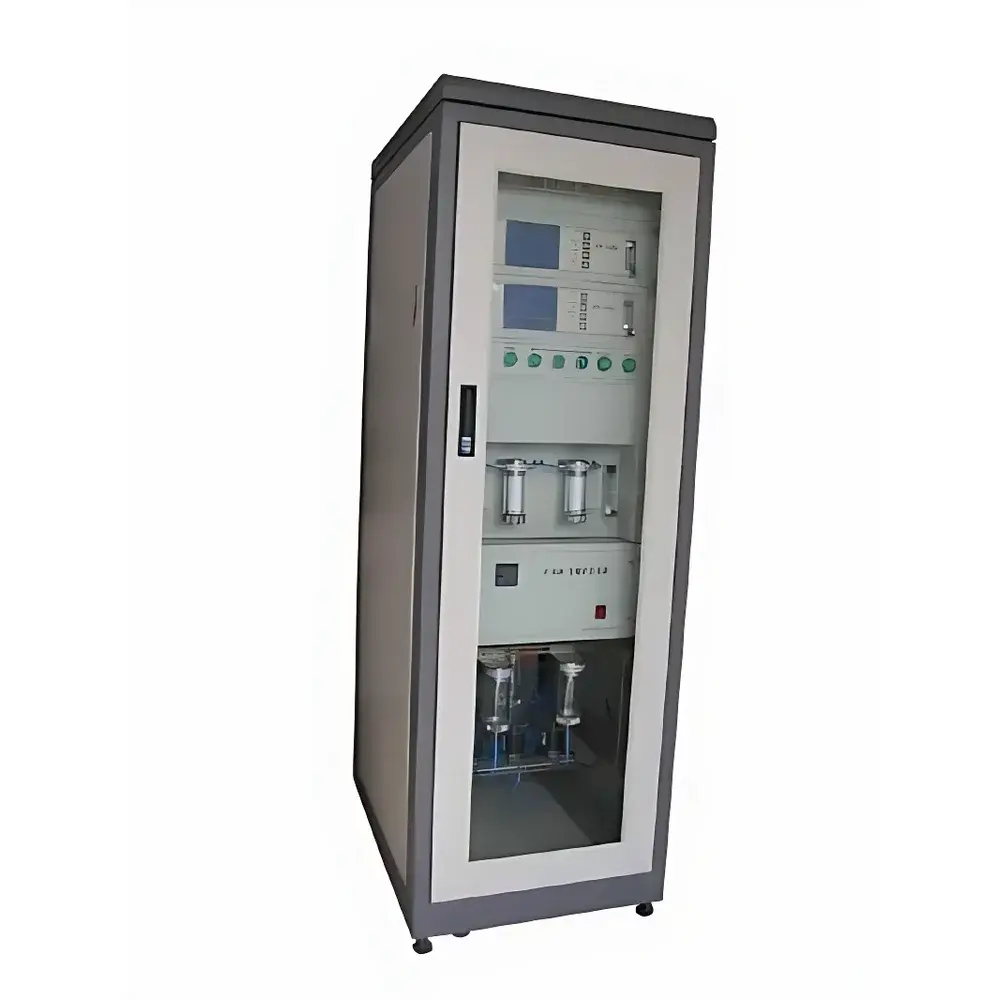
JF-3000 Cement Kiln Gas Monitoring & Control System
| Origin | Beijing, China |
|---|---|
| Manufacturer Type | Authorized Distributor |
| Origin Category | Domestic (China) |
| Model | JF-3000 |
| Price | Upon Request |
| Measurement Range | CO: 0–5% vol, O₂: 0–10% vol |
| Alarm Setpoint Range | 10–90% of Full Scale |
| Zero Drift | ≤ ±1% FS (after 8-hr warm-up, 48-hr continuous operation) |
| Sensitivity Drift | ≤ ±1% FS |
| Temperature Influence | ≤ 3% FS over 5–40°C |
| Response Time (T₉₀) | ≤ 2 min |
| Sample Flow Rate | 0.5 L/min |
| Output Relay Capacity | 220 V AC / 5 A |
| Dimensions | 1800 × 610 × 700 mm |
| Weight | ~180 kg |
Overview
The JF-3000 Cement Kiln Gas Monitoring & Control System is an industrial-grade, fully automated in-situ gas analysis platform engineered for continuous, real-time monitoring of carbon monoxide (CO) and oxygen (O₂) concentrations within cement rotary kiln exhaust streams and process ducts. Designed to meet the stringent operational and safety requirements of high-temperature, high-dust industrial environments, the system employs electrochemical (CO) and paramagnetic or zirconia-based (O₂) sensing technologies—selected for long-term stability, low cross-sensitivity, and resistance to thermal shock and particulate loading. Unlike laboratory-grade analyzers, the JF-3000 integrates robust sample conditioning—including automatic moisture removal, particulate filtration, and probe reverse-pulse cleaning—to ensure uninterrupted measurement integrity under harsh kiln-side conditions. Its primary function extends beyond data acquisition: it serves as a critical safety interlock subsystem, delivering programmable alarm and shutdown logic compliant with IEC 61511 (Functional Safety of Safety Instrumented Systems) and aligned with ISO 13849-1 for machinery safety. The system operates unattended for extended periods, supporting predictive maintenance strategies and process optimization via trend analysis of combustion efficiency indicators (e.g., CO/O₂ ratio).
Key Features
- Fully automated sampling architecture with integrated condensate separator, heated sample line (optional), and self-cleaning probe with programmable reverse-blow cycles
- Dual-channel independent measurement: CO (0–5% vol) and O₂ (0–10% vol), each with user-configurable full-scale ranges and alarm thresholds
- Intelligent alarm management: two-tier event handling—audible/visual local alarm (for lower-limit excursions) and hardwired safety interlock output (for upper-limit excursions triggering kiln shutdown)
- Auto-calibration capability with zero/span verification using certified calibration gases; calibration logs stored with timestamps and operator ID
- High-reliability relay outputs rated at 220 V AC / 5 A, suitable for direct integration with PLCs, DCS systems, or emergency stop circuits
- Industrial-grade LCD HMI with intuitive menu navigation, real-time concentration display, historical trend plotting (72-hour buffer), and configurable data logging intervals
- Environmental resilience: operating ambient temperature range 5–40°C; drift contribution from ambient variation limited to ≤3% FS
Sample Compatibility & Compliance
The JF-3000 is validated for use with hot, humid, and dust-laden flue gases typical of cement clinker production (typically 150–300°C upstream of the preheater exit or at cooler exhaust points). Sample conditioning includes multi-stage filtration (≤1 µm particulate retention), thermoelectric or compressed-air cooled condensate traps, and optional heated transport lines to prevent dew-point-related condensation. The system complies with CE marking requirements for electromagnetic compatibility (EMC Directive 2014/30/EU) and low-voltage safety (LVD Directive 2014/35/EU). While not certified to SIL2 per IEC 61508, its architecture supports integration into SIL2-rated safety loops when deployed with redundant sensors and third-party safety relays. It meets general requirements for continuous emission monitoring systems (CEMS) per EN 15267-3 for performance testing and is routinely deployed in facilities requiring adherence to GB/T 21915–2008 (Chinese standard for industrial gas analyzers) and ISO 14001 environmental management frameworks.
Software & Data Management
The embedded firmware supports Modbus RTU (RS-485) and optional Modbus TCP/IP communication protocols for seamless integration into plant-wide SCADA or MES platforms. All measurement data—including raw sensor outputs, alarm states, calibration events, and interlock activations—are timestamped and stored locally on non-volatile memory (≥30 days at 1-minute intervals). Remote access is enabled via secure Ethernet connection using industry-standard OPC UA clients. Audit trails are maintained per GLP/GMP principles: all parameter changes, calibration actions, and user logins are recorded with digital signatures and immutable timestamps. Optional cloud-based data visualization modules provide web-accessible dashboards with customizable KPIs (e.g., average CO spike frequency, O₂ setpoint deviation index) and automated PDF report generation for regulatory submissions.
Applications
- Real-time combustion control in rotary kilns to minimize incomplete combustion (CO) while maintaining optimal excess air (O₂) for energy efficiency and NOₓ suppression
- Safety-critical monitoring of kiln inlet/outlet ducts to detect reducing atmosphere conditions indicative of refractory failure or fuel starvation
- Process validation during kiln start-up, shutdown, and transition phases where transient CO spikes pose explosion risks
- Compliance support for environmental permits requiring continuous CO reporting (e.g., EU Industrial Emissions Directive 2010/75/EU Annex VI)
- Cross-industry deployment in aluminum smelting (anode baking furnaces), coke ovens, waste-to-energy plants, and iron sintering facilities where similar CO/O₂ safety dynamics apply
FAQ
What gas detection technologies are used for CO and O₂ measurement?
The JF-3000 utilizes electrochemical sensors for CO detection and either paramagnetic or zirconia-based sensors for O₂, selected based on site-specific temperature, moisture, and interference gas profiles.
Can the system be integrated with existing DCS or PLC infrastructure?
Yes—standard Modbus RTU (RS-485) is included; Modbus TCP/IP and Profibus DP are available as factory-configured options.
Is remote calibration supported?
Remote initiation of zero/span calibration sequences is possible via HMI or Modbus command; however, physical introduction of certified calibration gas remains mandatory for traceable verification.
What maintenance intervals are recommended?
Filter elements require replacement every 3–6 months depending on dust load; sensor lifetime is typically 24–36 months under continuous operation with proper sample conditioning.
Does the system comply with FDA 21 CFR Part 11 for electronic records?
While not a pharmaceutical-grade system, its audit trail functionality (user authentication, immutable logs, electronic signatures) satisfies foundational ALCOA+ data integrity principles applicable to regulated manufacturing environments.







