
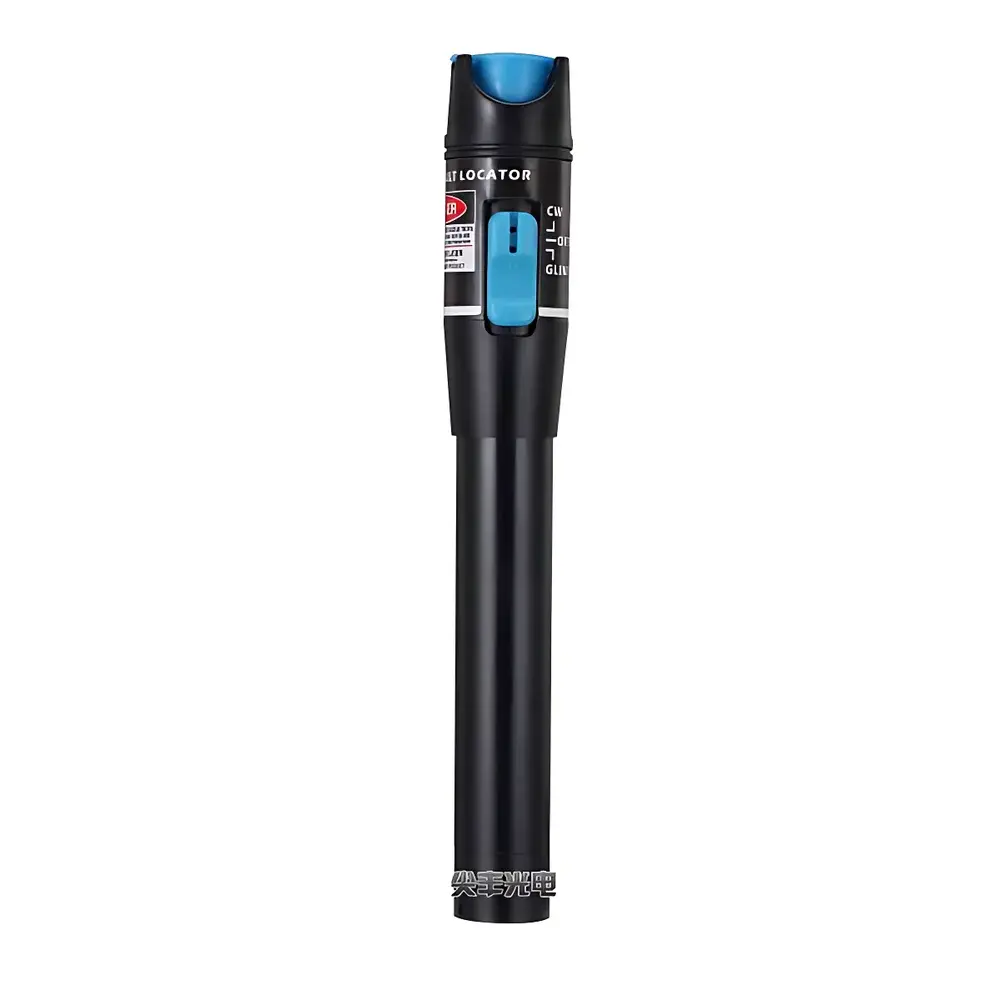
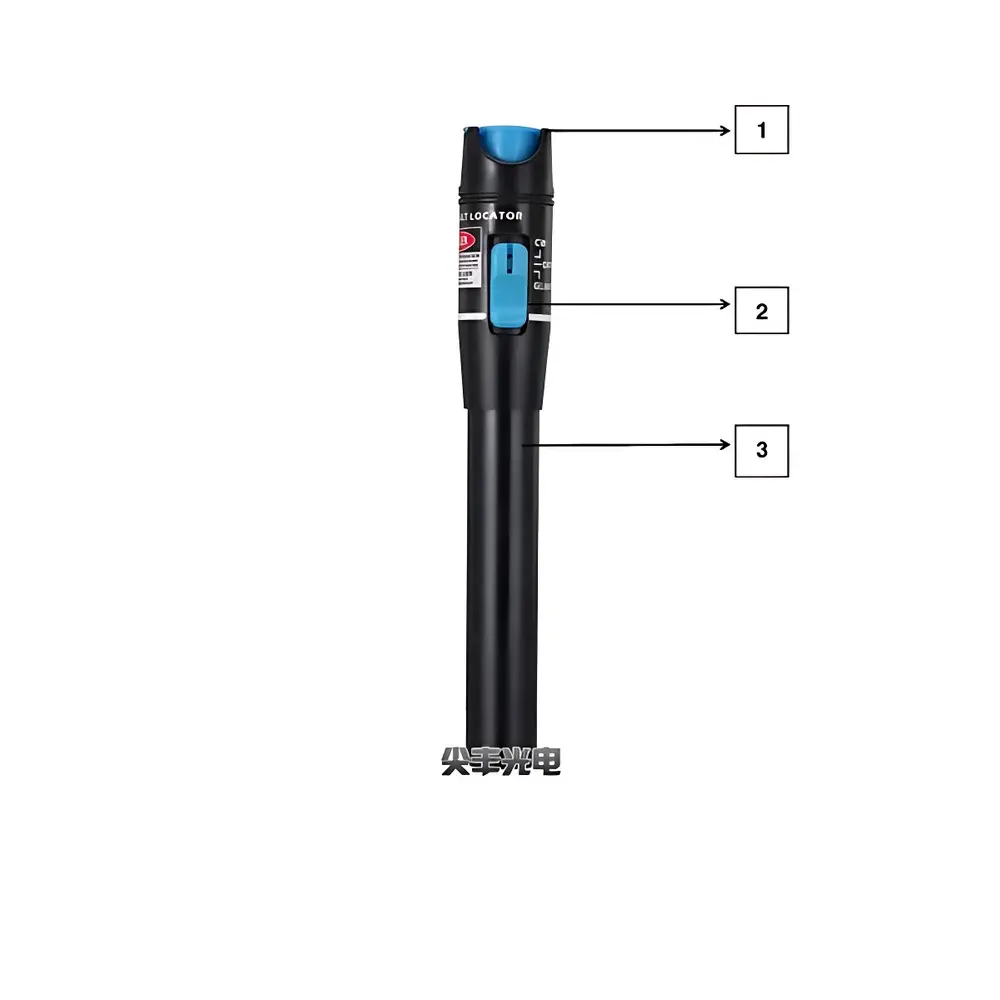
JF-H410B AOE Tech Visual Fault Locator (VFL) Pen
| Brand | AOE Tech |
|---|---|
| Model | JF-H410B |
| Wavelength | 650 nm |
| Output Power | 5 mW |
| Spectral Width | ±5 nm @ 20°C |
| Fiber Compatibility | SM & MM |
| Operating Mode | CW / 2 Hz Modulated |
| Connector Interface | 2.5 mm Universal Ferrule |
| Power Supply | 2 × AAA batteries |
| Continuous Operation Time | 20–30 h |
| Operating Temperature | −10°C to +60°C |
| Storage Temperature | −25°C to +70°C |
| Dimensions | 17.5 × 2.6 × 2.6 cm |
| Weight | 200 g |
Overview
The JF-H410B Visual Fault Locator (VFL) Pen is a compact, handheld optical diagnostic tool engineered for rapid identification of macro-bend losses, fiber breaks, poor mechanical splices, and connector faults in both single-mode (SM) and multimode (MM) fiber optic cables. Utilizing a stable 650 nm red laser diode with nominal output power of 5 mW, the device emits visible light that propagates through the fiber core and leaks visibly at points of discontinuity—enabling technicians to locate faults within up to 10 km of installed cable without requiring optical time-domain reflectometry (OTDR) equipment. Its design follows fundamental principles of visible-light leakage detection: when light encounters a bend radius below the critical threshold or a physical break, scattering occurs at the cladding boundary, producing localized red glow detectable by the naked eye—even through standard jacketing materials. This makes the JF-H410B particularly effective during field installation verification, post-splice validation, and routine maintenance of patch cords, pigtails, ribbon cables, and drop cables.
Key Features
- Compact pen-form factor (17.5 cm length, 200 g mass) optimized for one-handed operation and pocket-portability across lab, data center, and outdoor deployment environments.
- High-visibility 650 nm laser emission with spectral stability (±5 nm at 20°C), ensuring consistent visibility across varying ambient lighting conditions.
- Dual operating modes: continuous-wave (CW) for steady illumination and 2 Hz modulation for enhanced contrast detection in high-ambient-light settings.
- Universal 2.5 mm ferrule interface compatible with FC, SC, ST, LC, and MU connectors—eliminating need for adapter inventory during multi-standard deployments.
- Extended runtime of 20–30 hours on two standard AAA alkaline cells, supporting full-day field diagnostics without recharge infrastructure.
- Ruggedized housing rated for operational use between −10°C and +60°C, with storage capability down to −25°C—suitable for telecom infrastructure across temperate and subtropical climates.
Sample Compatibility & Compliance
The JF-H410B is validated for use with ITU-T G.652.D (standard single-mode) and ISO/IEC 11801 OM1–OM5 multimode fibers. It complies with IEC 60825-1:2014 Class 2 laser safety requirements for visible-light sources, including mandatory labeling, automatic power cutoff upon battery depletion, and beam divergence control (<1.5 mrad). While not intended for quantitative loss measurement, its qualitative fault indication supports adherence to TIA-568.3-D and EN 50173-1 cabling certification workflows when used as a pre-OTDR verification step. No regulatory submission under FDA 21 CFR Part 1040.10 is required due to its Class 2 classification.
Software & Data Management
As a standalone optical diagnostic instrument, the JF-H410B does not incorporate embedded firmware, Bluetooth/Wi-Fi connectivity, or software-driven calibration. All operational parameters—including output mode selection and battery status—are managed via tactile push-button interface. No proprietary drivers, configuration utilities, or audit-trail logging are provided, aligning with industry practice for Class 2 VFLs deployed in GLP/GMP-adjacent environments where simplicity, traceability, and minimal validation overhead are prioritized over digital integration.
Applications
- Pre-installation continuity testing of fiber jumpers and pigtails prior to system commissioning.
- On-site identification of micro/macro bends induced during cable routing or conduit pulling.
- Verification of mechanical splice integrity in FTTx distribution points and outside plant closures.
- Troubleshooting intermittent link failures in enterprise LANs and campus backbone networks.
- Educational demonstration of fiber light propagation and loss mechanisms in optical communications laboratories.
- Complementary use alongside OTDRs to distinguish between true breaks and high-reflection events such as dirty connectors or air gaps.
FAQ
Is the JF-H410B suitable for testing armored or tight-buffered fiber cables?
Yes—the 650 nm red light remains observable through standard PVC, LSZH, and polyethylene jackets; however, metallic armor layers or thick steel tape shielding will fully attenuate visible emission.
Can this VFL be used with angled physical contact (APC) connectors?
Yes, but note that APC polish introduces ~−65 dB return loss; direct coupling may result in reduced brightness at the far end—use with flat-polish (UPC) adapters recommended for maximum throughput.
Does the device include calibration documentation or NIST-traceable certification?
No—per IEC 60825-1, Class 2 VFLs are exempt from formal calibration requirements; users should verify output visibility against known-good fiber segments before each shift.
What is the expected service life of the laser diode?
Rated for >10,000 hours of cumulative operation under specified thermal and drive-current conditions; degradation manifests gradually as reduced output intensity rather than sudden failure.
Is eye protection required during operation?
IEC-compliant Class 2 rating permits momentary (≤0.25 s) direct viewing without injury risk; however, ANSI Z136.1 recommends avoiding intentional intra-beam observation and using magnifying optics only with certified laser safety eyewear (OD 2+ at 650 nm).



