
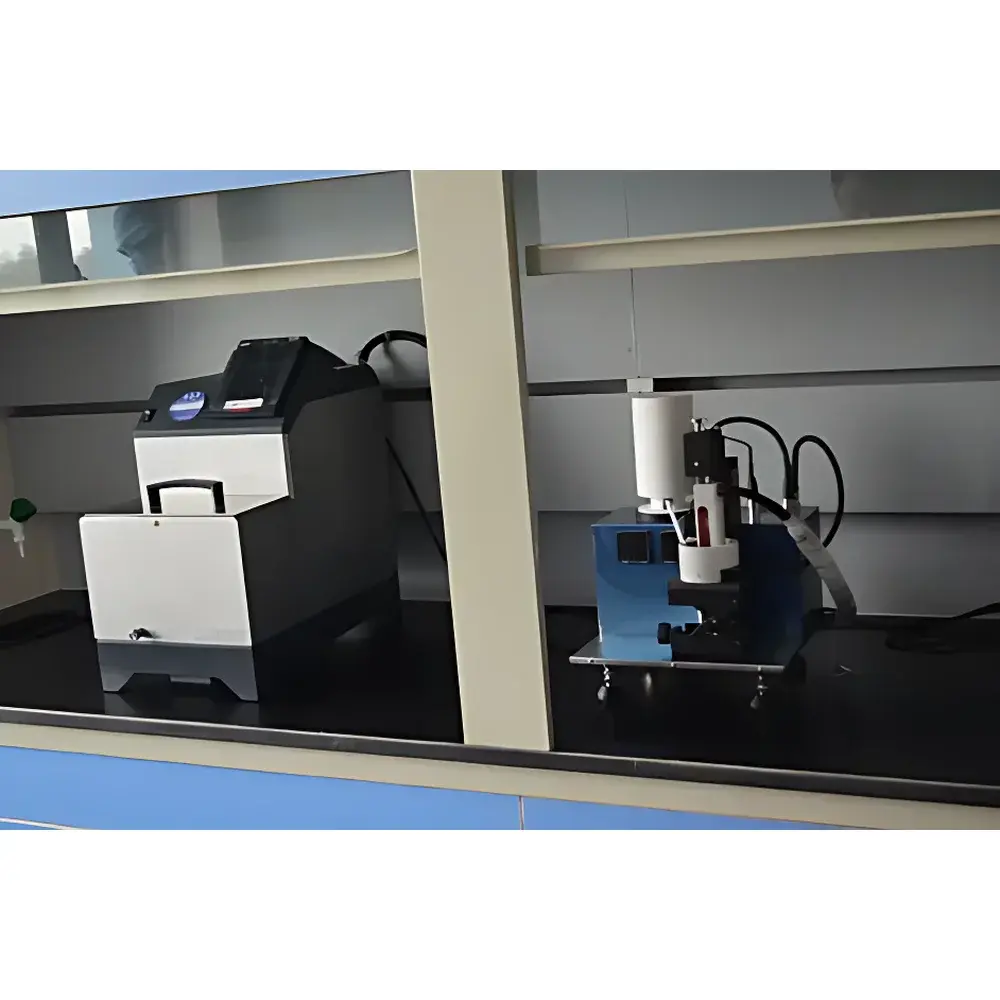
JF99H High-Temperature Powder Contact Angle Analyzer
| Brand | ZYKX |
|---|---|
| Origin | Beijing, China |
| Manufacturer Type | Authorized Distributor |
| Country of Origin | China |
| Model | JF99H |
| Pricing | Available Upon Request |
| Measurement Principle | Washburn Capillary Rise Method |
| Pressure Range | 0–330 mbar |
| Pressure Resolution | 0.16 mbar |
| Temperature Range | Ambient to 200 °C (optional dual-zone electric heating control) |
| Contact Angle Range | 0–180° |
| Quartz Tube Dimensions | OD 10 mm / ID 8 mm or 6 mm |
| Instrument Dimensions | 295 × 240 × 260 mm |
| Power Supply | 220 V AC, 20 W |
Overview
The JF99H High-Temperature Powder Contact Angle Analyzer is a precision instrument engineered for the quantitative determination of contact angles on granular and powdered solid materials under controlled thermal conditions. Unlike conventional sessile-drop methods applicable only to flat, homogeneous solid surfaces, powder systems require indirect measurement due to their inherent micro-roughness, porosity, and lack of macroscopic continuity. The JF99H implements the Washburn capillary rise method—a well-established physicochemical technique grounded in capillary penetration theory—to derive equilibrium contact angles from dynamic liquid ingress kinetics into a consolidated powder bed. This approach relies on the fundamental relationship between capillary pressure, surface tension, pore geometry, and liquid viscosity, as formalized in the Washburn equation: ln h = ln(γ·cosθ·r / 4η) + ln t, where h is penetration depth, t is time, γ is liquid surface tension, θ is the contact angle, r is effective pore radius, and η is dynamic viscosity. By monitoring real-time pressure drop across a vertically oriented quartz column packed with standardized powder, the system calculates cosθ with high reproducibility—enabling comparative wettability assessment across diverse powder formulations, including metal oxides, pharmaceutical excipients, catalyst supports, and battery electrode materials.
Key Features
- Integrated dual-zone temperature control system enabling precise thermal regulation from ambient up to 200 °C—critical for studying temperature-dependent wetting behavior in catalytic, sintering, or thermal processing applications.
- High-resolution digital pressure transducer (0.16 mbar resolution) calibrated over a 0–330 mbar range to capture subtle capillary pressure differentials during early-stage liquid penetration.
- Interchangeable quartz capillary tubes (OD 10 mm; ID options: 6 mm or 8 mm) fabricated from high-purity fused silica to ensure chemical inertness, thermal stability, and optical clarity for optional visual verification.
- Compact benchtop architecture (295 × 240 × 260 mm) with low power consumption (20 W at 220 V AC), designed for integration into QC laboratories, R&D cleanrooms, and university material science facilities.
- Modular sample holder assembly facilitating rapid powder loading, uniform compaction, and repeatable bed density control—essential for minimizing experimental variance linked to packing heterogeneity.
Sample Compatibility & Compliance
The JF99H accommodates a broad spectrum of dry, free-flowing powders—including but not limited to ceramics, polymers, inorganic salts, nanomaterials, and composite blends—with particle size distributions typically ranging from submicron to 500 µm. Sample preparation follows standardized protocols aligned with ASTM D7483 (Standard Test Method for Determination of Wettability of Powders Using the Washburn Method) and ISO 15987 (Determination of Surface Free Energy of Solid Surfaces by Contact Angle Measurements). Critical attention is given to powder bed density calibration: users are advised to employ a calibrated die-set and uniaxial press to achieve consistent bulk densities within ±2% relative standard deviation across replicates. The instrument’s design conforms to general electrical safety requirements per IEC 61010-1 and incorporates thermal shielding compliant with EN 60529 (IP20 enclosure rating).
Software & Data Management
Data acquisition and analysis are performed via dedicated Windows-based software supporting real-time pressure-time curve logging, automatic linear regression of ln(h) vs. ln(t) plots, and direct cosθ derivation. All raw datasets are timestamped and stored in CSV-compatible format for traceability. Audit trails record operator ID, calibration date, temperature setpoint, tube ID, and sample batch number—supporting GLP-compliant documentation workflows. While the system does not implement full 21 CFR Part 11 electronic signature functionality out-of-the-box, its structured metadata architecture enables seamless integration with validated LIMS or ELN platforms used in regulated pharmaceutical and materials development environments.
Applications
- Quantifying hydrophobicity/hydrophilicity of pharmaceutical excipients during formulation development.
- Evaluating surface energy changes in metal powders pre- and post-oxidation or surface modification.
- Assessing binder compatibility and dispersion quality in ceramic green-body processing.
- Characterizing wettability evolution in Li-ion battery cathode/anode powders exposed to electrolyte solvents at elevated temperatures.
- Supporting quality control of catalyst carriers by correlating contact angle shifts with surface functionalization efficiency.
FAQ
Why can’t conventional contact angle goniometers be used for powders?
Because powders lack a continuous, optically definable solid–liquid interface required for tangent-based droplet contour analysis; their heterogeneous morphology necessitates ensemble-averaged, thermodynamically derived approaches such as Washburn analysis.
Is a reference liquid always required?
Yes—Washburn analysis requires at least one reference liquid with known surface tension and zero contact angle (e.g., n-hexadecane on PTFE-coated beds) to calibrate the effective pore radius term in the equation.
How critical is powder bed density control?
Extremely—the Washburn model assumes constant pore geometry; variations in packing density directly alter permeability and introduce systematic error in cosθ calculation. Standardized compaction protocols are mandatory for inter-laboratory comparability.
Can the JF99H operate under inert atmosphere?
Not natively; however, the quartz tube assembly may be sealed and purged externally prior to insertion into the heated chamber, enabling limited inert-condition testing with appropriate engineering controls.
What maintenance is recommended?
Quarterly recalibration of the pressure sensor using NIST-traceable dead-weight standards; annual inspection of quartz tube integrity and heater element resistance; routine cleaning of sample chamber with isopropanol and lint-free wipes.



