
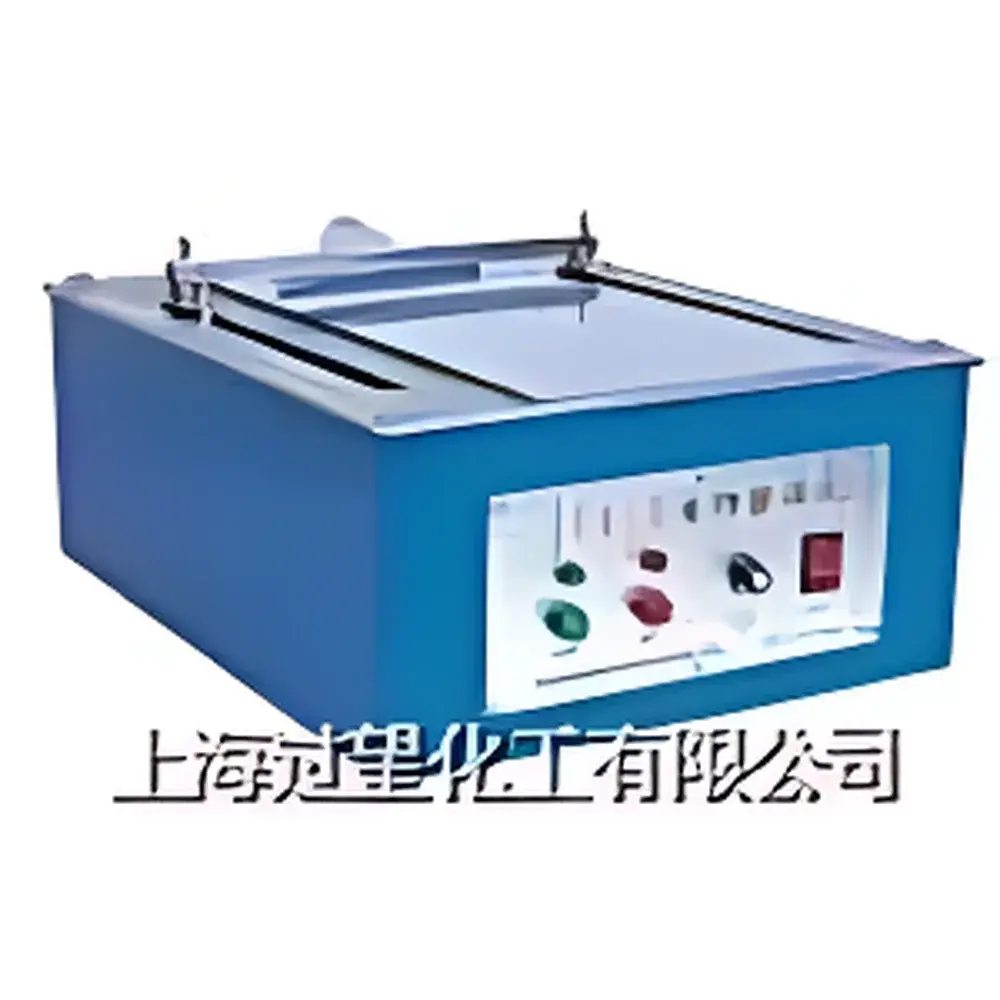
JFA-II Film Applicator with Adjustable Fixture System
| Origin | Shanghai, China |
|---|---|
| Manufacturer Type | Authorized Distributor |
| Origin Category | Domestic (China) |
| Model | JFA-II |
| Pricing | Available Upon Request |
| Coating Base Dimensions | 470 mm × 200 mm |
| Maximum Coating Length | 230 mm |
| Coating Speed Range | 0–8 cm/s (infinitely variable) |
| Total Power Consumption | 100 W |
| Electrical Supply | 220 V AC, 50 Hz |
| Overall Dimensions (L×W×H) | 470 × 370 × 240 mm |
| Net Weight | 34 kg |
Overview
The JFA-II Film Applicator with Adjustable Fixture System is an engineered laboratory instrument designed for controlled, reproducible wet-film deposition on rigid and semi-rigid substrates. It operates on the principle of precision-guided blade or bar coating—where a fixed-gap applicator element moves linearly across a stationary sample mounted on a calibrated base plate—ensuring uniform film thickness within defined process tolerances. Unlike manual drawdown methods, the JFA-II integrates motorized traverse motion, adjustable fixture clamping, and mechanical speed regulation to eliminate operator-induced variability. This architecture supports method standardization in quality control laboratories, R&D departments, and materials testing facilities where compliance with ASTM D823, ISO 2808, and GB/T 9271 is required for coating thickness validation, adhesion pre-testing, or formulation screening.
Key Features
- Adjustable substrate fixture system accommodating flat panels, metal coupons, glass slides, plastic sheets, and composite laminates up to 470 mm × 200 mm in footprint
- Infinitely variable coating speed from 0 to 8 cm/s, regulated via precision DC motor and digital encoder feedback—enabling fine-tuned rheological response evaluation under controlled shear conditions
- Rigid aluminum alloy frame with vibration-damped base construction, minimizing positional drift during traverse and ensuring consistent gap maintenance between applicator bar and substrate surface
- Modular applicator bar interface supporting interchangeable blades (e.g., 25 µm, 50 µm, 100 µm, 200 µm wire-wound rods or precision-ground stainless-steel bars) compatible with ISO 2808 Annex A geometries
- Integrated safety interlock preventing actuation unless fixture is fully engaged and emergency stop compliant with IEC 60204-1
- Low thermal signature design (100 W max power draw) suitable for continuous operation in temperature-controlled cleanrooms or QC labs without auxiliary cooling
Sample Compatibility & Compliance
The JFA-II accommodates substrates ranging from 0.1 mm to 6 mm in thickness—including aluminum panels (ASTM D2197), cold-rolled steel coupons (ISO 1514), float glass (EN 572-2), PET films, and fiber-reinforced composites. Its clamping mechanism applies uniform lateral pressure without edge deformation, preserving substrate integrity during high-viscosity paste application. The system meets mechanical requirements for GLP-compliant coating preparation per ASTM D1849 and supports traceable wet-film thickness documentation when paired with calibrated micrometers or optical profilometers. All structural components are manufactured to RoHS Directive 2011/65/EU specifications, and electrical subsystems conform to CE marking standards under EMC Directive 2014/30/EU and Low Voltage Directive 2014/35/EU.
Software & Data Management
While the JFA-II operates as a stand-alone electromechanical instrument without embedded firmware or touchscreen interface, it is fully compatible with external laboratory data acquisition workflows. Digital speed setpoints can be logged via optional analog voltage output (0–10 V) synchronized with external DAQ systems. Users may integrate the device into LIMS environments through programmable logic controllers (PLCs) or LabVIEW-compatible timing modules for audit-trail generation. For regulatory submissions, coating parameters—including speed, ambient temperature/humidity (via external sensor input), substrate ID, and applicator bar calibration certificate—are manually recorded in paper-based or electronic batch records aligned with FDA 21 CFR Part 11 requirements when used in pharmaceutical packaging or medical device coating development.
Applications
- Preparation of standardized wet films for drying behavior analysis, including solvent evaporation kinetics and skin formation onset
- Baseline thickness profiling prior to cross-hatch adhesion testing (ASTM D3359) or pull-off strength measurement (ISO 4624)
- Formulation optimization of waterborne acrylics, UV-curable oligomers, conductive inks, and battery electrode slurries
- Calibration verification of non-contact thickness gauges (e.g., eddy current, beta backscatter) using reference films of known dry/wet ratio
- Accelerated weathering sample conditioning per ASTM G154 Cycle 1, where uniform initial film mass loading is critical to degradation repeatability
- Academic research in polymer thin-film physics, particularly interfacial dewetting studies requiring sub-millimeter coating uniformity
FAQ
What types of applicator bars or blades are compatible with the JFA-II?
The system accepts standard ISO 2808-compliant wire-wound rods (e.g., Paul N. Gardner Co. or Elcometer models) and custom-ground stainless-steel bars with nominal gaps from 12 µm to 500 µm. Adapter plates are available upon request for non-standard geometries.
Can the JFA-II be used for viscous pastes above 50,000 mPa·s?
Yes—when equipped with a high-torque applicator bar and pre-conditioned substrate heating stage (optional accessory), the JFA-II has demonstrated stable coating performance with ceramic slip formulations and lithium-ion cathode slurries up to 120,000 mPa·s at 25 °C.
Is third-party calibration certification available?
Factory calibration includes speed linearity verification (±0.5% full scale) and mechanical parallelism assessment (≤5 µm deviation over 230 mm travel). UKAS-accredited calibration services are coordinated through authorized regional partners upon order.
Does the JFA-II support automated start/stop triggers?
Yes—via TTL-level input/output ports, enabling synchronization with dispensing nozzles, environmental chambers, or inline vision inspection systems in pilot-line configurations.
What maintenance schedule is recommended for long-term accuracy?
Biannual inspection of rail lubrication, belt tension, and fixture jaw wear is advised. Applicator bars should be cleaned ultrasonically after each use and verified for dimensional stability annually using optical interferometry.



