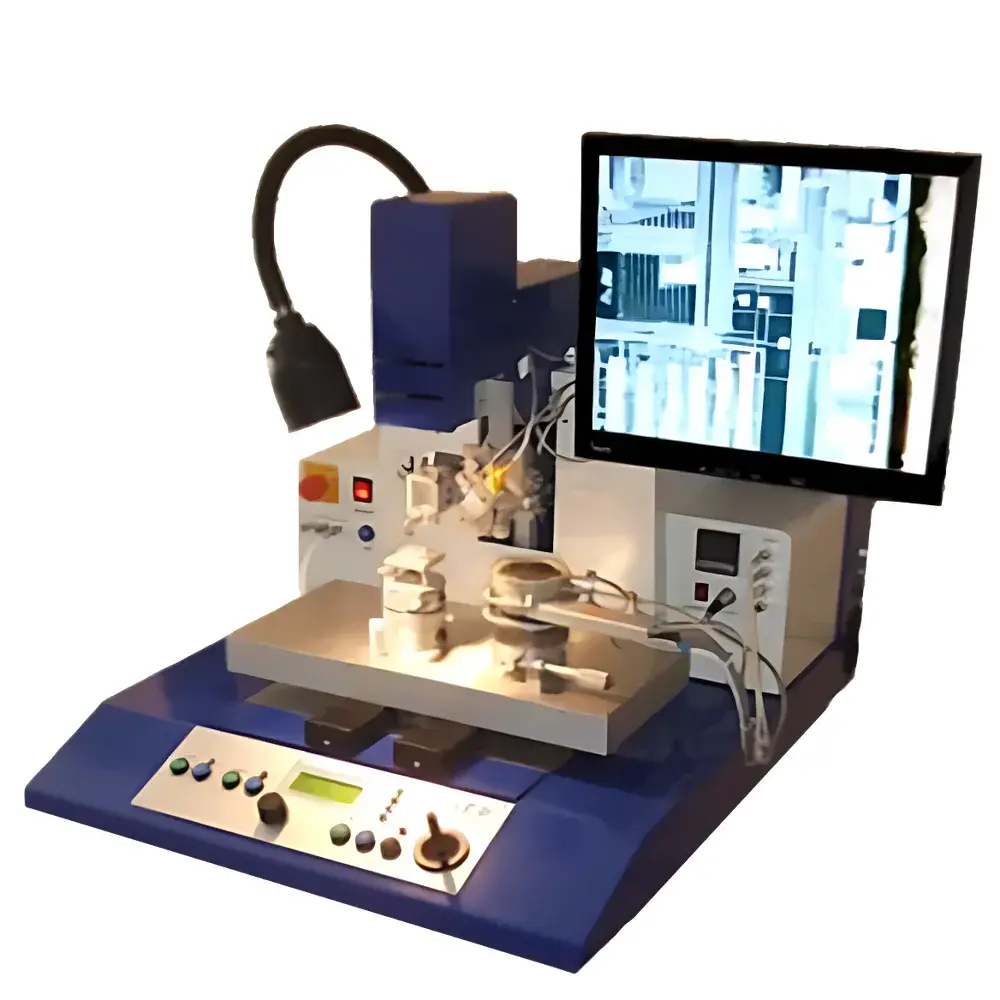
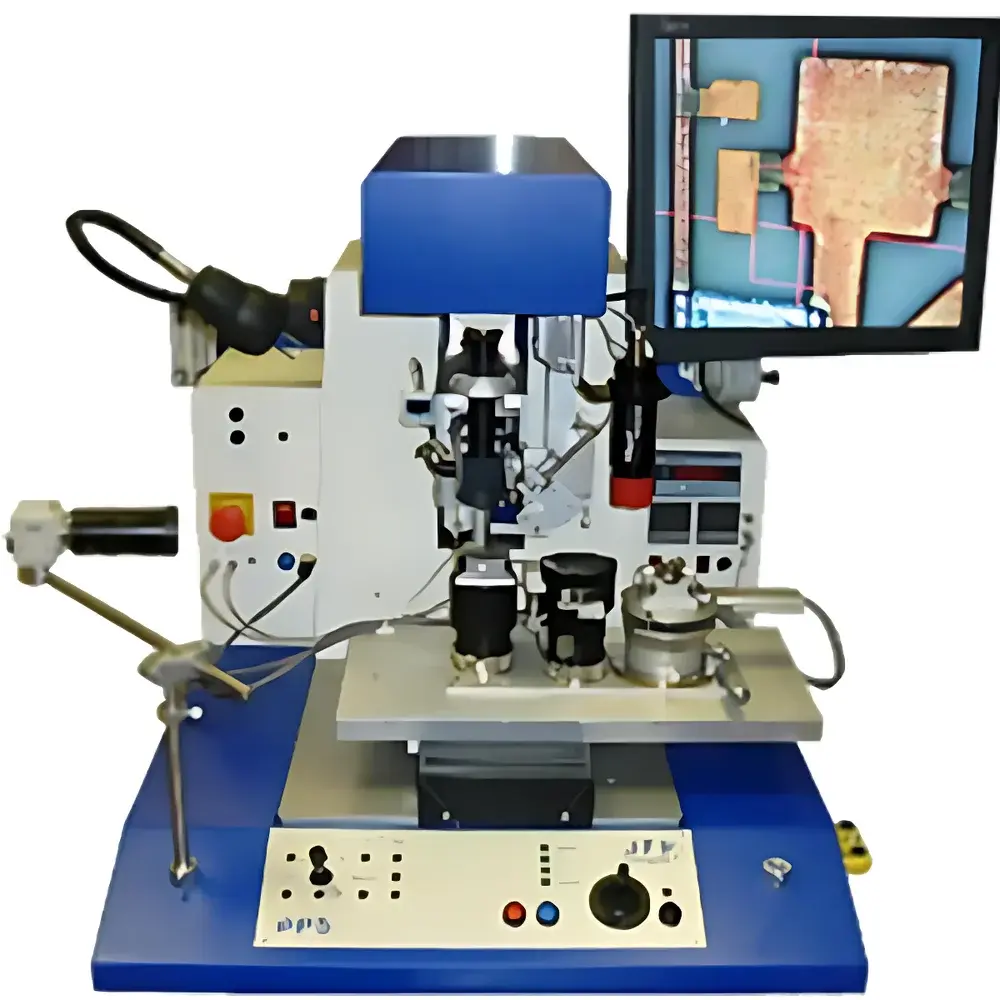
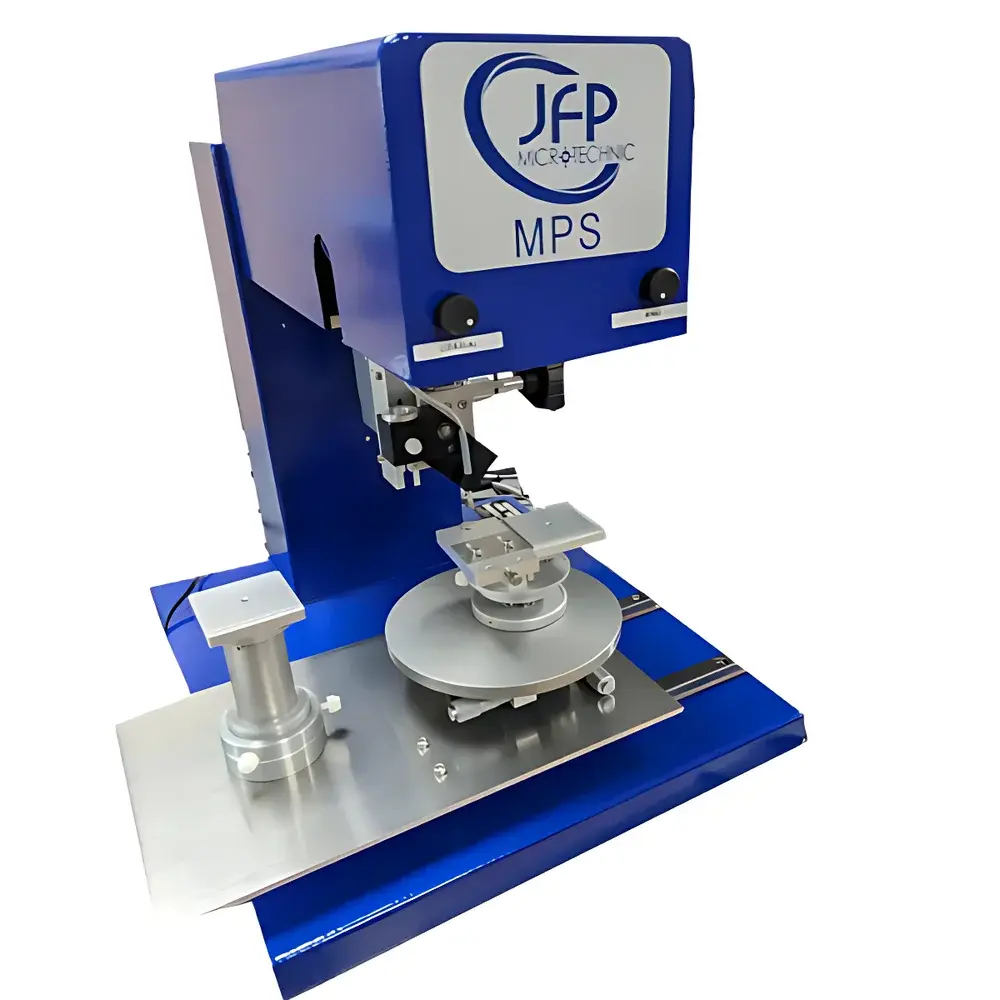
JFP PP6 / PP7 / MPS Manual Pick-and-Place System
| Brand | JFP |
|---|---|
| Country of Origin | France |
| Model | PP6 / PP7 / MPS |
| Type | Manual Semiconductor Die Bonder & Pick-and-Place System |
| Compliance | Designed for ISO Class 5–7 cleanroom environments |
| Control Interface | Ergonomic joystick + 7-inch capacitive touchscreen |
| Optical System | UHD coaxial camera with adjustable magnification (10×–100×) |
| Bonding Capabilities | Epoxy, solder, eutectic, and formic acid-compatible chucks |
| Max Substrate Thickness | 100 mm |
| Min Die Size | 70 µm × 70 µm |
| Placement Accuracy | ±1 µm (repeatability under controlled lab conditions) |
| Optional Modules | Flip-chip alignment stage, dispensing module, ultrasonic bonding head, thermal chuck (60–250 °C) |
Overview
The JFP PP6, PP7, and MPS manual pick-and-place systems are precision-engineered semiconductor die bonders developed by JFP Microtechnic—a French manufacturer headquartered in Marcoussis (south of Paris) since 1992. These instruments implement a manual, operator-guided die placement architecture based on high-resolution visual alignment, calibrated mechanical motion, and modular thermal/mechanical actuation. Unlike fully automated platforms, the PP6/PP7/MPS series prioritizes flexibility, process transparency, and hands-on control—making them ideal for R&D laboratories, pilot-line packaging development, failure analysis labs, and low-volume high-mix production where rapid reconfiguration and real-time process observation are critical. The core principle relies on optical die recognition via coaxial UHD imaging, coupled with sub-micron XYθ positioning using motorized linear stages and a programmable rotary indexer. All models conform to fundamental semiconductor handling standards—including static-dissipative construction, non-outgassing materials, and compatibility with nitrogen-purged or vacuum-assisted bonding chambers.
Key Features
- Sub-micron placement repeatability (±1 µm) achieved through vibration-isolated granite base, direct-drive linear motors, and closed-loop position feedback.
- Modular thermal management: interchangeable chucks support epoxy dispense, solder reflow, eutectic bonding (Au-Sn, Au-Ge), and formic acid-assisted oxide reduction—each with independent temperature zoning and ramp/soak profiling.
- Ergonomic dual-control interface: intuitive 7-inch capacitive touchscreen for parameter entry and recipe management; progressive 3-axis joystick for real-time fine positioning without keyboard dependency.
- Optical subsystem includes telecentric illumination, motorized zoom lens (10×–100×), and dual-camera configuration—one for global field-of-view navigation, one for high-magnification die-edge registration.
- Expandable tooling architecture: supports optional dispensing nozzles (50–500 µm orifice), ultrasonic transducers (62 kHz PLL-controlled), flip-chip alignment stages with sub-0.5 µm overlay capability, and vacuum collet arrays for fragile or ultra-thin dies (≤50 µm).
- No external air or hydraulic supply required—fully self-contained electromechanical operation compliant with ISO 14644-1 Class 5 cleanroom integration protocols.
Sample Compatibility & Compliance
The PP6/PP7/MPS accommodates wafers up to 200 mm (8″), diced dies from 70 µm × 70 µm to 25 mm × 25 mm, and substrates up to 100 mm thickness—including ceramic carriers, silicon interposers, glass lids, sapphire substrates, and LTCC modules. It handles brittle materials (GaAs, SiC, AlN) and thermally sensitive components (MEMS, photonics PICs) without microcrack induction due to its contact-force-limited placement algorithm and programmable touchdown velocity (0.1–5 mm/s). All models meet CE marking requirements and are designed for compliance with ISO 9001 quality system documentation, ISO/IEC 17025 calibration traceability pathways, and GLP audit readiness—particularly relevant for qualification testing per JEDEC J-STD-020, MIL-STD-883, and AEC-Q200 automotive packaging validation workflows.
Software & Data Management
JFP’s proprietary BondSoft™ v4.x firmware provides full local control with optional networked deployment (Ethernet/IP). Each placement event logs timestamp, XYZθ coordinates, applied force profile, thermal cycle data, and optical verification snapshots—exportable in CSV or HDF5 format for traceability. Audit trail functionality complies with FDA 21 CFR Part 11 requirements when configured with user-role authentication, electronic signatures, and immutable log archiving. Recipes are version-controlled and can be shared across PP6/PP7/MPS units without recalibration—enabling consistent process transfer between R&D and pilot manufacturing sites. Integration with third-party MES (e.g., Siemens Opcenter, Camstar) is supported via RESTful API and OPC UA interfaces.
Applications
- Semiconductor packaging development: die attach validation for fan-out wafer-level packaging (FOWLP), 2.5D/3D IC stacking, and heterogeneous integration test vehicles.
- Photonics assembly: precise alignment of laser diodes, VCSELs, and InP-based modulators onto silicon photonics interposers with sub-micron pitch tolerance.
- MEMS and sensor packaging: low-stress die placement onto flexible polyimide substrates or ceramic cavities requiring minimal shear force and controlled thermal soak.
- Failure analysis and rework: localized die replacement on known-good-die (KGD) test boards, probe card repair, and package-level root-cause investigation.
- Academic and government research: teaching platforms for microassembly principles, process window characterization, and novel adhesive formulation evaluation under controlled environmental conditions.
FAQ
What distinguishes the PP6 from the PP7 and MPS models?
The PP6 is optimized for high-precision single-die placement with integrated epoxy dispensing and thermal chucking; the PP7 adds dual-chuck capability for sequential pickup-and-place operations; the MPS is a compact variant tailored for SMD and hybrid microassembly—featuring enhanced Z-axis resolution and simplified tool-change mechanics.
Is vacuum or compressed air required for operation?
No—these systems operate entirely on electrical power. Vacuum for die pickup is generated via integrated brushless diaphragm pumps; no external utility connections are needed.
Can the system be validated for GMP-compliant production environments?
Yes—when deployed with BondSoft™ audit mode enabled, full electronic records, user access controls, and calibration certificates (NIST-traceable), the platform meets baseline requirements for GMP Annex 11 and ISO 13485 medical device packaging workflows.
What level of training is required for first-time operators?
A two-day on-site training session covers mechanical safety, optical calibration, recipe creation, force/temperature parameter mapping, and basic troubleshooting—enabling proficient operation within one week.
Are spare parts and service support available outside Europe?
JFP maintains authorized service partners in North America (USA), Asia-Pacific (Japan, Singapore, Taiwan), and Israel—with 72-hour response SLA for critical spares and remote diagnostics via secure VNC-enabled firmware.
Related Products